







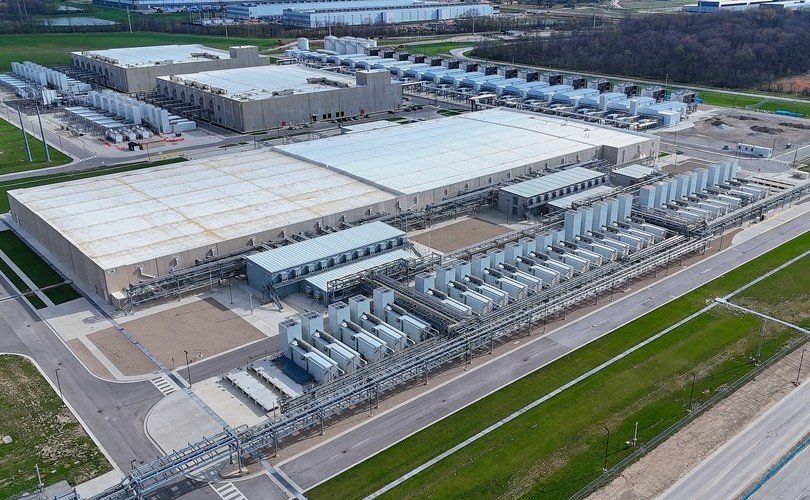
Recent studies highlight an alarming fact about the artificial intelligence (AI) data centers that are being constructed in communities across the country: Temperatures in the area immediately surrounding the massive complexes can soar by as much as 16 degrees Fahrenheit, creating what researchers call “heat islands” or “heat domes.”
One study that focused on more than 6,000 data centers found that the air temperature at ground level increased by an average of 3.6 degrees Fahrenheit and by 16.4 degrees Fahrenheit in extreme cases.
Looking at data centers in North America and Europe, the researchers determined that the impact on air temps could extend downwind as far as six miles away, affecting more than 340 million people. That number will increase as the AI hubs continue to proliferate at a rapid pace.
Another study that looked at data centers in Arizona came up with similar findings, with the average air temperatures around the centers found to hover at about four degrees Fahrenheit above the surrounding area.
Ancient Colombians Built a Landscape Bigger Than London Without Needing a Ruler
Satellite imagery of northern Colombia’s wetlands revealed an extraordinary human experiment: thousands…
![Wanted: Suspect for Theft of Packages in the 3rd District [VIDEO]](https://thephillypi.com/wp-content/uploads/2026/09/Wanted-Suspect-for-Theft-of-Packages-in-the-3rd-District-768x512.jpg)
Wanted: Suspect for Theft of Packages in the 3rd District [VIDEO]
On April 13,2026 at approximately 2:00 PM, an unknown person was captured…

Canadian journalists warned not to call 9/11 a ‘terrorist attack’
(Journalists and editors employed by the Canadian Broadcasting Corporation (CBC) were warned…

FBI warns of surge in ATM Jackpotting, $20 Million lost in 2025
The FBI warns ATM jackpotting is rising nationwide, with over $20 million…

Travel Creators Matt and Julia Journey to Iran in 2026: Exploring Daily Life Beyond Headlines
TABRIZ, Iran — Popular travel vloggers Matt and Julia have released a…

A security flaw at DavaIndia Pharmacy allowed attackers to access customers’ data and more
A security flaw at DavaIndia Pharmacy exposed customer data and gave outsiders…
“As we do more measurements under different kinds of atmospheric conditions, I think we’re going to see more significant impacts around data centers,” lead author David Sailor said.
An Arizona State University (ASU) report on the study explains:
With hundreds of megawatts of data center capacity operating in many cities, and thousands more proposed, the combined impact on urban temperature could be substantial. U.S. data center capacity is projected to more than double by 2030. Sailor and co-authors said the overlooked heat hazard demands attention from city planners and industry developers.
The waste heat produced by a single data center can surpass the amount emitted by 40,000 households, according to Sailor. Air-cooled condenser arrays discharge air heated to 14 to 25 degrees F above the surrounding air temperature, creating thermal plumes that move downwind over neighboring areas.
“They’re such a concentrated load of electricity consumption and hence heat emissions that we became concerned about the impact that they could have locally, and also in the downwind neighborhoods,” said Sailor, a professor at ASU and director of its School of Geographical Sciences and Urban Planning.
One proposed way for the AI industry to avoid raising air temperature is to instead release heat into local bodies of water, but critics caution that that might have a detrimental impact on aquatic life.
The AI industry has exploded in recent years with countless applications in business, media, the internet, medicine, entertainment, and more. Advocates tout promised benefits in areas such as improving productivity, simplifying complex tasks, and more rapidly and effectively diagnosing diseases, while others caution that the technology can be exploited for nefarious purposes such as supplanting individual choice, replacing human workers, effectively erasing personal privacy, and outsourcing discernment of true or false information.