




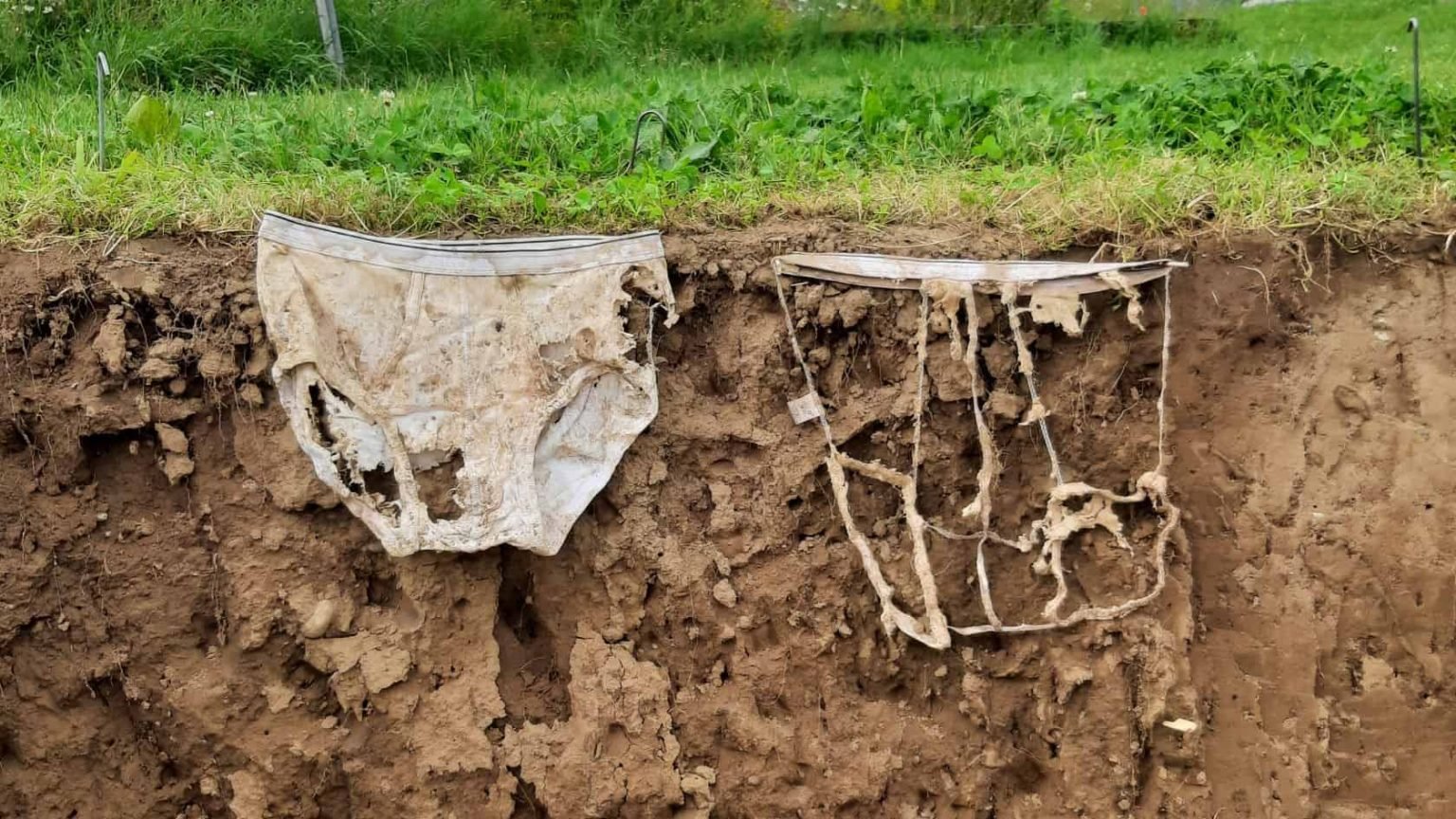
Slightly or heavily decomposed? The more active the soil organisms, the faster the cotton material decomposes. Credit: Priska Koller, Agroscope.
In the spring of 2021, thousands of pristine white briefs disappeared beneath the Swiss countryside, buried just a few inches in the soil. Thirty days later, volunteers dug up the first batch. After 60 days, they unearthed the rest. Some pairs were still recognizably underwear. Others had been reduced to ragged webs of fabric, with the synthetic seams and waistbands outlasting much of the cotton.
The culprit was the soil itself.
In a nationwide citizen-science experiment, researchers asked 1,000 people to bury standardized cotton underwear alongside tea bags and then send the remains, plus soil samples, to a laboratory. The new and inventive study in the journal Plants, People, Planet found that how the land was used was the strongest predictor of how rapidly the cotton vanished. Private gardens chewed through the most fabric. Lawns did the least.

The ‘Russian Bounties’ Hoax: The Fake News Story That Promoted Michael Schwirtz to the Top
In June 2020, The New York Times delivered what appeared to be…

North Korea tests new weapon system (PHOTOS)
DPRK media released photos showing the launch of a road-mobile missile tipped…

The Iran War Has Turned VLCCs Into $650,000-A-Day Assets
Authored by Julianne Geiger via OilPrice.com, More Gulf oil is moving again.…

Italian university La Sapienza still offline to mitigate recent cyber attack
Rome’s La Sapienza University was hit by a cyberattack that disrupted IT…

This monster RTX 5090 Alienware gaming PC costs less than buying the GPU and CPU alone — take $500 off a powerful 9950X3D rig
Nvidia's RTX 5090 now costs $7,000. Or so near to it that…

Woman suffers in jail for 2 weeks after Flock camera falsely identified her car
A Florida woman recounted her horrific experience being arrested and jailed for…
That’s a problem because the holes in the underwear act as a proxy for soil health. The more holes in the underwear, the better. It means the soil is packed with nutrients and is rich in carbon, which plants love. If the cotton in the underwear is eaten just a tiny bit, it means the soil in which it was buried is awful for plant growth.
The premise of the experiment might sound funny and eyebrow-raising, but the question behind it is as serious as it gets. Soil supports most food production, stores enormous amounts of carbon and water, and may harbor about 59 percent of the planet’s species, according to a 2023 global estimate in PNAS.
Yet the biological life of soil is difficult to see, and difficult to explain to people who encounter it mostly as dirt. Perhaps destroyed underwear gets the points across instead?
Why Cotton Briefs Can Measure Life Underground

Cotton is mostly cellulose, a carbon-rich material that bacteria, fungi and other decomposers can break apart. In active soil, that process should happen faster.
Scientists have used similar tests for many years. Cotton strips have long served as a simple measure of decomposition in soil, and the more recent Tea Bag Index uses standardized green and rooibos tea to compare how quickly organic material breaks down in different environments. Burying cotton underwear has also become a popular outreach exercise to get the public involved with science and environmental sustainability. However, researchers had rarely treated it as a standardized scientific measurement.
The Swiss switched up a bit. Every participant received the same small white men’s briefs made almost entirely from organic cotton, along with standardized green and rooibos tea bags. Two pairs went into each site, with instructions to be buried about eight centimeters. One pair came out after roughly a month; the other after two.
Assessing Decomposing Cotton
Back at Agroscope, Switzerland’s federal agricultural research center, scientists did not simply eyeball the damage. They spread the underwear over a blue background, photographed it from a fixed height and used image-analysis software to calculate how much area had disappeared. After quality filtering, 780 sites remained for statistical analysis.
Across all sites, average decomposition climbed from about 10 percent after one month to just over 50 percent after two. Gardens led the pack: roughly 58 percent of the cotton disappeared in two months. Arable fields averaged about 51 percent, permanent grasslands 47 percent and lawns only about 40 percent. The authors suggest frequent mowing, low plant diversity and herbicide use may help explain lawns’ poor showing, although they did not isolate those effects.

“Our results show that how soil is managed can significantly affect both soil life and soil quality,” Marcel van der Heijden, a University of Zurich agroecologist and co-leader of the study, said in a University of Zurich release.
“Healthy, biologically active soil is crucial for fertility, nutrient cycling and many other ecosystem services.”
Gardens Won and Lawns Lost, but There Was a Catch

The obvious conclusion would be that gardens had the healthiest soils. But the underwear did not measure soil health directly. It was measuring decomposition — how quickly microbes and other soil organisms could break down the cotton. And decomposition depends partly on how much food those organisms have available.
That distinction is clearer in the gardens. They contained more organic carbon than most other sites, but they were especially rich in nutrients. Available phosphorus averaged about 13.7 milligrams per kilogram in garden soils, roughly four times the level in arable fields. Swiss guidelines cited in the study put the optimal range at about 1.6 to 4.3 milligrams per kilogram, depending on soil type. Yet, some gardens exceeded 60.
Cotton is mostly cellulose, which is rich in carbon but poor in nutrients. Microbes trying to digest it can work faster when the surrounding soil supplies plenty of nitrogen, phosphorus and other nutrients. In fact, the researchers found that nutrient availability tracked underwear decomposition more closely than soil organic carbon did. That led them to an important qualification: the Underpants Index appears to be a better indicator of soil fertility and decomposition activity than of soil health in the broadest sense, although the two often align.
And more fertility is not always better. In a vegetable garden, nutrient-rich soil can support vigorous plant growth. But excessive phosphorus can wash into waterways and disrupt ecosystems, while very nutrient-rich conditions can also reduce biodiversity in more natural habitats. So, a nearly vanished pair of briefs may indicate a lively, fertile soil — or, in some cases, one that has simply been overfertilized.
“However, maximum decomposition is not desirable in every ecosystem,” said Franz Bender, an agroecologist at Agroscope and co-leader of the project.
“In near-natural habitats such as forests, very high nutrient levels can indicate disruptions to the natural balance of nutrients. In gardens, too, rapid decomposition of the underwear may point to an oversupply of nutrients,” he said.
All that’s to say that a pair of underwear that nearly disappears is not automatically a gold medal for the soil beneath it.