




![Wanted: Suspect for Theft of a Dog in the 35th District [UPDATE]](https://thephillypi.com/wp-content/uploads/2026/09/Wanted-Suspect-for-Theft-of-a-Dog-in-the-35th-330x220.jpg)

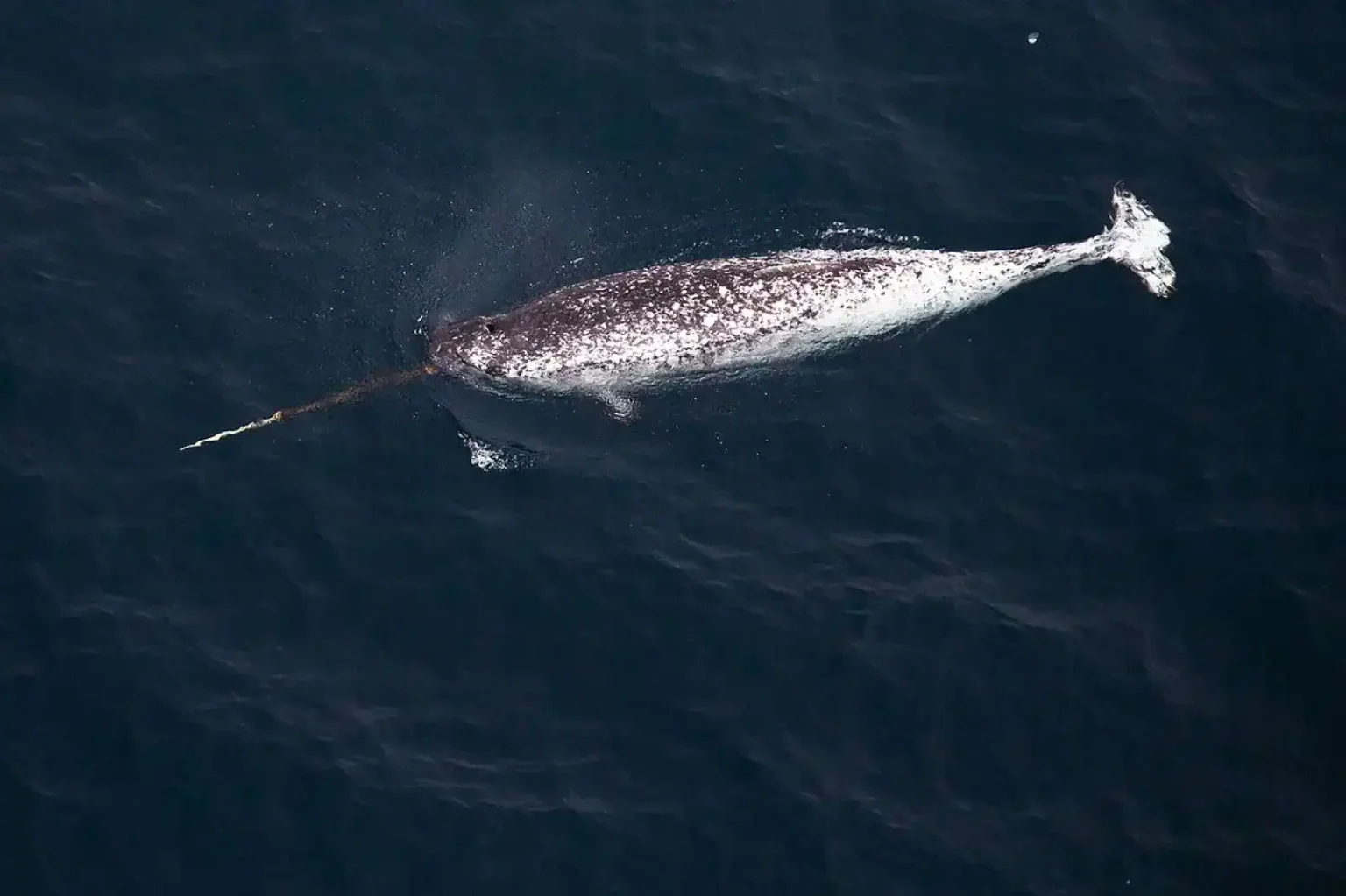
Narwhals are among the strangest animals in the oceans. They’re like unicorns of the sea, with the males growing a single spiraling tusk that can stretch several meters, but they spend much of their lives beneath sea ice, diving into dark fjords and deep offshore waters that are difficult for humans to reach.
It also makes them unusually good oceanic explorers. In East Greenland, six narwhals fitted with sensors have now revealed warm, salty Atlantic water hiding deep inside the fjords — including in waters that reach toward glacier fronts hundreds of kilometers inland.
Sensors attached to the whales collected more than 2,000 profiles of temperature, salinity and depth. The measurements expose a hidden pathway by which ocean heat can reach glacier fronts and melt them underwater, a process that scientists struggle to observe because ships rarely penetrate these remote, ice-covered waters.
A warm ocean hidden beneath a cold one
The work centered on Scoresby Sound, a sprawling fjord complex on Greenland’s east coast covering roughly 10,000 square kilometers and extending about 350 kilometers inland. Some of its inner fjords plunge more than a kilometer deep. For much of the year, sea ice makes them difficult or impossible to survey by research vessel.

New threat actor UAT-9921 deploys VoidLink against enterprise sectors
A new threat actor, UAT-9921, uses the modular VoidLink framework to target…

BeyondTrust fixes critical pre-auth bug allowing remote code execution
BeyondTrust patched a critical pre-auth flaw in Remote Support and PRA that…

ApolloMD data breach impacts 626,540 people
A May 2025 cyberattack on ApolloMD exposed the personal data of over…

Dutch agencies hit by Ivanti EPMM exploit exposing employee contact data
Dutch agencies confirmed attacks exploiting Ivanti EPMM flaws that exposed employee contact…

Scientists Made Tobacco and Lettuce Produce a Meat Protein That Could Make Fake Meat Taste More Real
Scientists have engineered tobacco and lettuce plants that carry the gene for…

U.S. CISA adds SolarWinds Web Help Desk, Notepad++, Microsoft Configuration Manager, and Apple devices flaws to its Known Exploited Vulnerabilities catalog
U.S. Cybersecurity and Infrastructure Security Agency (CISA) adds SolarWinds Web Help Desk,…
But narwhals already know these waters intimately.
“The narwhals have been in parts of the fjords where very few measurements have been taken before. And there, 300 kilometres from the coast, we find traces of Atlantic water. It is completely new that we can show this,” says Mads Peter Heide-Jørgensen, Professor at the Greenland Institute of Natural Resources.
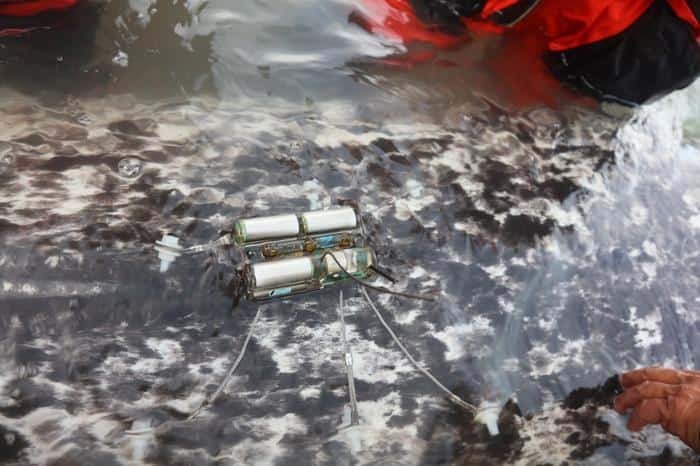
Between August 2017 and July 2020, researchers equipped six narwhals with sensors that measure conductivity. This conductivity, in turn, reveals information about water salinity, along with temperature and depth. The animals produced 2,060 ocean profiles as they swam and dived, sometimes descending more than 1,500 meters. Individual tags remained on the whales for between 85 and 332 days, without significantly affecting the narwhals.
Basically, they turned the whales into oceanographic study platforms as they were going about their business.
In hot water
The narwhal explorers found a lot of warm water. This wasn’t necessarily surprising given the state of the planet’s warming, but it was surprising to see just how far this warm water penetrated.
“This is the water that helps melt the glaciers. We show how the warm water can contribute to accelerating the rate at which glaciers lose ice,” says Mads Peter Heide-Jørgensen.
East Greenland’s coastal ocean contains several distinct water masses. Near the surface sits relatively cold, fresh Polar Water flowing south from the Arctic. Beneath it lies Atlantic Intermediate Water, which is warmer and saltier.
Scientists call this growing Atlantic influence Atlantification. It’s not clear whether the Atlantic water is invading an area where it wasn’t showing up before, or, rather, this warmer and saltier Atlantic-origin always extended farther than we thought. In this case, the Atlantic is exerting a stronger influence on an Arctic system traditionally insulated by colder water and sea ice.
Humans did the desk work
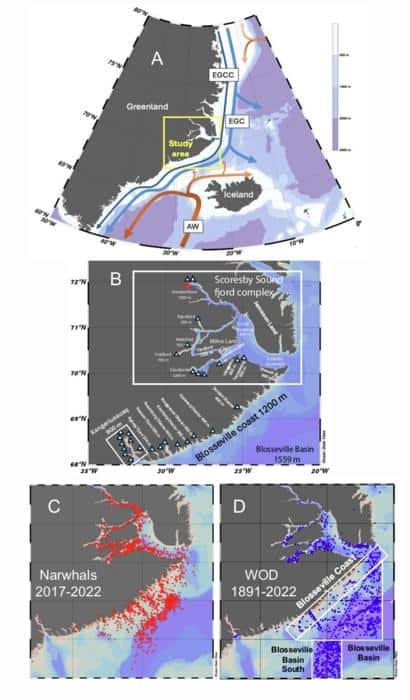
The narwhals went and did the field work gathering data, but then the humans did the processing work. Specifically, they combined their measurements with more than 2,200 historical profiles from the World Ocean Database, creating a record stretching back to 1891. The combined data indicate long-term warming and a growing influence of Atlantic water in the region.
“We used the two large datasets to build a robust model showing how temperature, salinity and depth are related. The models show that the layer consisting of Atlantic water has become thicker, while the upper layer of Polar Water has become thinner,” says Susanne Ditlevsen.
RelatedPosts
Reducing air pollution levels won’t cause a spike in climate heating
Ivory trade made Greenland great, then barren again
Greenland is getting darker, increasing fears about global warming and sea level rise
The Greenland ice sheet is losing some 270 billion tons of ice each year, a new study finds
The published study reports an average warming trend of about 0.047 degrees Celsius per year for waters above 500 meters between 1960 and 2021.
Six whales obviously can’t map all of Greenland. Besides, narwhals swim where they choose, not along the tidy survey lines an oceanographer might design. But historical measurements are sparse as well, particularly during winter. This is why this study is so intriguing, because it shows a new way of gathering elusive data, using nature itself.
Some of the most consequential changes around Greenland may be unfolding hundreds of meters underwater, beneath sea ice and far beyond the routine reach of research ships. To see them, scientists needed observers already adapted to that world.
So, thanks narwhals!