















Executive Summary
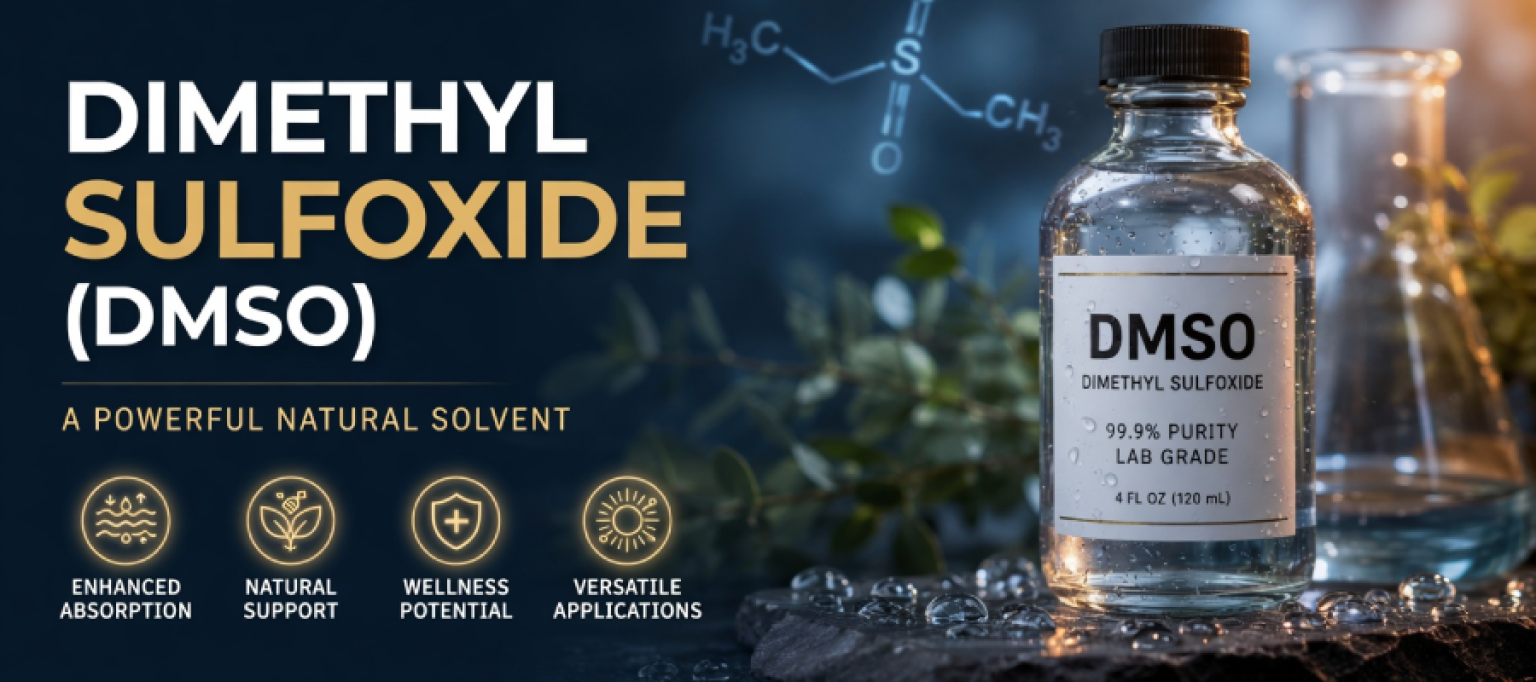
Dimethyl sulfoxide (DMSO), an organosulfur compound with the chemical formula $\text{(CH}_3\text{)}_2\text{SO}$, continues to be a subject of interest across pharmacology, sports medicine, and biochemistry. Known primarily as a versatile industrial solvent and laboratory reagent, DMSO possesses unique chemical properties—most notably its ability to rapidly cross biological membranes and enhance the transdermal delivery of other substances.
While research has explored its potential anti-inflammatory, analgesic, and antioxidant effects in conditions such as arthritis, neuropathy, and acute muscle injuries, the clinical evidence for most unapproved indications remains limited or inconclusive. Currently, the U.S. Food and Drug Administration (FDA) has approved prescription DMSO primarily for the treatment of interstitial cystitis (painful bladder syndrome) and as a cryoprotectant for stem cells and organ preservation.
Understanding the technical mechanisms, safety considerations, and regulatory distinctions surrounding DMSO is essential for evaluating its role in modern medicine.
Technical & Pharmacological Mechanisms
1. Molecular Structure & Dipolar Character
DMSO is an organosulfur molecule with a highly polar $\text{S}=\text{O}$ bond and two hydrophobic methyl groups ($\text{–CH}_3$). This amphiphilic nature allows it to solubilize both hydrophobic and hydrophilic compounds.
$$\text{Chemical Formula: } (\text{CH}_3)_2\text{SO}$$
    O
    ║
  S / \
   /   \
CH₃     CH₃
2. Transdermal Penetration Enhancement
The primary reason DMSO is investigated as a topical vehicle is its capacity to alter the stratum corneum—the outermost layer of human skin.

Raindrops Can Build an Electrical Charge Strong Enough to Corrode Metal in a Surprising Way
A water droplet sliding down a leaf can acquire enough electrical charge…

Massive Free Laptop Upgrade Reveals Genius Ways To Save Serious Tech Cash
Welcome back to the tech desk here at The Philly PI. In…

How to Unlock Peak Performance and Overclock Your Samsung Galaxy S22 Today
In the fast-paced ecosystem of mobile computing, squeezing every ounce of performance…

Large-scale data breaches hit more Japanese firms
More Japanese companies have revealed that they have experienced major customer data…

DIPLOMATIC DERAILMENT: Former Japanese Minister Slams India Over Bullet Train Delays, Broken Promises, and Signaling Clashes
TOKYO / NEW DELHI — The high-stakes $15 billion flagship mega-project designed…

Zionism and the Ottoman Empire: The Final Step to Conquering Palestine
The final step, which lasted until the fall of the Ottoman Empire,…
- Lipid Bilayer Reorganization: DMSO interacts directly with the intercellular lipid matrix of the skin, increasing lipid fluidity and expanding lipid spacing.
- Keratin Interaction: At high concentrations, DMSO interacts with intracellular proteins (keratin), reversibly altering their structure to allow rapid movement of water- and oil-soluble molecules across the epidermal barrier.
- Carrier Effect: Because of this barrier modification, active pharmaceutical ingredients (APIs)—such as nonsteroidal anti-inflammatory drugs (NSAIDs) or corticosteroids—can be delivered more effectively through skin layers into localized tissues.
3. Free Radical Scavenging & Anti-Inflammatory Activity
In experimental models, DMSO functions as a scavenger of hydroxyl radicals ($\cdot\text{OH}$), one of the most reactive and damaging species of reactive oxygen (ROS). By quenching free radicals and inhibiting leukocyte migration, DMSO demonstrates localized anti-inflammatory and mild analgesic properties in preclinical research.
Current Evidence vs. Regulatory Status
| Indication / Area | Evidence Level | FDA Status | Notes / Key Findings |
| Interstitial Cystitis | High (Clinical Trials) | Approved | Administered via intravesical instillation (bladder wash) to reduce inflammation and bladder pain. |
| Cryopreservation | High | Approved | Standard additive used to prevent ice crystal formation during cell/tissue freezing. |
| Topical Drug Vehicle | Moderate to High | Approved in specific formulations | Approved as an inactive carrier in topical prescription drugs (e.g., specific topical NSAID solutions). |
| Osteoarthritis & Joint Pain | Low to Moderate | Not Approved | Clinical studies show inconsistent results; high risk of skin irritation at effective concentrations. |
| Neuropathy & Muscle Pain | Low / Inconclusive | Not Approved | Systematic reviews indicate a lack of robust, large-scale randomized controlled trials (RCTs). |
Key Safety Concerns & Risks

- Absorption of Impurities: Because DMSO is a potent solvent and penetration enhancer, it carries whatever substances are present on the skin surface—including toxins, pesticides, or industrial contaminants—directly into the bloodstream.
- Industrial vs. Pharmaceutical Grade: Over-the-counter or industrial-grade DMSO products may contain chemical impurities, heavy metals, or residual solvents that pose serious health risks when absorbed through the skin.
- Common Side Effects: Topical application frequently causes local burning, redness, itching, and a characteristic garlic-like breath and body odor (caused by the metabolite dimethyl sulfide, $\text{DMS}$).
- Drug Interactions: When combined with active prescription medications, DMSO can unpredictably alter systemic absorption rates and toxicity profiles.
Expert Guidelines for Consumers & Patients
- Consult a Healthcare Provider: Do not apply industrial or non-regulated DMSO products to skin or open wounds.
- Use Only FDA-Approved Formulations: Ensure any medical use is prescribed and monitored by a licensed clinical specialist.
- Avoid Unverified Oral Supplements: The safety and toxicity profile of ingested DMSO are not established for routine health maintenance.
This article is intended for informational and educational purposes only and does not constitute medical advice. For specific medical questions or guidance regarding pain management, consult a qualified healthcare professional.