









A water droplet sliding down a leaf can acquire enough electrical charge to punch a microscopic hole even through a protective paint coating on metal.

In laboratory experiments, researchers watched the effect emerge repeatedly. Electrically neutral droplets left Teflon-coated copper smooth after 3,000 impacts. But droplets first allowed to slide across a houseplant leaf, PVC wallboard, plastic window material or a water-repellent surface scarred the coating and damaged the copper beneath.
The surprising results, described in a new Nature paper, point to a third way water may punch through coatings and cause rust in your home or on your car. Droplets can wear down protective coatings through repeated impacts, while salts, acids and pollutants can attack them chemically. But water can also become electrically charged as it moves.
The study does not yet establish how much ordinary rain contributes to corrosion this way in the real world. But this is a new mechanism that coating designers have largely ignored.
When a Drop Becomes a Tiny Electrical Discharge
Water and a solid surface can exchange charge as they touch and separate, a liquid version of static electricity. In the experiments, 35-microliter saltwater drops slid four centimeters before falling onto coated copper. Depending on the surface, each acquired about 0.2 to 2 nanocoulombs of charge.
High-speed video revealed a clue to what happened next. As a charged drop approached the metal, its underside stretched into a sharp cone. The researchers argue that the drop and the metal beneath the insulating coating effectively become two electrodes with opposite charges. As the gap narrows, the electric field intensifies until the coating suffers dielectric breakdown — the same basic failure that allows current suddenly to cross an electrical insulator.

U.S. CISA adds SolarWinds Web Help Desk, Sangoma FreePBX, and GitLab flaws to its Known Exploited Vulnerabilities catalog
U.S. Cybersecurity and Infrastructure Security Agency (CISA) adds SolarWinds Web Help Desk,…

Germany's Former Spy Chief Arrested In Biggest Espionage Scandal Of The Century
August Hanning, former head of the German BND foreign intelligence agency, which…

Dr. Joyce Demands Major Crackdown on Foreign Robocalls Targeting Americans
WASHINGTON — In an era defined by constant connectivity, millions of Americans…

French Rafale Fighters in Poland Test NATO Airpower Survival Against Missile and Drone Attacks
French Rafale fighters have dispersed across Poland in a drill designed to…

THE GENIUS ACT: How Stablecoin Legislation Redefines the U.S. Dollar and the Political Footprint of Howard Lutnick
The New Architecture of Digital Finance With the enactment of the Guiding…

“When such charged droplets strike a coating, they discharge locally and can puncture the layer in specific spots like a small flash of lightning,” Rüdiger Berger of the Max Planck Institute for Polymer Research said in the institute’s press release.

The researchers confirmed that the charged droplets were actually discharging into the metal. Most of the electrical charge a droplet picked up while sliding disappeared when it hit the coated copper, showing that the charge had passed through the protective layer.
The charge in each droplet is extremely small. The problem is what happens at very close range: as a charged drop approaches the metal beneath a very thin coating, it creates an intense electric field across that tiny gap. That can locally overwhelm the coating and open a microscopic path to the metal underneath.
In other words, the droplet does not corrode the metal with a powerful shock. It creates a tiny electrical failure in the coating, and repeated failures give water and salts a way in.
From Microscopic Pits to Corrosion
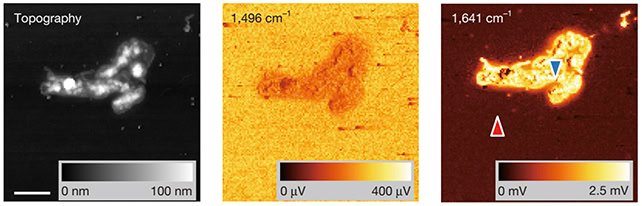
The effect was not limited to one coating. The researchers saw similar damage in polystyrene films of several thicknesses, in gold covered with polystyrene and in gold protected by an insulating silica layer. Their model suggested that a roughly 2-nanocoulomb drop could trigger breakdown across about 10 micrometers of Teflon or 50 micrometers of polystyrene, although the actual breakdown strength changes with coating thickness.
Repeated hits made the problem worse. On commercial copper foil, 10,000 charged-drop impacts measurably weakened the coating’s barrier properties. After roughly 50,000 impacts, corroded regions more than a millimeter across appeared. Under the same salt concentration, charged impacts damaged the coating substantially more than simply keeping it immersed in the salt solution.
Nor did a drop have to crash into metal. In another experiment, charged drops slid across a smooth coating covering a hidden boundary between quartz and copper. After 3,000 passes, a trench-like defect appeared precisely along that buried boundary. Neutral sliding drops produced no such damage.

Previously, a 2022 Nature Physics study from some of the same researchers showed that electrostatic forces can alter how droplets slide. A 2023 study in The Journal of Physical Chemistry Letters found that water drops sliding only a few centimeters can reach kilovolt electrical potentials. Elsewhere, scientists have tried to turn that electricity into something useful, including a 2020 Nature study of a droplet generator and a 2023 Science Advances experiment that produced sparks above 1,200 volts. The new research flips that story: electricity generated by moving water may also damage materials.
Now, we’ve learned that electricity from water droplets can significantly corrode metals — and that can get enormously expensive. The Association for Materials Protection and Performance places the global cost of corrosion at about $2.5 trillion, or roughly 3.4 percent of global GDP in the estimate it cites.
But there are still open questions about the scale of the effect. These were controlled laboratory experiments, not years-long exposures on bridges, ships or cars. Researchers still need to determine how often natural rain, ocean spray or other droplets acquire damaging charges and how much real-world coating failure this mechanism explains. Charged droplets also occur in fountains and waterfalls and in industrial processes including electrostatic spraying and inkjet printing, broadening the places where scientists may now want to look.
For now, the finding adds another property to the anticorrosion checklist. Future coatings may need not only chemical toughness and resistance to wear, but enough electrical strength to survive the tiny discharges hiding in moving water.