















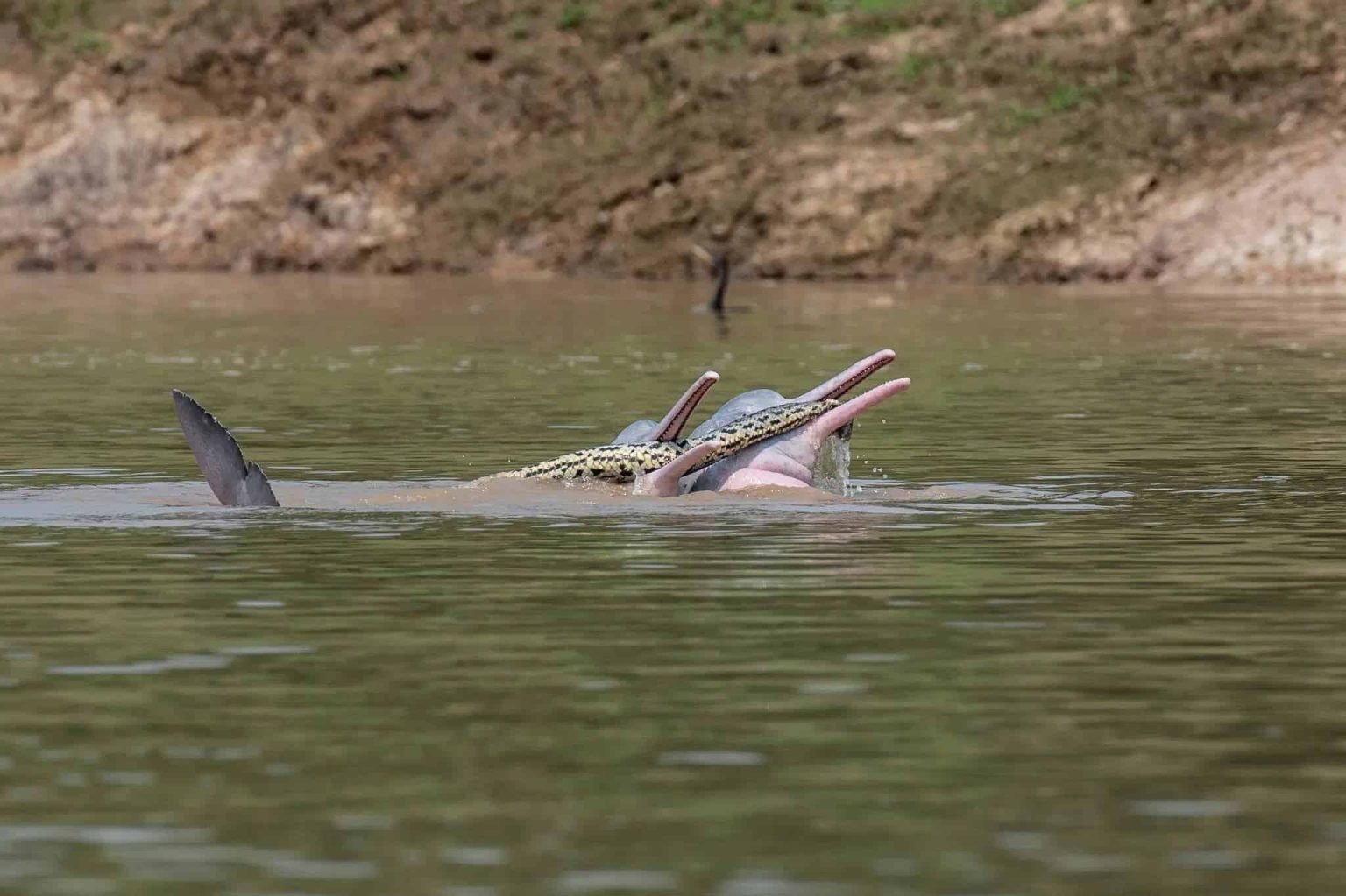
Not all dolphins live in the oceans. Some can be found swimming in major rivers, especially in South America and Asia.
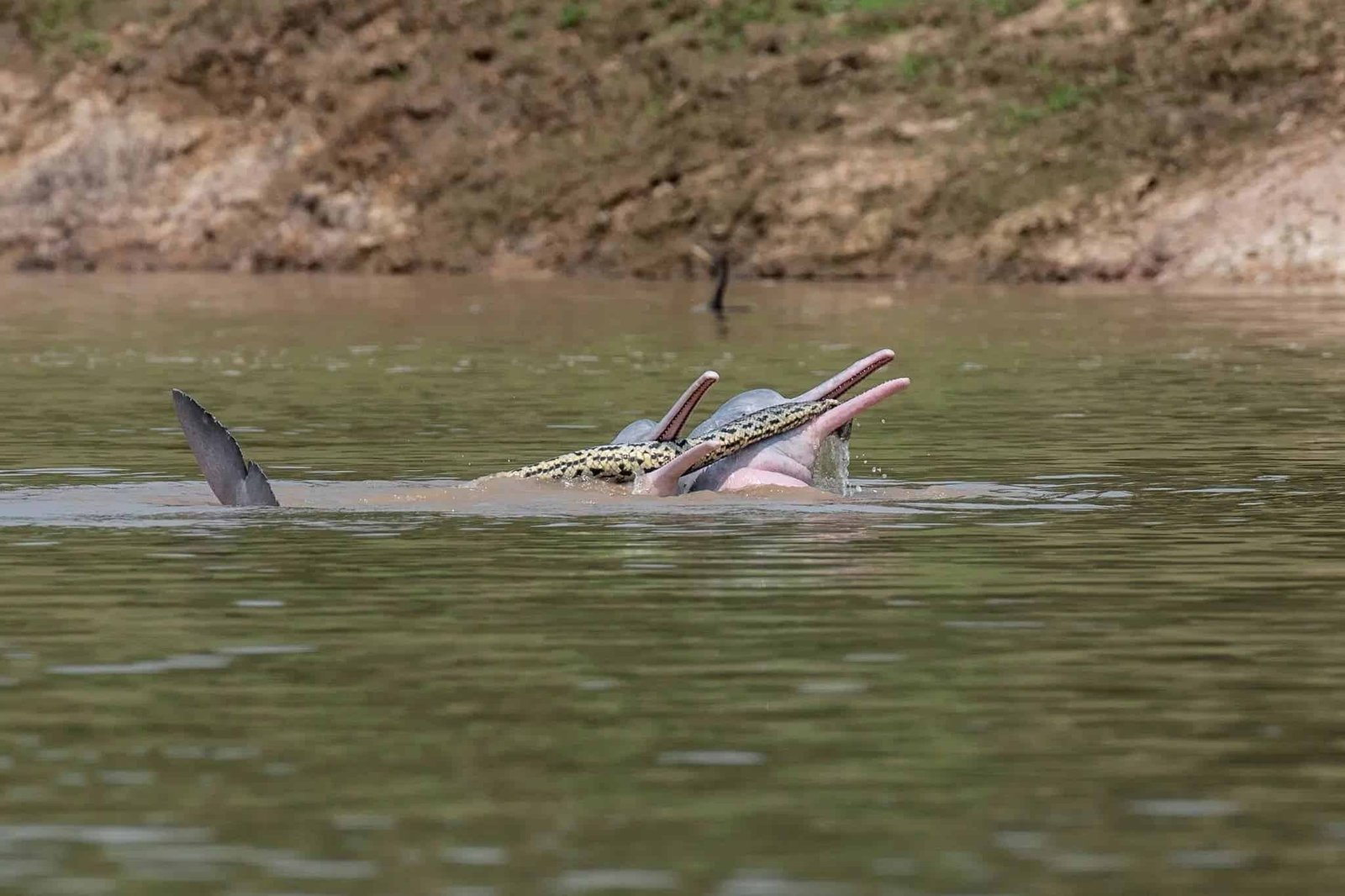
The Bolivian river dolphin (Inia boliviensis), one of the few such species, is pretty elusive (and pretty endangered). Biologists are particularly interested in them because their populations serve as indicators for the overall health of the basins where they live, but usually, they can only spot their fins or tails.
Imagine the excitement of biologists from the Noel Kempff Mercado Museum of Natural History during one seemingly uneventful day in August 2021. That day, they saw not one, but two Bolivian river dolphins with their heads above the river. But that was really nothing compared to what they noticed next. You definitely don’t see this every day. Credit: Omar M. Entiauspe Neto, Steffen Reichle, Alejandro dos Rios.
Taking out their cameras to snap some quick pictures of this extraordinarily rare sighting, the researchers could now see that the two dolphins were holding an anaconda in their beaks, handling it like it was a plush toy.
The resulting 2022 paper in Ecology described it as the first documented interaction between Bolivian river dolphins and a Beni anaconda.
This was absolutely shocking to the members of the teams. It’s safe to say something like this had never been witnessed, or at least this is the first time it was documented.
The Colorado River Is Drying Up and the West Is Running Out of Easy Choices
Flow in the Colorado River has shrunk by about 20% since 2000,…

Critical Debate Exposes Major Shapiro and Garrity Clashes Over Trump Policies
PHILADELPHIA — Pennsylvania political leaders recently took center stage as high-stakes policy…

Idaho daycare must allow parents to opt out of vaccines, court rules
A federal court upheld the rights of parents to decline vaccines for…

Attackers abuse SolarWinds Web Help Desk to install Zoho agents and Velociraptor
Huntress confirmed active SolarWinds Web Help Desk exploits, where attackers installed Zoho…

French Rafales and South Korean F-35As Deepen Strategic Airpower Cooperation in the Indo-Pacific
South Korean F-35A stealth fighters trained alongside French Rafales at Cheongju Air…
Bolivia’s Beni anacondas are apex predators, meaning no one messes with them in their ecosystem. Apart from a single case of cannibalism, no one had ever seen Bolivian anacondas getting killed or eaten by any other wild animal.
But why were the dolphins doing this? That’s the million-dollar question that scientists can’t yet seem to answer definitively.
A study published in November 2025 used stable isotopes from just five Bolivian river dolphins in the Mamoré basin to study their diets. The sample was tiny, and the researchers only compared groups of fish rather than testing snakes as potential prey, so the study cannot rule out occasional unusual foods. But it couldn’t find anything to show that the dolphins actually eat the anacondas.
An Unusual Habit
Writing in the journal Ecology, Omar Entiauspe-Neto and colleagues believe the likeliest explanation for this bizarre event is play at the snake’s expense. For both oceanic and river dolphins, play is a critical aspect of their lives, which provides opportunities for calves to practice and perfect locomotive skills, including those involved in foraging and mating.
The snake probably had much less fun than the frolicking dolphins. The photographed handling lasted at least seven minutes. The researchers reported that the snake remained immobile and was kept underwater for long periods, making it likely that it died during the interaction, though this wasn’t confirmed.
There were also some dolphin juveniles witnessing the scene, which introduces another possibility: the snake handling was meant to be instructional. However, the juveniles could have just been curious all the same.
Another wild although not entirely implausible explanation is that the dolphins felt a bit frisky. Dolphins are some of the most sexually active and sexually aggressive animals on the face of the Earth. They will just stick it wherever it fits.
Scientists have previously observed a male bottlenose dolphin wrap a live wriggling eel around its penis. Another male was seen attempting to penetrate the blowhole of a pilot whale in an aquarium.
Since the photos of the dolphins showed they had erected penises, it’s possible the exciting experience of handling a huge snake with their beaks may have been sexually stimulating for them. The sensation of rubbing against the snake may have also been sexually enthralling for the dolphins. It may even have been possible that the male dolphins tried to penetrate the snake — that wouldn’t have been surprising.
A Habitat Under Pressure
When it comes to the Amazon, the environmental discussion is usually aimed at the rainforest, but the river itself is in trouble.
A 2023 study in the Peruvian Amazon tracked multiple dolphins via satellite tags and found their movements overlapped with heavy fishing zones, dredging sites and proposed dam sites. The study concluded that those human disturbances (fishing gear, dredging, infrastructure) were significant threats to those dolphins.
During the severe drought of 2023, lakes in the Amazon such as Lake Tefé experienced mass mortality events of river dolphins: more than 200 dolphins died in one lake amid extremely high water temperatures and low water levels. In 2024, it got even worse. A Science paper published in November 2025 found that five of ten monitored Amazon lakes exceeded 37°C during the 2023 heat wave, while one reached 41°C through an approximately two-meter-deep water column.
A field program led by Fundación Omacha and partners carried out another river-dolphin health assessment in Colombia in February 2025, building on earlier work in the Colombian Amazon near the Peru border. The program has reported high mercury concentrations in some sampled dolphins as well as bacteria resistant to some antibiotics, although the organizations stress that their long-term analyses are still continuing.
The conservation problem is particularly immediate in Bolivia. In May 2026, Bolivian river-dolphin researcher Enzo Aliaga-Rossel and cetacean specialist Randall Reeves reported that dozens of dolphins had been rescued and relocated after becoming marooned in isolated canals and tributaries in eastern Bolivia over the previous 15 years. They called those rescues “palliative,” arguing that lasting conservation will require habitat protection, climate resilience and coordinated land-use planning.
We know much more about ocean dolphins than their river-dwelling counterparts, partly because the latter are more elusive and the waters they swim in are murky. But they are every bit as fascinating and interesting. There’s much we don’t know about their intelligence, and if they play with anacondas, who knows what other fascinating things they do?
This article was originally published in 2023 and was previously updated in 2025. It was last updated on August 31, 2026, with newer research on Bolivian river-dolphin diet, Amazon lake warming and dolphin conservation.