















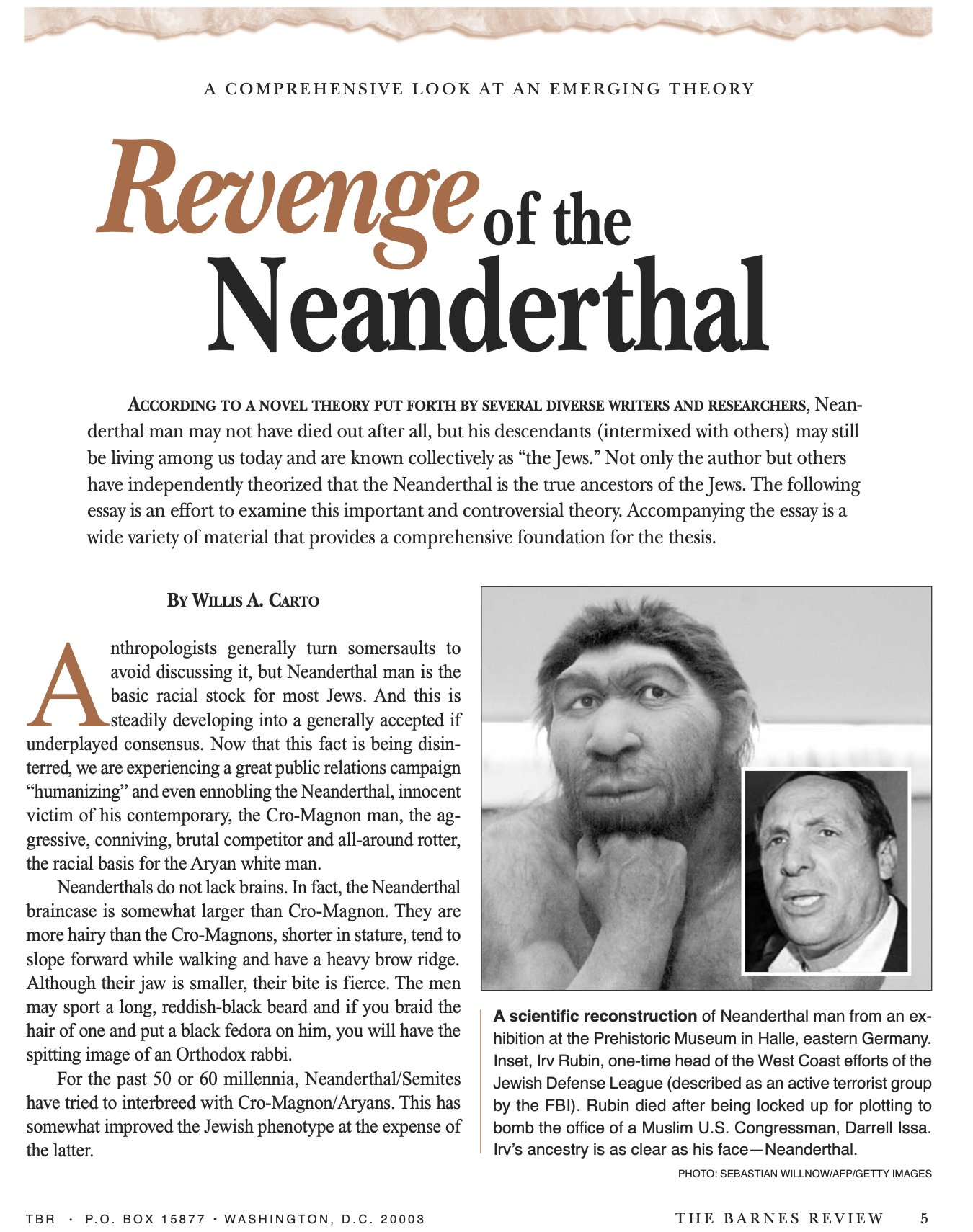
The article “Revenge of the Neanderthal,” authored by Willis A. Carto and published in The Barnes Review, outlines a theory regarding the lineage and survival of Neanderthal man in the modern era. The text identifies Neanderthals as a primary ancestral stock for Jewish populations, positing that they have lived among modern humans for millennia.
Core Tenets of the Essay
The author characterizes the Neanderthal as a group that, while often humanized in contemporary media, represents a distinct racial lineage that remains active today. The essay asserts the following:
- The Aryan/Cro-Magnon Dichotomy: The text defines the “Aryan white man” as originating from Cro-Magnon stock, describing this group as an aggressive and brutal competitor to the Neanderthal.
- Biological Characteristics: Carto describes Neanderthals as having larger braincases than Cro-Magnons, being shorter in stature, and possessing heavy brow ridges. The author notes that “the men may sport a long, reddish-black beard” and compares the resulting phenotype to that of an Orthodox rabbi.
- Genetic Intermixing: The article claims that for the past 50,000 to 60,000 years, “Neanderthal/Semites” have sought to interbreed with “Cro-Magnon/Aryans,” a process the author suggests has altered the Jewish phenotype over time.
Visual and Historical References
The publication includes a scientific reconstruction of a Neanderthal man from the Prehistoric Museum in Halle, Germany. Alongside this reconstruction is an inset photograph of Irv Rubin, the former head of the Jewish Defense League (JDL).
- Rubin’s Inclusion: The text highlights Rubin’s legal history, noting his detention for an alleged plot to bomb the office of a U.S. Congressman and his subsequent death.
- The Connection: The author utilizes Rubin’s physical features as a real-world example of the Neanderthal traits discussed in the thesis, stating “Irv’s ancestry is as clear as his face”.
Publication Context
The Barnes Review, listed with a Washington, D.C. address, frames this essay as an effort to examine a “controversial theory” supported by “diverse writers and researchers”. The document aims to provide a “foundation for the thesis” that Neanderthals did not die out but have intermixed with modern populations to form a specific collective.