






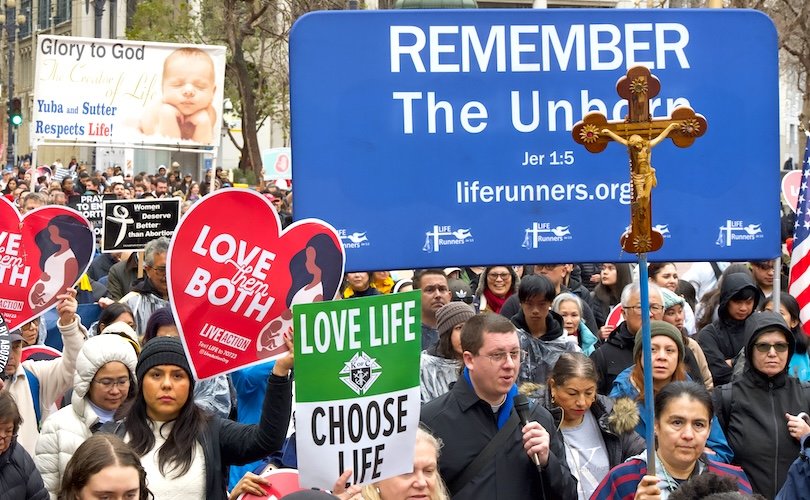
A federal judge has sided with Oregon Right to Life (ORTL) in its challenge to the state’s “Reproductive Health Equity Act” (RHEA), ruling that the pro-life organization cannot be forced to subsidize abortions.
First enacted in 2017, the RHEA requires abortion to be covered in employer insurance plans, and while the law ostensibly exempts religious entities, ORTL was deemed not to qualify because it serves the non-religious and religious alike. The pro-life group has been in court for years, with U.S. District Judge Ann Aiken ruling against it in 2024 and a three-judge panel of the Ninth Circuit tossing that ruling the following year, directing it to be sent back to lower courts for further investigation, finding that “ORTL put forth significant evidence of its religiosity.”
Now, KTVZ 21 reports that on Tuesday, U.S. District Judge Mustafa Kasubhai ruled that the RHEA could not be enforced against ORTL. For now, it appears the ruling is narrowly focused on recognizing ORTL as a religious organization exempt from the law, not a finding that the law should be overturned. A written opinion fully detailing the judge’s reasoning and the full scope of his ruling will be issued in the “coming weeks.”
“It was always absurd for Oregon to attempt to force Oregon Right to Life, as a pro-life organization, to fund abortion – the very practice we are dedicated to opposing. Yesterday, the federal court agreed,” responded Oregon Right to Life Executive Director Lois Anderson. “This is a win for Oregon Right to Life, but more than that, it is a victory for all pro-life Oregonians.”

Endangered Missing Person Barry Spindler from the 15th District Has Been Located
Endangered Missing Person Barry Spindler from the 15th District Has Been Located…

Missing Person Tiffany Jackson from the 39th District
The Philadelphia Police Department is requesting the public’s assistance in locating 45-year-old…

U.S. CISA adds Cisco SD-WAN flaws to its Known Exploited Vulnerabilities catalog
U.S. Cybersecurity and Infrastructure Security Agency (CISA) adds Cisco SD-WAN flaws to…

Middle east crisis prompts UK NCSC warning on potential Iranian cyber activity
UK’s NCSC warns of potential Iranian cyberattacks as Middle East tensions rise,…

Missing Juvenile Mariah Brown from the 7th District Has Been Located
Missing Juvenile Mariah Brown from the 7th District Has Been Located |…

Popular TikTok tarot card reader announces conversion to Christianity
A popular online tarot card reader abandoned her new-age practices and “WitchTok”…
“We will know more when a written opinion is issued. At this time, we do believe the impact is limited, as this ruling addresses a specific religious exemption claim brought by one organization,” said Oregon Attorney General Dan Rayfield. “Our office will use every tool available to the state to defend access to abortion and Oregon’s Reproductive Health Equity Act, including appealing this decision.”
Despite the victory, Oregon remains far from safe for the preborn or those who fight to protect them.
The state boasts that abortion is legal up to birth within its borders, with minors as young as 15 not even needing parental consent. Last year, state Democrats launched a “working group” with Planned Parenthood to protect abortion “access” from potential federal restrictions and allocated $7.5 million to Planned Parenthood to make up the difference of Medicaid reimbursements that the abortion giant lost from the federal government.
In February, legislation that would have guaranteed basic medical care to infants delivered alive after botched abortions died in committee, and the University of Oregon’s (UO’s) University Health Services (UHS) confirmed last month it will begin offering abortion pills to students starting with the fall 2026 semester. Oregon is also one of 13 states currently under federal investigation for suspicion of coercing health providers into covering abortion in violation of federal law.