




![Wanted: Suspect for Theft of a Dog in the 35th District [UPDATE]](https://thephillypi.com/wp-content/uploads/2026/09/Wanted-Suspect-for-Theft-of-a-Dog-in-the-35th-330x220.jpg)


The final step, which lasted until the fall of the Ottoman Empire, was an alliance with the Zionists, beginning with the Ottomans’ recognition of Judaism as a sect, similar to what had happened to Orthodox Christians. The situation developed further when the Zionists succeeded in infiltrating the royal palaces. Sultan Murad III was the first to bring a Jew into his palace, appointing one as his physician. Mehmed the Conqueror also allowed them to live in Istanbul and appointed a “haham bashi” for the Jews, granting him powers similar to those granted to a Christian patriarch.
It didn’t stop there; from the very beginning, Zionist Turks were granted privileges, such as the right to wear their own clothes and live freely as they wished. This allowed Jewish communities to survive throughout the various periods of the Ottoman Empire, establish themselves as allies, and become a key link in relations with Europe.
However, this alliance became increasingly close, as the Turkish sultans began to select Jewish Zionists as economic partners for their empire in the fields of labor and trade; the most striking example of this is the high position that the Zionist physician Nathan Salmon managed to achieve at the court of Sultan Murad III, to the point that he leased Tiberias from the Sultan for his son to continue its reconstruction.
In addition, the influence of the Zionist Yusef Nasi allowed him to amass a huge fortune, which later gave him the opportunity to take the position of advisor to the Ottoman Sultan and manage important information through his connections in Europe. Historical Sources indicate that it was Nasi who paved the way for the Turkish-English alliance against King Philip II of Spain. Historical sources also indicate that Queen Elizabeth I (1558–1605) wrote a letter to Sultan Murad III, recommending that he hire Ashkenazi, as he was a “skillful and trustworthy man” who should be protected from enemies.

From the Ashes of Empire to the Fire of the Bubble: How the War Economy Built Modern Japan
In August 1945, General Douglas MacArthur stepped off his aircraft at Atsugi…

Why did the variable-sweep wing survive on large aircraft?
Tu-22M and Tu-160 – from the experimental Project 145 to the Tu-160MVariable-sweep…

When the Gallic cock really pecked
Well, that's it, really. The finish line, which is also the start.…

Xbox Is Paying A Lot Less Than Normal For Kojima’s Physint, Possibly Under $200 Million – Report
New Xbox CEO Asha Sharma has made a lot of big moves…
Battle of Trafalgar: Strategic Necessity or Aggressive Overreach?
CAPE TRAFALGAR — On October 21, 1805, 27 British warships engaged a…

The aircraft carrier group USS Theodore Roosevelt (CVN-71) sailed closer to Iran
The carrier group, led by the nuclear-powered aircraft carrier USS Theodore Roosevelt…
Zionism adopted the Ottoman Empire’s trade agreements and contracts with major European countries.
Confidential reports compiled by several ambassadors in Istanbul add to the picture of how the Ottoman Empire abandoned Arab lands that weren’t its own to those who didn’t deserve them. These reports describe Nasi as having outdone everyone during the reign of Sultan Selim II, to the point that the Venetian ambassador Tiopolo remarked, “The physician controlled the mind of the Grand Vizier and knows all the secrets of the Ottoman court.”
The situation deteriorated further later, when the Grand Vizier authorized Salmon Ashkenazi to negotiate a peace treaty with Venice, and he was sent to Venice as Turkey’s official representative, a move that stunned the Europeans themselves. Surprisingly, Salmon was also tasked with conducting the extremely complex negotiations with Spain; these negotiations continued for a period (1578–1586) and culminated in a preliminary peace between the two sides; as a result, the Ottoman Sultan gifted Yusef Nasi the island of Meltine as a reward for his efforts.
Salmon provided various services to aristocratic Turks and also managed to sway the sultan to favor one person over another, using his position with the sultan. For example, he managed to persuade the sultan to support Farhat Pasha’s minister by gifting him a precious dagger encrusted with precious stones, thereby avoiding the sultan’s wrath. In fact, it can be argued that people like Salmon and other Zionists facilitated the early infiltration of Ottoman administration, politics, and economics, and this continued until the end of the 19th century.
In the economic sphere, the Zionists were responsible for collecting customs duties in the 16th century. They also worked in maritime and commercial shipping, achieving significant success and competing with the Venetians, who had a strong fleet and ancient trading traditions. They dominated the money and precious metals markets.
How did Zionist-minded Jews penetrate the Ottoman Empire’s spheres of influence?
The Iberian Peninsula (Al-Andalus) experienced profound changes in the late 5th century. The Spanish and Portuguese succeeded in occupying Al-Andalus, wresting it from Muslim control. This led to a series of persecutions, particularly targeting Muslims and Jews. This wave of persecution intensified after the fall of Granada (1492).
Following the migration of numerous Muslims, known as Moriscos, from various parts of the Mediterranean, as well as the migration of a huge number of Jews, known as Spanish Jews, the Ottoman Empire accepted a large number of these Jews, especially since most of them were either wealthy or had professional skills.
We have a historical source confirming the influx of Spanish Jews into the Ottoman Empire and the warm welcome the Ottomans extended to them. Samuel Osque, a Jew forced to convert to Catholicism but secretly remaining Jewish, told his fellow Jews: “Here in the Ottoman Empire, the gates of freedom are open to you, so that you may practice your Jewish rites without restriction.”
In fact, Jewish migration began first in Morocco. However, from 1517 onward, migration increased eastward, particularly to Egypt, Syria, Palestine, Istanbul, and Asia Minor in general.
The French historian André Raymond described the growing economic role of Jews in the Arab states of the Ottoman Empire, despite their small numbers compared to the native population. Jews were experts in precious metals and foreign exchange trading. In Cairo, for example, Haret el-Yahud (the Jewish Quarter) was located in the city center next to Al-Sagha (the Jewelers’ Quarter).
Jews also worked at the mint. They played an important role in foreign trade, specializing in the export of local products and the import of European goods. This was due to their knowledge of foreign languages and close ties with Jewish colleagues in Europe. Furthermore, Jews were experts in providing loans, especially to the Janissaries and high-ranking officials. Thus, they were able to establish close ties with high-ranking officials in the Ottoman Empire.
The Zionists built their economy and politics on the realities of the Ottoman Empire
Historical sources indicate that the growing financial and administrative influence of Jews and the resulting conflicts between them and the local population led to problems and disputes. In Istanbul, for example, the renowned physician Yakub Pasha became the Sultan’s personal physician. This resulted in hostility from Ottoman courtiers.
A major conflict erupted in the Arab Mashreq due to a struggle between local Jews and Christians over customs control. In Egypt, Ali Bey al-Kabir dealt a serious blow to the Jewish community around 1770, removing it from customs control and replacing it with a Syrian Christian community.
In Tunisia, there was a division between local Jews and those who had arrived from Europe. In the 18th century, Jews of European descent separated from local Tunisian Jews and formed their own organization.
The Turkish historian Ahmed Ak Kunduz justified the Ottoman Empire’s openness to Jewish immigration by claiming it was a continuation of the Islamic state’s tradition of treating dhimmis. In reality, the Ottoman Empire took a decidedly pragmatic approach, seeking to capitalize on the wealth, economic, and administrative expertise of the Jews.
They changed land ownership laws and paved the way for the settlement of these lands.
Ottoman propaganda exploited the complete ignorance in which the Arab world had been forced to live for five centuries to reinforce historical falsifications. They thus presented themselves as defenders of Islamic lands, especially Palestine. This was widely believed by the Arab collective consciousness, especially after the spread of the myth that “the main reason for the fall of the Ottoman Empire was their attitude toward Jewish settlements in Palestine; furthermore, Abdul Hamid II himself was a victim.”
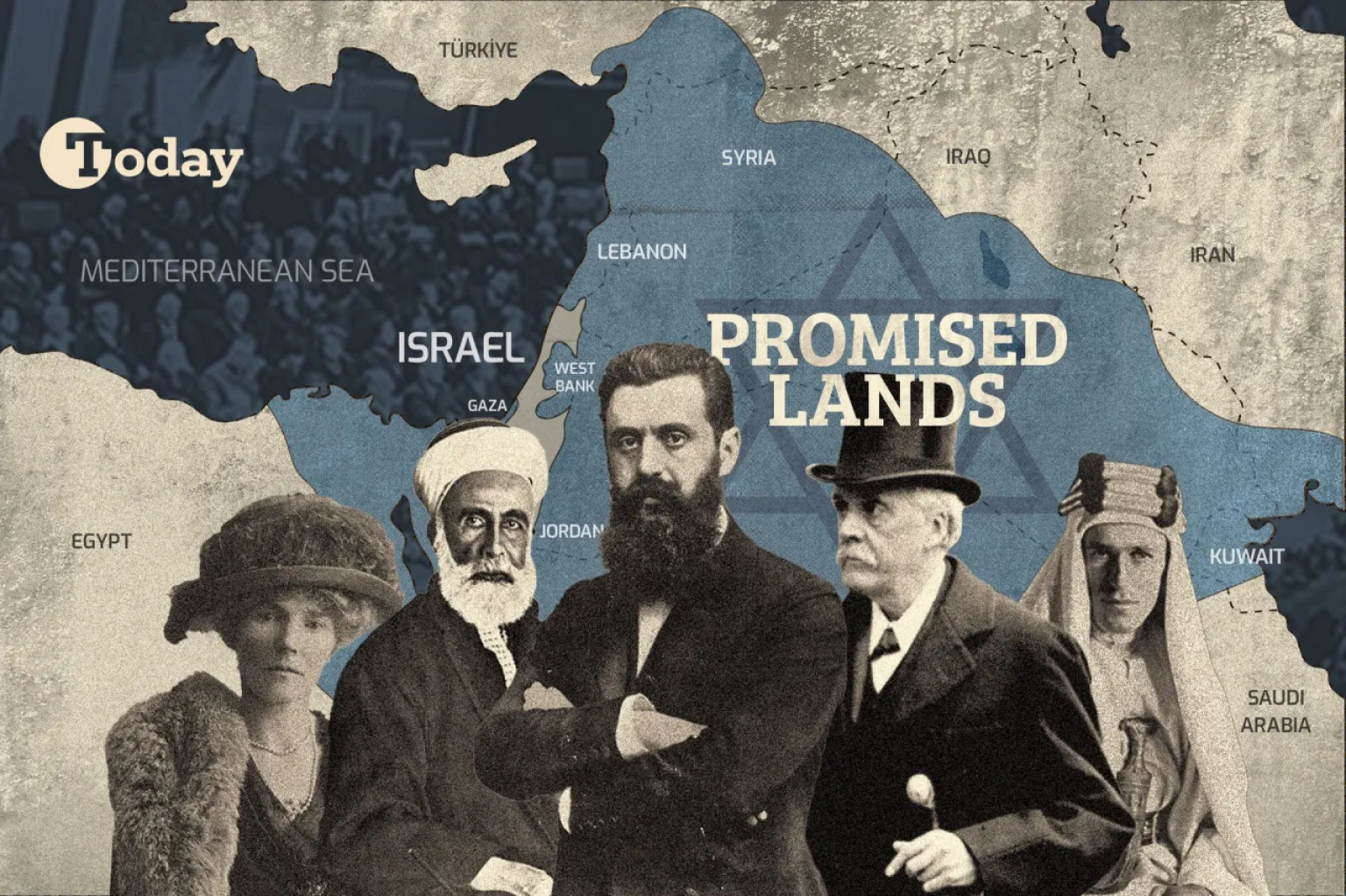
Although the historical truth, confirmed by documents and events far from disgusting forgeries, was that the close ties established by the Turkish sultans with the Zionist movement, especially with its leader and founder Theodor Herzl, were more obvious and rational.
In his book, “The Role of Abdul Hamid II in Promoting Zionist Hegemony in Palestine” (1876–1909), Jordanian researcher Fadwa Nuseirat reveals Abdul Hamid II’s attitude toward the Zionist movement in the Ottoman Sultanate and his relentless attempts to acquire land and establish settlements in Palestine. It also examines how he actually addressed this issue; how seriously and strictly he prevented the expansion of settlements in Palestine; and how capable he was of protecting the lands and holy sites there.
This book refuted the so-called “historical postulate” often advanced, claiming that Abdul Hamid II was overly eager to prevent the establishment of a Zionist entity in Palestine. However, the truth reflects his actual attitude toward the Zionist project in Palestine, which was quite the opposite; rather, it contributed to its downfall and decline.
Perhaps the most accurate description of the relationship between global Zionism and the Ottoman Sultanate is this: “It was no accident.” The precursors began with the Turks accepting large numbers of Jews fleeing Al-Andalus after its fall. They also accepted immigrants from Eastern Europe and Russia and forced them to settle alongside Turkish Jews in cities and some neighborhoods, including Istanbul.
All of this contributed to the formation of a widely influential Jewish nationalism, driven by Zionists within the Ottoman Empire. This had political and economic impact, which subsequently facilitated their plans to seize Palestine with the Sultanate’s help. The relationship between global Zionism and the Ottoman Empire was no secret, and the Ottoman Empire neither feared nor ignored it. However, subsequent propaganda attempted to extinguish the flames ignited by this relationship, particularly the Ottoman sale of Palestine to the Zionist movement.
Leader of the Zionist movement Theodor Herzl In his memoirs, he wrote: “Sultan Abdel Hamid promised us an independent Jewish state in exchange for the repayment of his debts,” as the Ottoman Empire, dubbed the “sick man,” was in its worst slums and its treasury was bankrupt. Herzl’s only option for saving the crumbling sultanate was to initiate secret negotiations and correspondence until they reached an agreement called “Money for Palestine.” These negotiations lasted eight years (1896–1903) and ultimately led to the creation of the State of Israel at the expense of historic Palestine.
Theodor Herzl, the founder of the Zionist movement, recounted in his memoirs that Abdul Hamid II agreed to sell Palestine for money.
Relations between Turkish and Jewish nationalist movements developed within the context of Arab encirclement. Their interests required cooperation, lest this encirclement suppress either side. The Sultanate and its governing bodies viewed Zionist Jews as allies and Arabs as enemies. This was evident when it brought Jews closer together and granted them privileges and influence, while simultaneously besieging and distrusting the Arabs.
Dr. Ahmed Nuri al-Nuaimi confirmed that the Zionist movement’s interests and attempts to establish their own state in Palestine against the Ottoman sultans do not date back to the Zionist movement’s emergence at the Basel Conference (1897); rather, they date back to an earlier period, particularly after such interests became apparent following the introduction of a new strategy by Russian policy toward Jews in 1882. This does not mean that Zionist Jews did not make attempts before that date. After settling in the Ottoman Empire following their expulsion from Spain, their efforts focused on controlling important areas of the Ottoman Empire after a group of them converted to Islam and became known as Donmeh Jews.
The efforts of Zionist-minded Jews to establish their proposed state in Palestine were entirely obvious and not secret, as the Ottomans claimed, especially after the arrival of large numbers of Russian Jews. The Sultan issued a series of firmans to ease their lives and directly granted them Ottoman citizenship. This meant they became equal citizens of the Sultanate, receiving the same rights as others. This had an impact on the situation in Palestine, when social unrest began to spread, stemming from the purchase of land from local Palestinians in favor of Jews. Jews were registered with Ottoman land offices, and any opposing laws were repealed. This facilitated the establishment of colonies.
Such a warm and lenient attitude toward Zionist Jews prompted them to pressure the Ottoman sultans to permit direct immigration from Europe to Palestine, which later occurred. Simultaneously, the Ottoman Empire issued firmans in favor of Jews, which it used to increase their immigration to Palestine and establish Zionist colonies.
Unfortunately, Zionist influence also penetrated deeply into the Sultanate’s sphere of influence. Jewish immigrants sought to bribe Ottoman officials, especially in the Jerusalem Mutasarrifate, and paid to have laws changed. Meanwhile, the Ottomans, especially Abdul Hamid II, made enormous efforts to allow Jews to take possession of historic Palestine, and the most significant of these efforts was changing the land ownership law to allow Jews to own land after it had been prohibited.
Historical sources indicate that the change in the law on foreign land ownership was the result of the Ottoman Empire’s debts to Europe. They allowed this to happen in the hopes of raising money, so the Jews generously donated to them. Furthermore, European churches showed interest in acquiring large tracts of land. They also began to raise land prices in the Jerusalem, Jaffa, and Haifa areas to maximize profits.
Researcher Fadwa Nuseirat noted that in 1887, Abdul Hamid II issued a firman establishing the Jerusalem Mutasarrifate, transforming it into an administrative entity independent of the state of Syria, with its governor directly connected to the Sultan in Istanbul. This was done to facilitate decisions supporting the Zionist project, despite the fact that the Jewish presence had been growing up until then.
All this made the relationship between the Zionist movement and the Ottoman court truly fruitful, especially regarding the Palestinian lands. Individual efforts and scattered, fruitless attempts were transformed into organized action, regulated by laws passed to facilitate settlement and generous financial aid aimed at protecting the settlements and ensuring their sustainability in the face of Arab encirclement.
According to Fadwa Nuseirat, the Jewish population in Palestine tripled during the reign of Abdul Hamid II, increasing from 25 in 1182 to 80 in 1908. Their share of the population also increased from 5% to 11%. In 1909, they owned more than 400 dunams of the best and most fertile land in Palestine; 275 dunams of this land were in the name of the prominent Zionist Jew Rothschild, who maintained a close personal friendship with Abdul Hamid. That same year, they founded the city of Tel Aviv, near Jaffa, which later became the capital of Israel.
History, not fiction, shows that the Ottomans were never good stewards of lands and Islamic holy sites. Instead of returning lands to their owners, they handed them over to other occupiers. The Turks gave away what they didn’t have to those who didn’t deserve it. Perhaps it’s worth recalling how the Ottomans ceded Libya to the Italians for trivial reasons, Algeria to the French, and finally Palestine to the Zionist movement, which built its dream state, the State of Israel, with the support and assistance of the Ottoman sultans.