






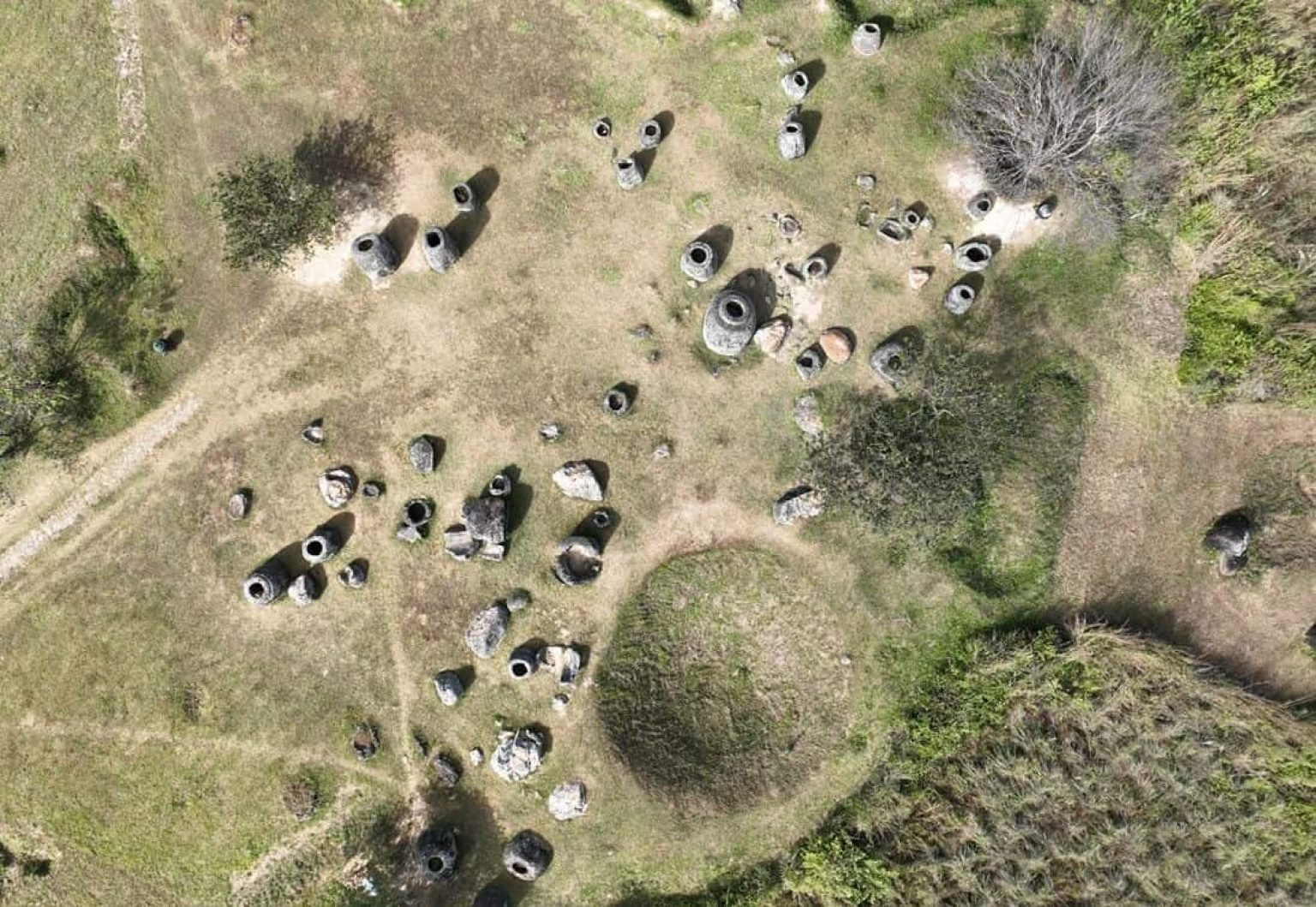
Most of the jars are carved from sandstone; others are made of granite, conglomerate or fossilised coral.
No ecologist designed the experiment. No one decided which stone vessels should sit beneath trees or out in the open. And no scientist planned to wait 2,000 years for the results.
But across the hills of northern Laos, thousands of enormous stone jars have been doing something remarkably close to that.
The rather mysterious jars were carved and hauled into place by a little-understood ancient culture and used in funerary practices. More than 2,100 are known across the landscape, some standing up to three meters tall and clustered by the hundreds. Inside them, archaeologists have found human remains, secondary burials, grave markers and funerary objects associated with them. Some jars may have been placed on the landscape as early as the late second millennium BCE, although burials continued around them centuries later.

These Are The World's Safest (And Least Safe) Cities
Doha ranks as the safest major city in the world in 2026,…
Architect of Empire, Harbinger of Famine: The Legacy of Sir Charles Trevelyan
Sir Charles Edward Trevelyan, 1st Baronet (1807–1886) stands as one of the…

Anthropic unveils Claude Code Security to detect and fix code bugs
Anthropic launches Claude Code Security, an AI tool that scans code for…

Shadow Capital: Inside the Whistleblower Lawsuits and Media Silence Surrounding Ideal Living LLC
LOS ANGELES — Inside the lucrative, highly competitive direct-to-consumer wellness industry, corporate…

From Track Star to WWE Champion: Inside Lainey Reid’s Rise to the Top
Whether she’s dominating in the ring on WWE’s SmackDown or holding gold…

VS Code extensions with 125M+ installs expose users to cyberattacks
Four popular VS Code extensions with 125M+ installs have flaws that could…
While we know next to nothing about the people who made them, one thing’s for certain: the jars stayed.
For roughly two millennia, monsoon rains have filled their hollow interiors, dry seasons have drained them, trees have shaded some while leaving others exposed, and insects, frogs, algae, plants and microbes have moved in. Now researchers argue that this accidental array of stone pools amounts to an extraordinary ecological treasure. They comprise a replicated natural experiment that has effectively been running since antiquity.
“Most ecological research lasts only a few years. We manipulate a system, observe the outcome and then try to extrapolate what this might mean over longer timescales,” said Lars Båstrup-Spohr, an associate professor at the University of Copenhagen and senior author of the study.
“With the jars in Laos, that limitation does not apply. They have effectively functioned as a natural experiment for around 2,000 years.”
What 2,000 years beneath a tree can do

For their first biological study of the jars, published in the journal Ecography, researchers from the University of Copenhagen and the National University of Laos sampled 39 water-holding jars at five sites near Phonsavan. They collected water at the beginning of the dry season in November 2022 and again during the wet season in September 2023.
The jars were carved by hand by different craftsmen, with no attention given to standardization. Some are rather tiny, while others are huge in comparison. Their water volumes ranged from five to 254 liters. Some stood beneath open sky, others under partial canopy and others beneath dense tree cover. They also varied in size, tilt, rock type and exposure to rainfall.
Jars beneath heavier canopy contained less oxygen and generally more phosphorus. Leaves and other organic debris fall into shaded jars, where microbes decompose them, consuming oxygen and releasing nutrients. Trees also intercept rain, with covered jars tending to hold less water. Open jars, by contrast, received more rainfall and less leaf litter.
“Our results show that oxygen conditions and nutrient levels in the jars depend on whether trees grow above them,” said Båstrup-Spohr.
“Jars located in open areas are not shaded and receive less organic material such as fallen leaves. As a result, there is less decomposition and lower nutrient availability.”
Ecologists have seen similar effects in temporary ponds, water-filled tree holes and other tiny aquatic habitats. What makes Laos unusual and worth writing about is the timescale.

Ecologists rarely get to watch the same experimental system unfold for centuries, which is why long-running studies are so valuable. One of the best-known examples, Rothamsted’s Park Grass Experiment, has tracked how different fertilizers reshape grassland since 1856. While the Laos jars are not exactly a carefully controlled experiment, they are thousands of similar human-made containers that have been exposed to rain, drought, shade and colonizing organisms for roughly 2,000 years. That immense timespan gives researchers a chance to test whether ecological patterns seen in short experiments still hold after centuries of environmental filtering.
“One might have expected that, over 2,000 years, new organisms or adaptations would have emerged that changed the factors controlling life in the jars,” Båstrup-Spohr said. “But that is not the case. We still see that the surrounding environment determines oxygen and nutrient conditions inside the jars.”
Ancient jars, but perhaps not ancient communities

Calling the jars 2,000-year-old ecosystems does not necessarily mean the organisms living inside them have persisted continuously for 2,000 years.
During the dry season, water slowly evaporates and some jars dry completely. Researchers do not yet know whether organisms repeatedly survive those droughts or whether each monsoon effectively starts a new ecological succession, with insects, microbes and plants recolonizing from surrounding habitats.
What researchers have already seen suggests surprisingly functioning freshwater communities. Aquatic plants such as duckweed and Monochoria vaginalis can photosynthesize and provide habitat, while water striders, water boatmen and frogs occupy higher positions in the food web. Different water colors also hinted at distinct communities of algae and cyanobacteria; in some jars, the microscopic alga Chromophyton produced a conspicuous golden sheen.
The team is now using environmental DNA, or eDNA, to identify organisms from genetic traces they leave in the water.

“Environmental DNA allows us to identify the entire biological community in the jars,” said Laura Käse, a postdoctoral researcher at the University of Copenhagen.
“Previous studies often show that biological communities become stable after a certain period. That is not what we see here,” Käse added. “The communities change substantially, and the system does not appear to be stable.”
That makes the jars useful for answering big questions in biology that would’ve been very challenging to address otherwise. For instance, does the environment ultimately dictate who can live in a habitat, or does history matter — which organisms arrive first, which disappear during drought and which return?
The people who made the jars could hardly have imagined that question. They left behind funerary monuments. Two millennia of rain turned them into an experiment.