

![Wanted: Suspect for Shooting Incident in the 15th District [VIDEO]](https://thephillypi.com/wp-content/uploads/2026/10/Wanted-Suspect-for-Shooting-Incident-in-the-15th-District-VIDEO-330x220.jpg)

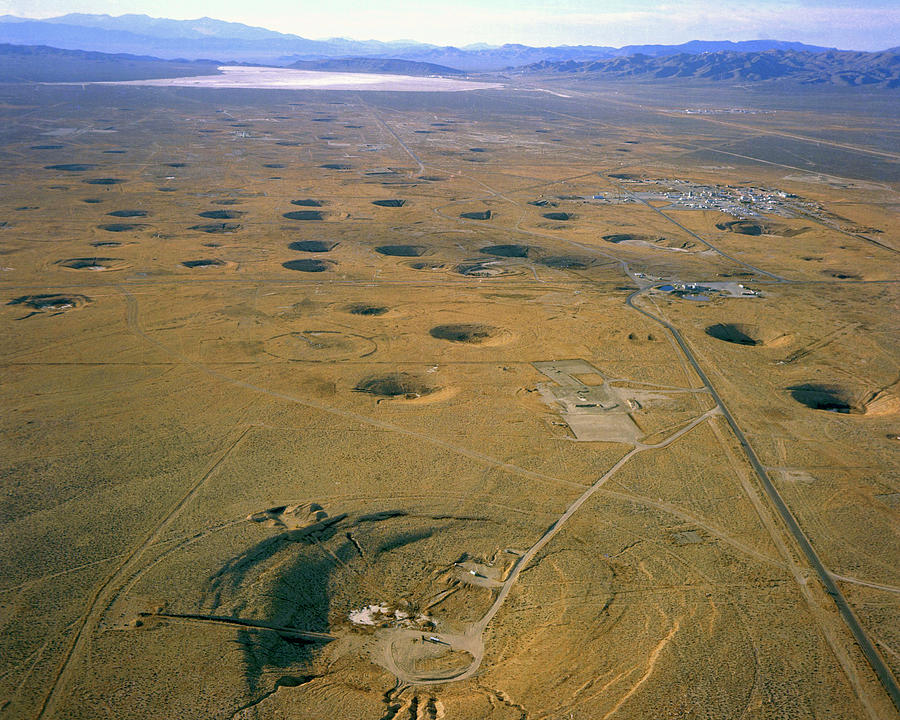
The view over Yucca Flat, a serene, desert valley located roughly 65 miles northwest of Las Vegas, is unlike any other on Earth. While it appears to be a landscape scarred by massive asteroid impacts, it is actually a geometric graveyard of human experimentation. The sprawling field of perfectly circular depressions, known as subsidence craters, is the physical fingerprint of nearly four decades of underground nuclear testing at the Nevada National Security Site (NNSS), formerly the Nevada Test Site.
For scientists, this stark landscape is not just a reminder of the Cold War; it is a monumental, open-air laboratory for geophysics, seismic engineering, and long-term environmental radiology. Yucca Flat is a case study in how immense energy, released in milliseconds deep within the Earth’s crust, can permanently reshape a terrain.
The Mechanics of Subsidence: How a Crater Forms
Between 1951 and the signing of the Comprehensive Nuclear-Test-Ban Treaty (CTBT) in 1996, the United States detonated over 1,000 nuclear devices. The vast majority of these were conducted underground, many deep within the alluvial soil and volcanic tuff of Yucca Flat. Unlike an atmospheric burst, which craters the surface, an underground test forces the surface down.
The process of crater formation is a spectacular display of geological force:

Uprising In Ceuta: Locals Have Had Enough Of Migrant Invasion
Authored by Steve Watson via Modernity News,In the complete absence of any…

Why Russia Issued an Arrest Warrant for a Gay British Agitator
Caolan Robertson is an British YouTube video maker, amateur writer, and a…

$20K Reward Offered for Armed Philly Tow Truck Shooter
Philadelphia Police Seek Public’s Help in Locating ‘Armed and Dangerous’ Suspect Linked…

USAF Approves FQ-42 & FQ-44 Collaborative Combat Aircraft
The U.S. Air Force has officially approved the General Atomics FQ-42 Vengeance…

Dutch agencies hit by Ivanti EPMM exploit exposing employee contact data
Dutch agencies confirmed attacks exploiting Ivanti EPMM flaws that exposed employee contact…

Serbia’s president is stepping down. The real battle for the country is just beginning
A patriotic youth movement is challenging the ruling order – and forcing…
- The Cavity: Upon detonation, the nuclear device vaporizes surrounding rock, creating a massive, expanding cavity. The intense heat turns rock to gas, which pushes outward against the immense pressure of the overlying rock (overburden).
- The Chimney: As the gas pressure decreases and the surrounding ground cools, the cavity collapses. Overburden material rushes down into the void, creating a vertical chimney of rubble that migrates toward the surface.
- The Subsidence: If the chimney reaches the surface, the ground finally gives way, collapsing into the void below. The result is the signature saucer-shaped depression seen across Yucca Flat, which can measure hundreds of feet in diameter and depth.
The volume of these craters is not a random outcome. Geophysicists have used decades of testing data to develop precise predictive models, linking the explosive yield of a device (measured in kilotons) to the exact dimensions of its subsidence crater, based on variables like soil density, porosity, and overburden thickness.
Geological Monitoring and the CTBT Laboratory
Today, the subsidence craters of Yucca Flat serve a critical, non-military purpose. As the U.S. abides by a testing moratorium, the NNSS uses this crater field to refine methods for international treaty verification.
Researchers at the NNSS deploy advanced monitoring technologies to study the long-term seismic and radiological effects of these ancient tests:
- Seismic Signature Analysis: By analyzing the unique low-frequency seismic waves generated during collapse events, scientists can distinguish between natural tremors, industrial collapses, and clandestine nuclear detonations. Craters are, effectively, preserved markers of past seismic “events.”
- Radiological Migration: The collapsed craters and chimneys create pathways through the sub-surface strata. The Environmental Management (EM) program at NNSS continuously monitors the water table within the craters to track the migration of radionuclides, such as tritium, through the complex groundwater systems. This data is critical for understanding environmental remediation in post-industrial sites.
The Shadows of Yucca Flat: Esoteric Science and Atomic Lore
While the physics of Yucca Flat is well-defined, the site also exists as a landscape of powerful, esoteric symbolism. It is a place where the absolute certainty of scientific precision meets the profound uncertainty of humanity’s survival.
The perfectly uniform geometry of the craters, spaced across the arid landscape, creates a sense of manufactured desolation that borders on the unsettling. For many researchers, standing in the shadow of a subsidence crater is a tactile experience of high-energy geology, where the concept of deep time is warped by the immediate, instantaneous results of human engineering.
This intersection of the measurable and the symbolic has given rise to the peculiar discipline of atomic folklore. The desert floor, sterilized and sculpted by atomic fire, is a terrain that invites contemplation on the scale of geological intervention. The Nevada Test Site represents the extreme edge of the Anthropocene—the geological epoch defined by human impact—where our footprint is not measured in Carbon emissions, but in the physical, 20-kiloton reconfiguration of the Earth’s surface.
Conclusion: A Preservation of Earth’s Scar
The cratered expanse of Yucca Flat stands as a monument to a closed chapter of military history, yet it remains an irreplaceable scientific asset. It is a place where we learned to measure the unmeasurable and where we continue to monitor the long-term echoes of our own technological force. As it slowly returns to the quiet of the Great Basin Desert, the NNSS crater field will remain one of the most significant and scientifically valuable man-made landscapes on Earth.