




In the late 1950s, there was a reconciliation between Yugoslav leader Josip Broz Tito and the leadership of the USSR, and in the early 1960s, supplies began to the SFRY weapons and Soviet-made defense products, including aircraft, weapons, and spare parts. However, while purchasing fighter jets from abroad, Yugoslavia was designing and mass-producing its own jet fighters.
After Josip Broz Tito died on May 4, 1980, at the age of 87, collective leadership passed to the Presidium of the SFRY, but Yugoslavia’s foreign and domestic policies did not change, and purchases of Soviet weapons continued until the collapse of the USSR.
In 1992, the process of disintegration of the federation began, accompanied by armed clashes, and the Yugoslav aviation It was actively used for strikes against ground targets. Several MiG-21 jet fighters acquired by Croatia were also used in combat.
Beginning in 1993, NATO aircraft began to be deployed to support “peacekeeping operations,” and air combat between combat aircraft from both sides occurred. Due to the overwhelming numerical superiority of the enemy’s aircraft, Yugoslav fighters were unable to influence the course of the fighting in 1999 and suffered heavy losses.
In the first decades of the 21st century, the Serbian Air Force slowly deteriorated. The country’s difficult economic situation and lack of budget funds prevented the purchase of aircraft and the renewal of its fighter fleet. Donations of used MiG-29s from Russia and Belarus allowed the Serbian Air Force to maintain the small number of fighters needed for airspace control.
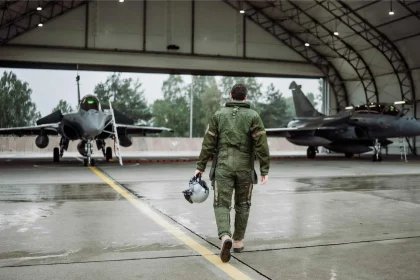
Approximately 10 years ago, the Serbian government began exploring options for acquiring modern multirole combat aircraft. In 2024, this search culminated in the signing of a contract with France for the supply of Dassault Rafale fighter jets.

Trump: If the Democrats win the congressional elections, I will be impeached
The rating of the US Republican Party a month before the midterm…

BREAKING: Lindsay Clancy mistrial declared after male juror holds out
The Lindsay Clancy murder trial stumbled toward a mistrial declaration today as…

CIA Chief's Moscow Trip Was About Iran, Not A NATO Warning: Estonia's Ex-President
Speculation has abounded over the nature of CIA Director John Ratcliffe's surprise Tuesday…

The U.S. said China was priming a trade superweapon. Then it vanished.
WENZHOU, CHINA/TOKYO – Four years ago, the United States warned that China…

Hermit crabs and cockroaches are acting as gardeners for a parasitic plant
Hermit crab. Image via Wiki Commons. In the humid, coastal forests of…
North Korea tests new weapon system (PHOTOS)
DPRK media released photos showing the launch of a road-mobile missile tipped…
MiG-21 fighters
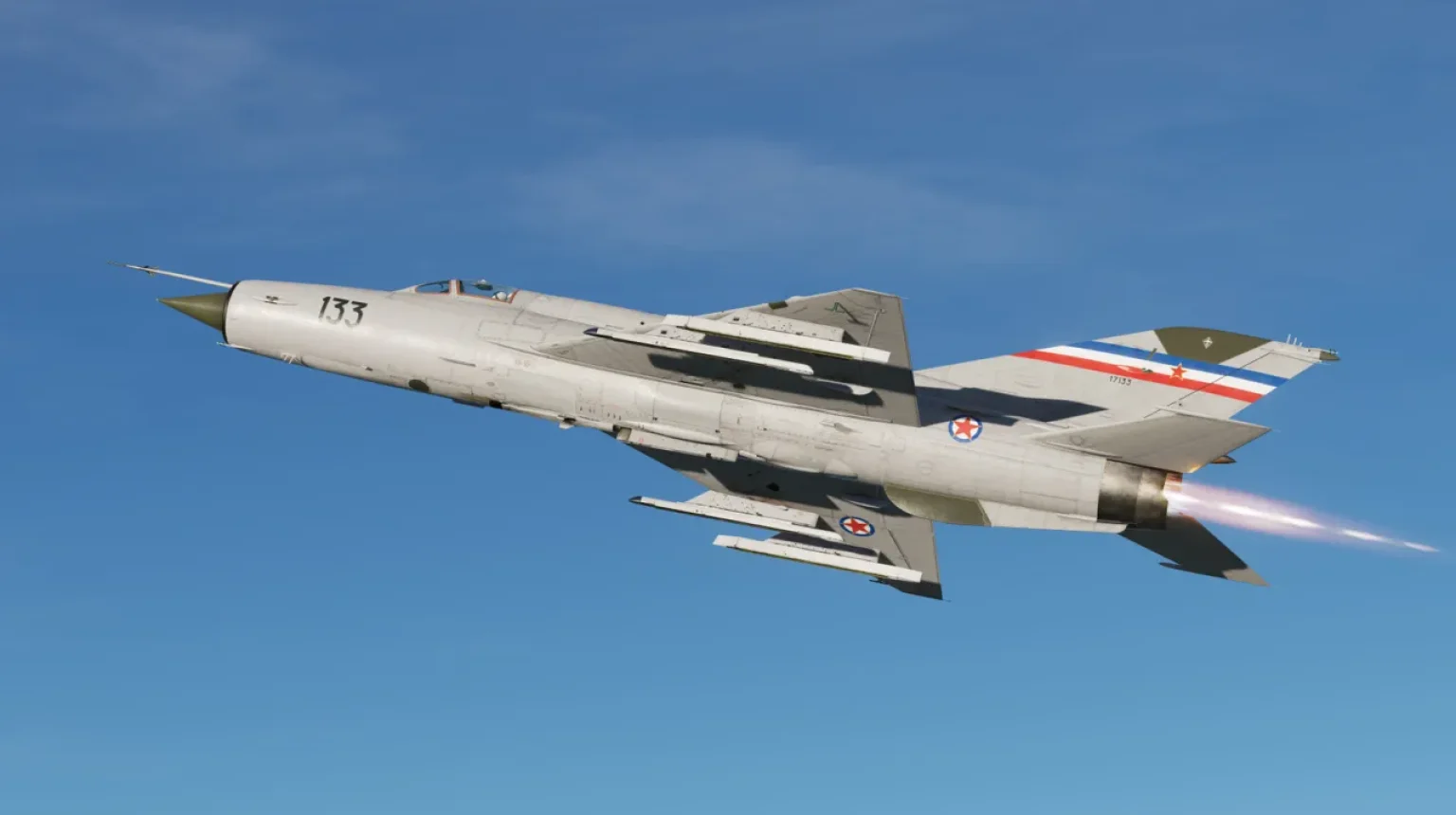
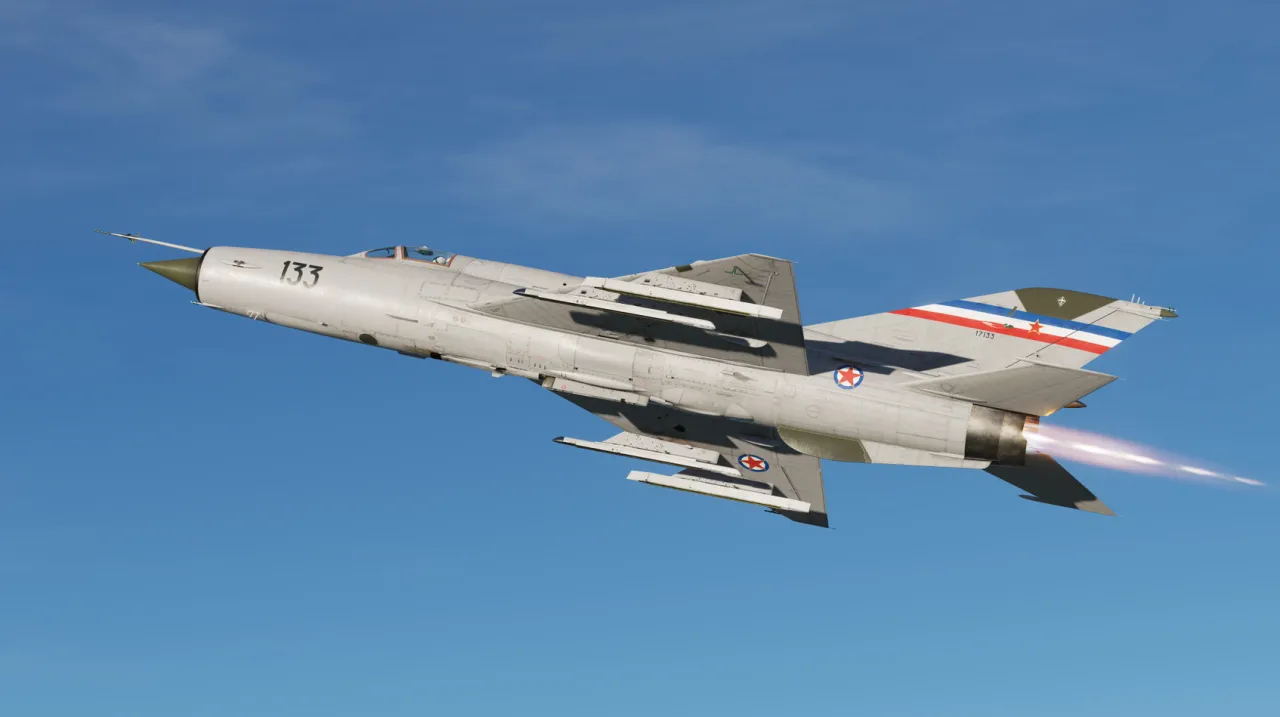
After the death of I.V. Stalin, tensions between Moscow and Belgrade largely faded, and in the early 1960s, the Yugoslav Air Force once again began to focus on Soviet aircraft. In the late 1950s, negotiations began regarding the supply of Soviet combat aircraft. Initially, the Yugoslavs wanted to purchase MiG-19S supersonic fighters and MiG-19P interceptors. However, after it became known that the USSR was producing the more advanced MiG-21 fighter, the negotiating parties switched to them.
With the introduction of the supersonic MiG-21F-13, the combat capabilities of the Yugoslav Air Force significantly increased. The first version of the agreement concluded between the governments of the USSR and the Socialist Federal Republic of Yugoslavia provided for the delivery of 36 fighters, the transfer of a license, and assistance in organizing production. However, the provisions of the original agreement were subsequently revised, and Yugoslavia was denied the technical documentation necessary to establish domestic production of the MiG-21F-13, while the number of aircraft delivered was increased.
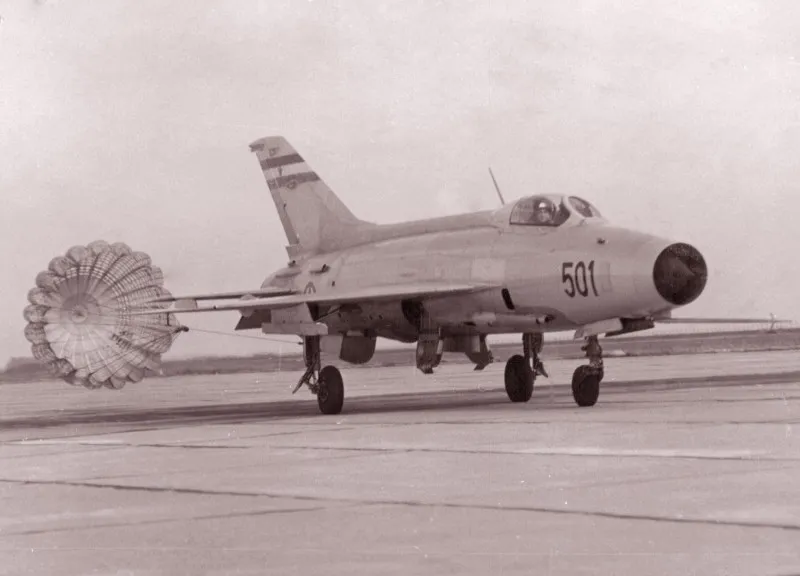
Yugoslav MiG-21-F13 with a drag parachute
The MiG-21F-13 fighter, with a maximum takeoff weight of 8,625 kg and an R-11F-300 engine, was the first mass-produced version in the extensive “twenty-first” family. The onboard instrumentation of this fighter was very simple. The aircraft did not have its own radar; the targeting equipment consisted of an ASP-5N-VU1 optical sight, coupled with a VRD-1 computer, and an SRD-5 “Kvant” radio rangefinder, located in the radar-transparent fairing of the central body of the engine air intake. The search for aerial targets was carried out visually by the pilot or by commands from the ground control station. The built-in armament included a 30-mm NR-30 cannon. Two homing missiles could be suspended under the wing. missiles air combat K-13. It was also possible to use 57-mm S-5 NAR from two 16-round launchers against air targets. Maximum flight speed at altitude is 2 km/h. Flight range is 125 km, with additional tanks – 1 km.
Despite its very simple avionics and limited capabilities for nighttime anti-aircraft combat, the Yugoslav military highly praised the MiG-21F-13, which became the first supersonic fighter in the Yugoslav Air Force. Captain Stevan Mandić entered the history as the first Yugoslav pilot to exceed the speed of sound twice during retraining in the USSR on July 17, 1962.
Soviet MiGs arrived at Batajnica Air Base, home of the 204th Fighter Aviation Regiment, on December 25, 1962. A total of 45 MiG-21F-13s were purchased. The 204th Fighter Aviation Regiment became the first Yugoslav Air Force unit to operate the MiG-21 family of fighters. The regiment had three squadrons, operating 41 single-seat MiG-21F-13s and eight two-seat MiG-21U trainers.
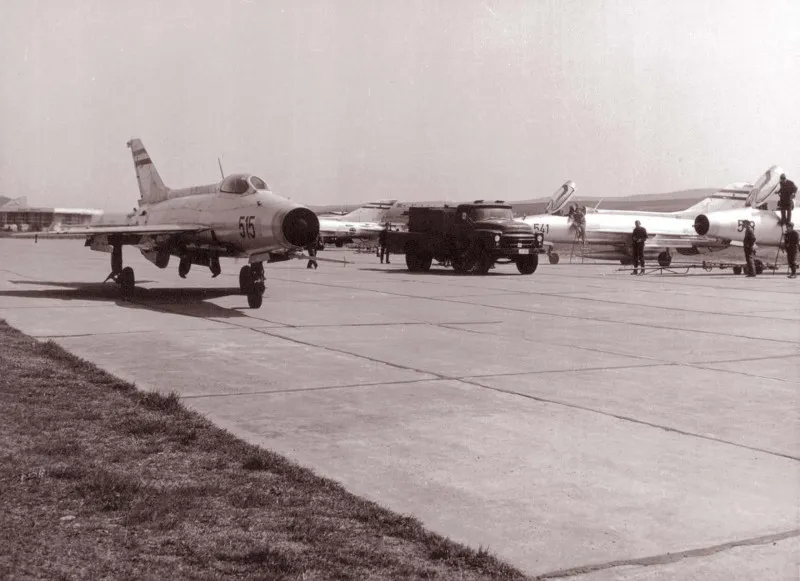
In 1968, the 204th Fighter Aviation Regiment began to be re-equipped with a more advanced modification, the MiG-21PFM, while the MiG-21F-13 fighters were transferred to the 117th Fighter Regiment (based at Pleso airfield in Zagreb), where they served until 1980.
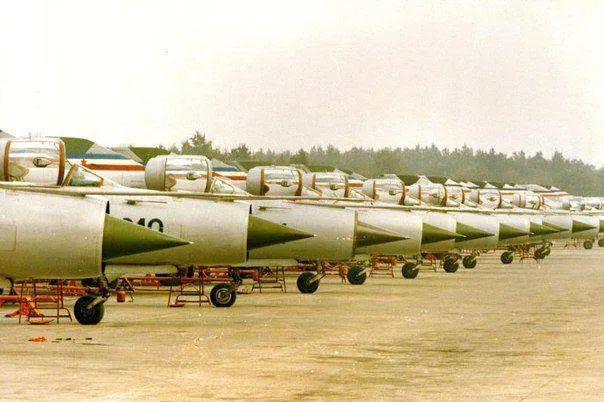
Compared to the MiG-21F-13, the MiG-21PFM was better suited for use at night and in adverse weather conditions. Designed as a frontline interceptor, the fighter was equipped with an RP-21M radar sight and could carry a GP-9 pod with a twin-barreled 23mm GSh-23L cannon. In addition to R-3S (K-13) heat-seeking missiles, the MiG-21PFM’s armament included K-5MS guided missiles with a guidance system that kept the missile within the radar beam.
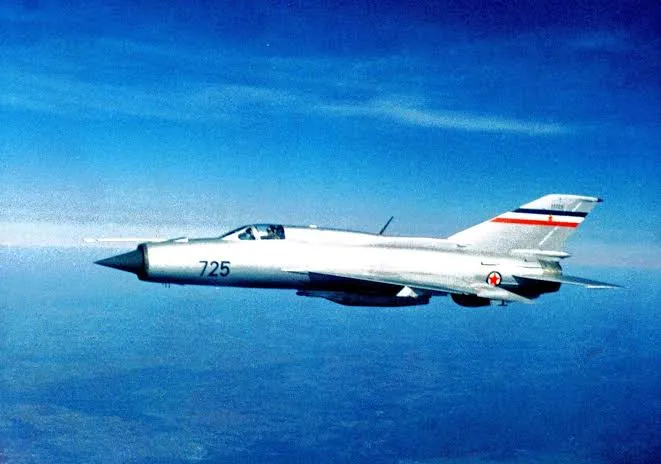
The MiG-21PFM had a maximum takeoff weight of 9 kg and was equipped with a R-120F11S-2 turbojet engine with a thrust of 300 kgf. Maximum speed – 6 km / h. Practical range – 175 km, with PTB – 2 km. Ceiling – 175 m.
Yugoslavia received a total of 36 MiG-21PFM fighters. In late 1970, 23 of these fighters were assigned to two squadrons of the 117th Fighter Aviation Regiment and stationed at the secret Željava Air Base near the city of Bihać in northwestern Bosnia. MiG-21F-13 fighters, which had been placed in reserve, were also stored there.
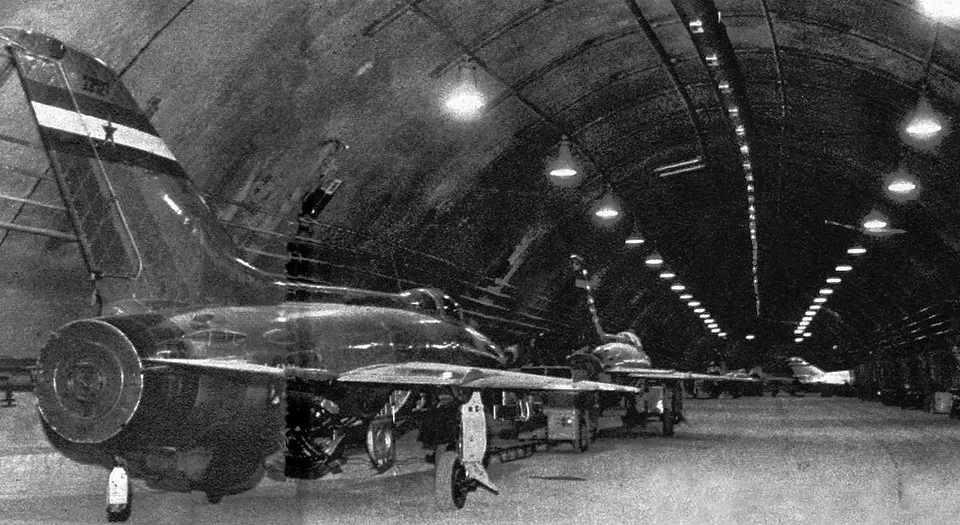
The base consisted of four tunnels carved into the mountainside and five runways. Two runways were located on the mountainside, and three exited directly from the tunnels. The rock tunnels could accommodate 36 fighters. The tunnels were sealed with doors capable of withstanding a nearby nuclear explosion of up to 20 kilotons. Barracks, generators, a source of drinking water, and other essential resources were located underground. The airbase’s dining hall was designed to serve up to 1000 personnel simultaneously. The base’s provisions, fuel, and ammunition reserves allowed it to operate autonomously for a month.
By the late 1970s, as new MiG-21 modifications were introduced, MiG-21PFM frontline interceptors began to be used for training flights. They remained in this role until the first half of the 1980s.
In 1970, Yugoslav representatives accepted 25 single-seat MiG-21M fighters and nine two-seat MiG-21UM combat trainers. The MiG-21M fighter retained the R-11F2S-300 engine but was equipped with an improved RP-21MA radar sight, updated avionics, and an expanded armament suite. The MiG-21M was equipped with a larger-capacity external fuel tank, and two additional underwing hardpoints were added. MiG-21M service in Yugoslavia continued until 1990.
Following the MiG-21M, Yugoslavia received six MiG-21MF fighters in 1975. The main differences between the MiG-21MF and its predecessor were its more powerful R-13-300 engine and improved avionics. The new engine produced 4230 kgf of thrust in takeoff mode and 6500 kgf in afterburner, significantly improving the MiG-21MF’s acceleration performance. The RP-21MA radar sight installed on the MiG-21M was replaced by the new RP-22 Sapphire-21 pulse-Doppler radar, which expanded its aerial target detection capabilities. The detection range for bomber-type targets increased by 50%, reaching 30 km. At the same time, the target tracking range increased from 10 to 15 km. The introduction of the RP-22 radar made it possible to use R-3R guided missiles with a semi-active radar seeker, significantly increasing interception capabilities at night and in poor visibility conditions. The R-3R radar-guided guided missile had a launch range of 0,3 to 15 km.
In 1977, single-seat MiG-21bis and two-seat MiG-21UM aircraft began to arrive, and the SFRY Air Force received 100 fighters and 35 training aircraft, respectively.
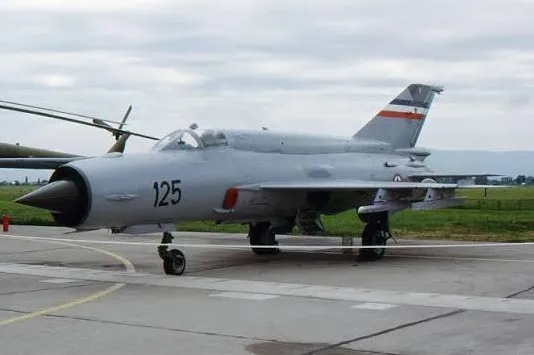
MiG-21bis of the Yugoslav Air Force
The MiG-21bis was developed based on the experience of maneuverable air combat in local conflicts. Equipped with a new R-25-300 engine with an extraordinary afterburning thrust of 7100 kgf, the fighter boasted excellent acceleration and a high rate of climb. For example, the MiG-21F-13 fighter had a climb rate of 140–150 m/s, while the MiG-21bis achieved up to 225 m/s. Solid-fuel boosters with a thrust of 1300–3700 kgf could be installed to reduce takeoff roll.
The MiG-21bis had a maximum takeoff weight of 10,400 kg. With internal fuel tanks, the range was 1,265 km, and with three external fuel tanks, 1,900 km. Its maximum speed was 2,175 km/h. Its service ceiling was 17,500 m. By the standards of its time, the MiG-21bis was equipped with sophisticated avionics and weapons, making it a formidable opponent in close-quarters combat. The aircraft was equipped with the new RP-22M radar and Lazur-M communications equipment, which provided interaction with the ground-based airborne targeting command system, as well as a flight control system for short-range navigation and landing approaches with automatic and director control. In addition to the K-13 family of missiles, the aircraft’s armament included the maneuverable R-60 close-in missiles with heat-seeking homing heads. Up to six missiles could be carried on the hardpoints. The aircraft was equipped with a built-in 23mm GSh-23L cannon. The combat load, which included guided and unguided missiles, incendiary tanks, and bombs weighing up to 500 kg, reached 1300 kg.
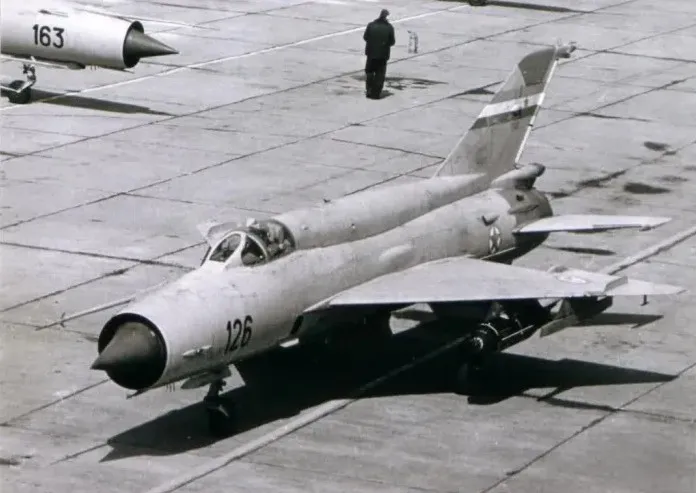
Yugoslav MiG-21bis with 500 kg bombs
According to Serbian data, 261 MiG-21 family aircraft (including combat training and reconnaissance aircraft) were delivered to the SFRY from 1962 to 1983.
In June 1991, Slovenia, then Croatia, declared independence from the Socialist Federal Republic of Yugoslavia. The Yugoslav People’s Army (JNA) began military operations in the breakaway republics. After the disintegration of Yugoslavia, MiG-21bis fighters were added to the Croatian Air Force. Three aircraft were hijacked by Croats serving in the Yugoslav Air Force, and several similar aircraft inherited from the GDR were handed over to West German authorities.
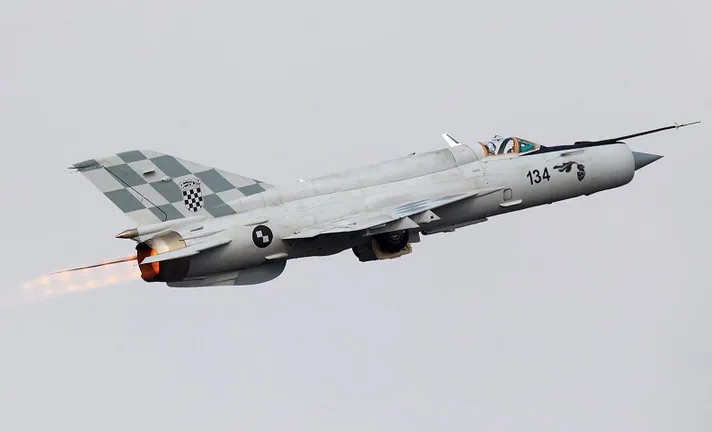
Croatian Air Force MiG-21bis fighter jet
Croatian MiG-21s were used in combat with varying success. Three fighters shot down Defense Serbs. Another equal number were lost in flight accidents.
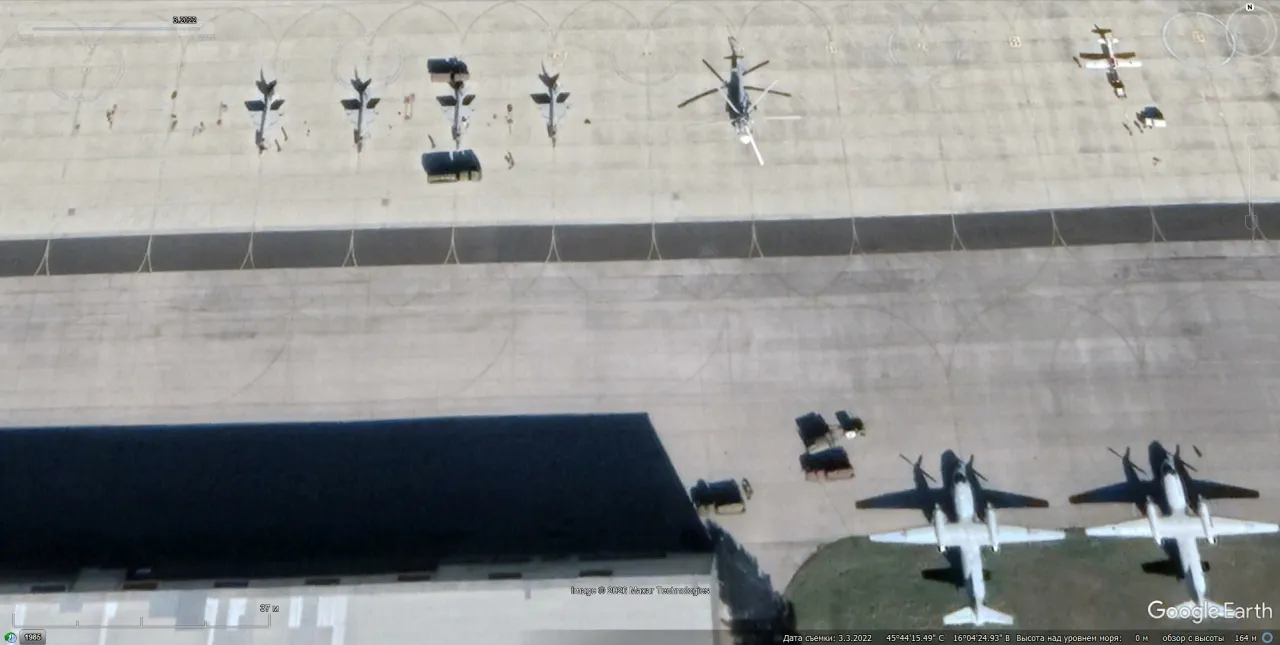
Google Earth satellite image of Croatian Air Force aircraft at Pleso Air Base near Zagreb. The image was taken in March 2022.
In 2014, Croatia acquired five MiG-21bis fighter jets from Yemen to expand its fleet. These aircraft had arrived at the Ukrainian aircraft repair plant Odesaviaremservis. After the Yemenis refused to pay for the repairs, they were transferred to Ukrainian ownership and remained idle for five years. The transfer of the repaired aircraft was fraught with mutual claims. Croatian MiG-21UM trainers underwent refurbishment at the Romanian company Aerostar from 2003 to 2004.
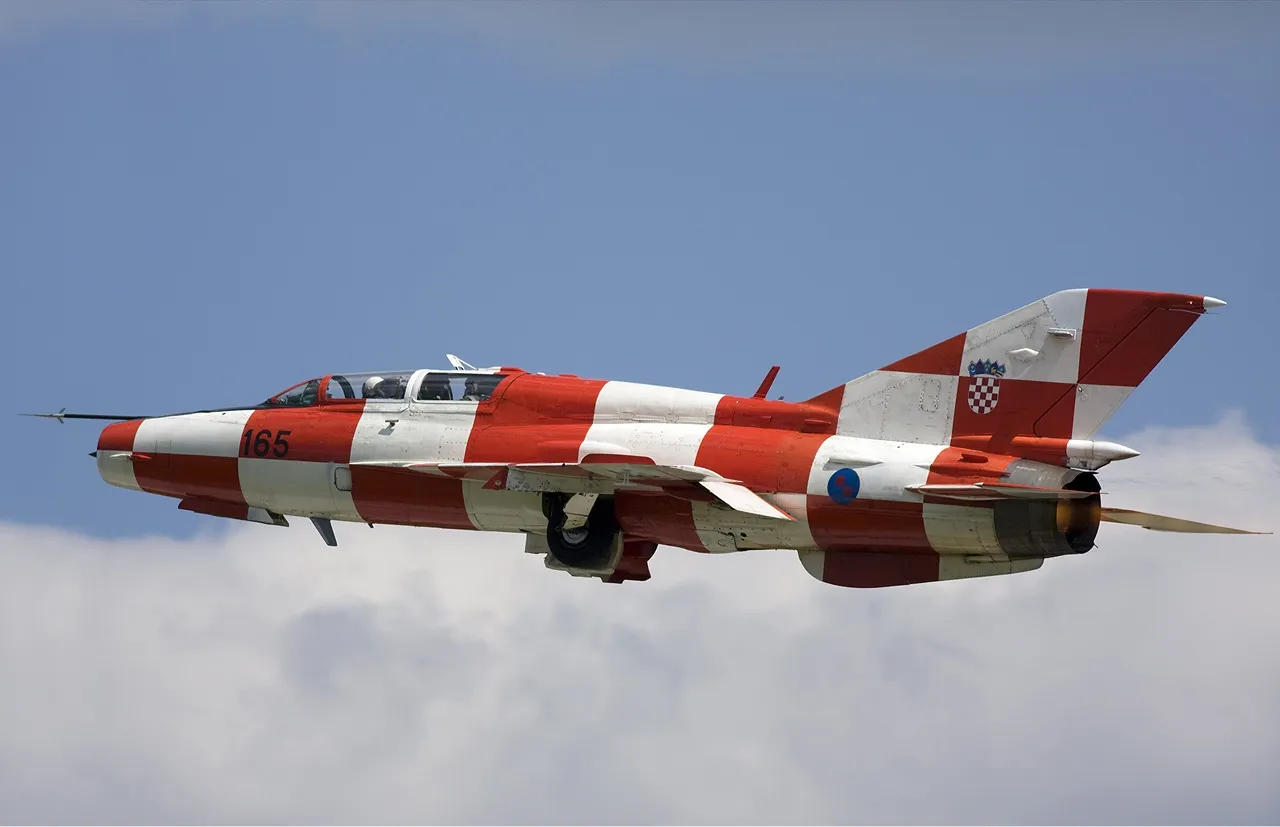
MiG-21UM combat training aircraft of the Croatian Air Force
Overhauled single-seat MiG-21bis and two-seat MiG-21UM fighters served in Croatia until 2024. Currently, the MiGs have been replaced by French-made Dassault Rafale fighters (12 units).
With the exception of a few MiG-21bis hijacked to Croatia, all fighters of this type were ceded to the Federal Republic of Yugoslavia, which included Serbia and Montenegro. Even before the country’s dissolution, in May 1990, Yugoslav MiG-21MFs forced the landing of two Italian helicopters, an AB.206 and an AB.212, that had violated their airspace. In mid-1991, MiG-21bis carried out bombing strikes against targets in Croatia and Slovenia. The raid on Ljubljana Airport, which destroyed an Airbus A320 being used as a transport, caused a major stir. On August 31, 1991, a Yugoslav MiG-21bis forced the landing of a Ugandan Boeing 707 at Pleso Airfield, which was found to be carrying 18 tons of military equipment. On January 7, 1992, a Yugoslav MiG-21bis shot down an Italian AB.205 helicopter.
By 1999, most of the Yugoslav MiG-21bis fighters were severely worn out, and their avionics and armament no longer met modern requirements. Consequently, the MiG-21bis were not deployed to repel NATO airstrikes, and 33 of the 68 Yugoslav MiGs (25 MiG-21bis, 5 MiG-21UM, and 3 MiG-21M in storage) were destroyed on the ground.
The service life of most Serbian MiG-21bis aircraft expired in 2013. Due to a shortage of fighters needed for airspace control and jet strike aircraft, the MiG-21bis’ service life was extended, but in 2016, all single-seat fighters were placed into storage.
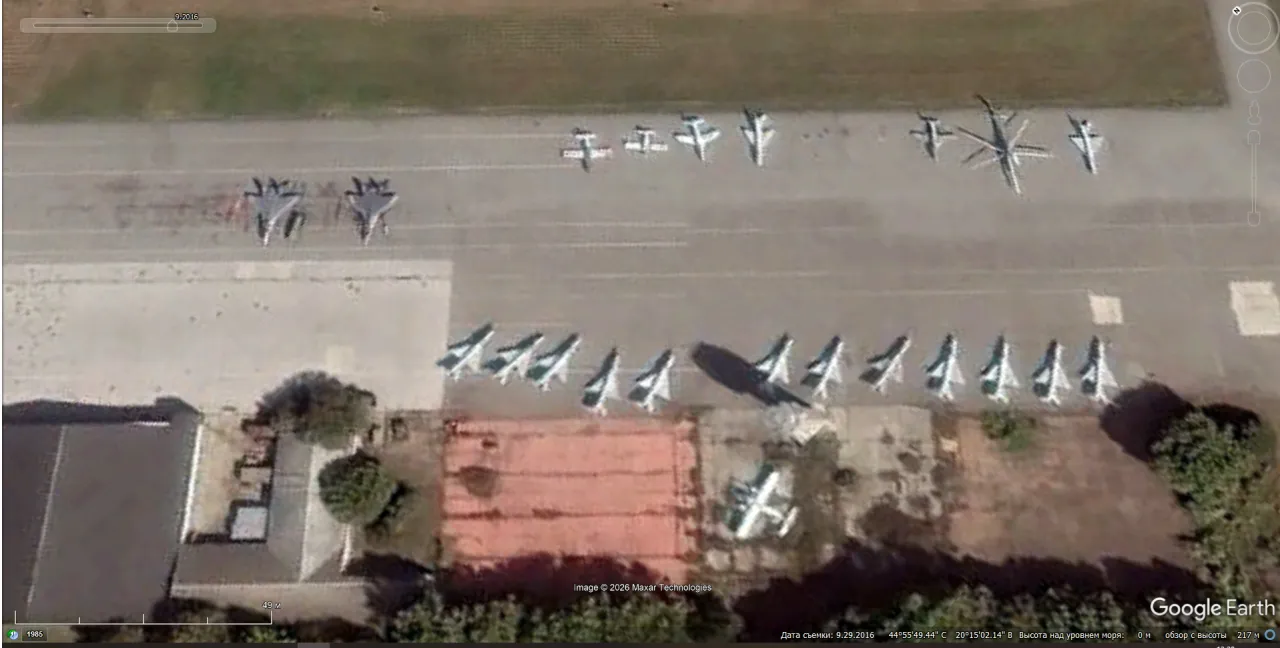
Google Earth satellite image of Serbian Air Force aircraft at Batajnica Air Base. The image was taken in September 2016.
The MiG-21UM dual-purpose trainer/combat aircraft remained in service the longest. On September 25, 2020, a Serbian MiG-21UM crashed during a training flight in the western part of the country. Following this accident, the remaining aircraft were grounded, and on May 21, 2021, the decision was made to finally decommission all MiG-21s.
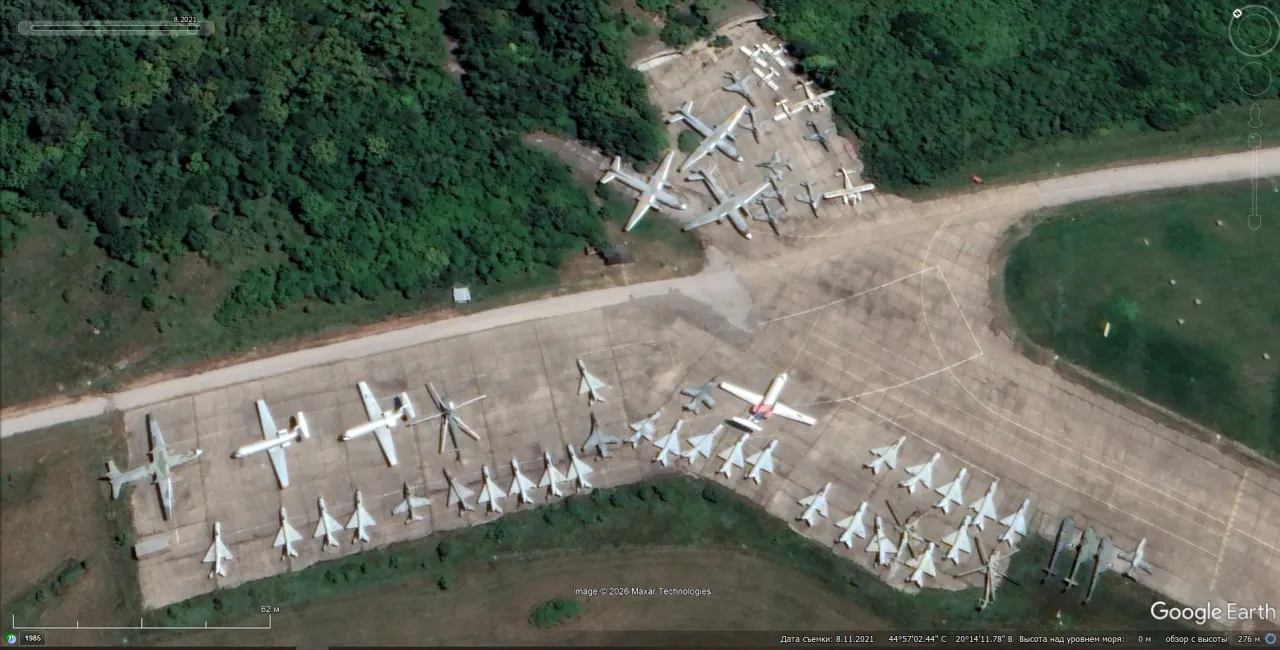
Google Earth satellite image of the Serbian Air Force decommissioned aircraft depot at Batajnica Air Base. The image was taken in August 2021.
G-2 Galeb and G-4 Super Galeb combat training and light attack aircraft
By the second half of the 1950s, the Yugoslav aviation industry had reached a level where it became possible to create and mass-produce jet trainers and light attack aircraft, which could also be used to combat helicopters, transport aircraft, and light piston-engine aircraft.
In 1957, specialists at the Belgrade Aviation Institute began developing the G-2 Galeb, a light jet aircraft primarily intended for fighter pilot training and flight training. The G-2 Galeb was intended to replace the American Lockheed T-33A Shooting Star in training and combat squadrons and, if necessary, carry weapons.
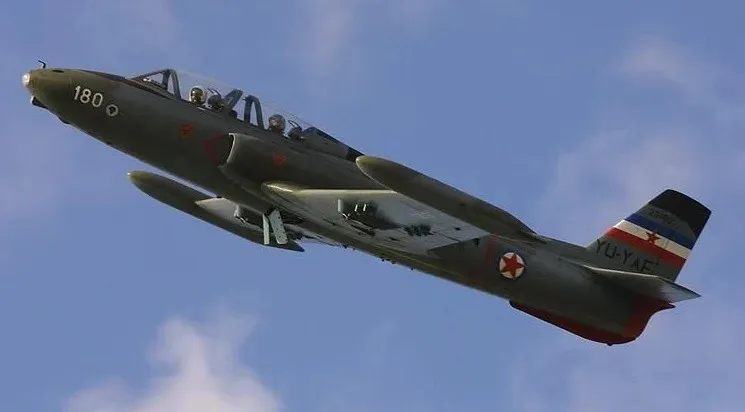
G-2 Galeb aircraft
The Galeb combat trainer, first publicly unveiled at the Paris Air Show in 1963, was a highly successful aircraft despite its low cost. The main components, with the exception of the turbojet engine, were developed and manufactured in Yugoslavia. The British Rolls-Royce Viper 11 Mk 22-6 engine, with a maximum thrust of 1134 kgf, was produced under license.
The aircraft, with a maximum takeoff weight of 4300 kg, could reach a speed of 812 km/h at an altitude of 5800 m. Cruising speed was 730 km/h. Service ceiling was 12,000 m. The operational range was 1240 km. The Galeb could remain airborne for 2,5 hours. Four external pylons could carry pods with 12,7 mm machine guns, pods with 55-127 mm unguided rockets, and bombs weighing up to 100 kg.
Serial production of the G-2 Galeb began in 1965. By 1985, the SOKO factory had produced 248 aircraft, 130 of which served with the JNA Air Force. Aircraft of this type were exported to Libya, Tanzania, and Zambia.
After the outbreak of armed clashes, the remaining Galebs in Croatia began attacking Yugoslav army units. Several aircraft were shot down by anti-aircraft fire. artillery and MANPADS. These aircraft were subsequently used extensively during the civil war that broke out in the Socialist Federal Republic of Yugoslavia, carrying out airstrikes against ground targets. There were also instances of them attacking peacekeeping helicopters. NATO aircraft destroyed a significant number of Galebs on the ground, but the primary targets were aircraft that had reached the end of their service life and were being used as decoys.
In 1978, the G-4 Super Galeb, intended to replace the G-2 Galeb and boasting improved operational, flight, and combat characteristics, made its maiden flight. Serial production of the Super Galeb began in 1983.
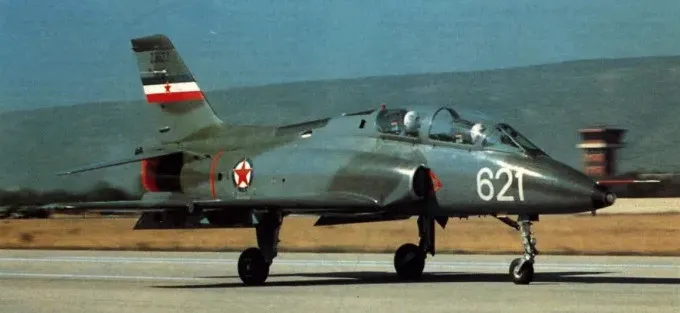
Aircraft G-4 Super Galeb
Compared to the G-2 Galeb, the maximum takeoff weight of the G-4 Super Galeb increased by 2 tons, reaching 6300 kg. The single-flight, non-uprated Rolls-Royce Viper 632-46 engine, producing a maximum thrust of 1800 kgf, was capable of reaching speeds of up to 920 km/h. Cruising speed was 840 km/h. The ferry range was up to 2400 km. The combat radius with a GSh-23L cannon in a pod and four unguided rocket pods reached 300 km. The total combat load on five pods, consisting of bombs, napalm tanks, unguided rockets, and pods with machine gun and cannon armament, was 1280 kg. Bombs weighing up to 250 kg could be suspended on external pods. Provision was also made for installing a reconnaissance pod with cameras and an infrared scanner.
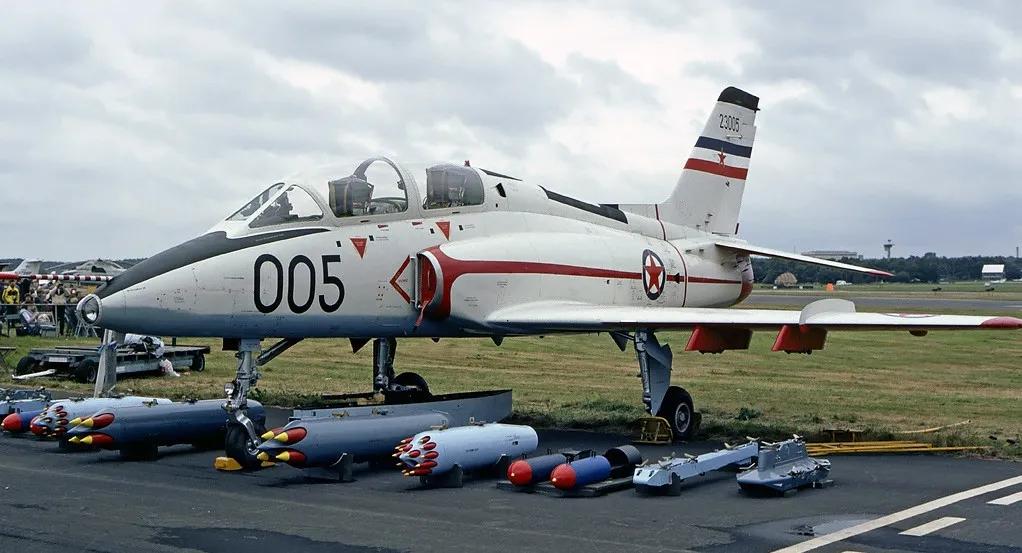
Armament of the G-4 Super Galeb aircraft when used in the attack version
According to a number of aviation experts and highly qualified pilots who have flown these aircraft, the Super Galeb is one of the best trainers designed for advanced training. This aircraft can also be successfully used as a ground attack aircraft and, thanks to its high maneuverability, can engage in defensive close-quarters dogfights with fighters. Due to its superior performance, the Super Galeb was even considered for use as a carrier-based trainer by the US Naval Aviation, but lost out to the British BAe Hawk, which was adopted by the US Navy under the designation T-45 Goshawk. The Yugoslav aerobatic team “Flying Stars” flew Super Galebs until 1999.
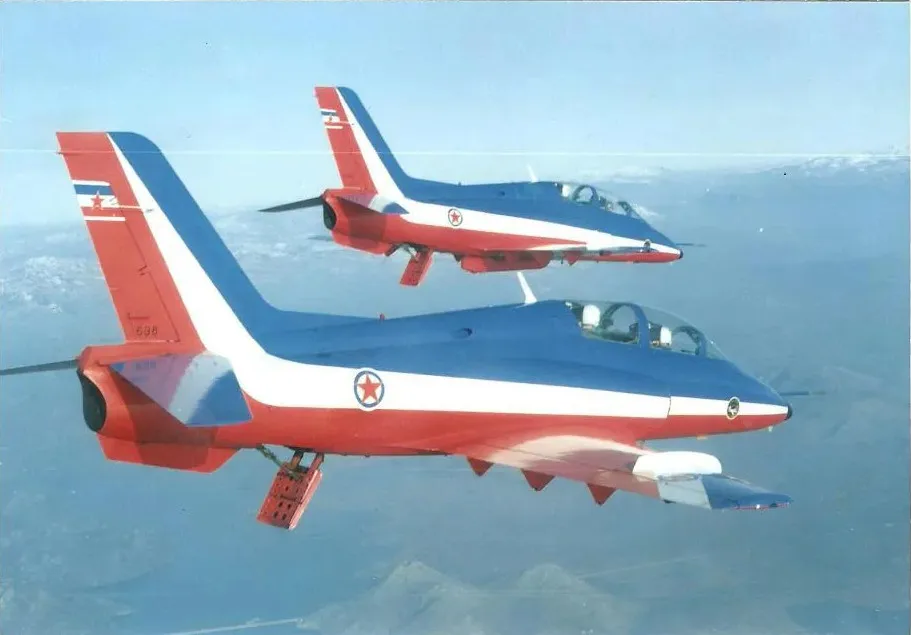
But, despite all its advantages, due to foreign policy reasons and high competition on the global arms market, the G-4 Super Galeb did not gain widespread popularity, and before the SOKO plant in Mostar ceased operations in 1991, only a little over 130 aircraft were built.
In the late 1980s, a modernized version with improved avionics and R-60 guided missiles was slated for production. However, the country’s disintegration prevented this. The only foreign buyer of six Super Galebs in 1991 was Myanmar, where they were used as ground-attack aircraft to fight insurgents. The Myanmar Air Force currently operates three aircraft.
Yugoslav G-4s were also actively used in combat operations in Yugoslavia from mid-1991 onward. In July 1991, they attacked Slovenian forces blockading roads, and in 1992, they carried out strikes against Croatians in Bosnia and Herzegovina. They carried out over 200 combat sorties, shooting down four aircraft with anti-aircraft fire and MANPADS. The Super Galebs did not participate in repelling NATO aggression; 23 aircraft (including those of the Flying Stars aerobatic team) were lost in the bombing raids.
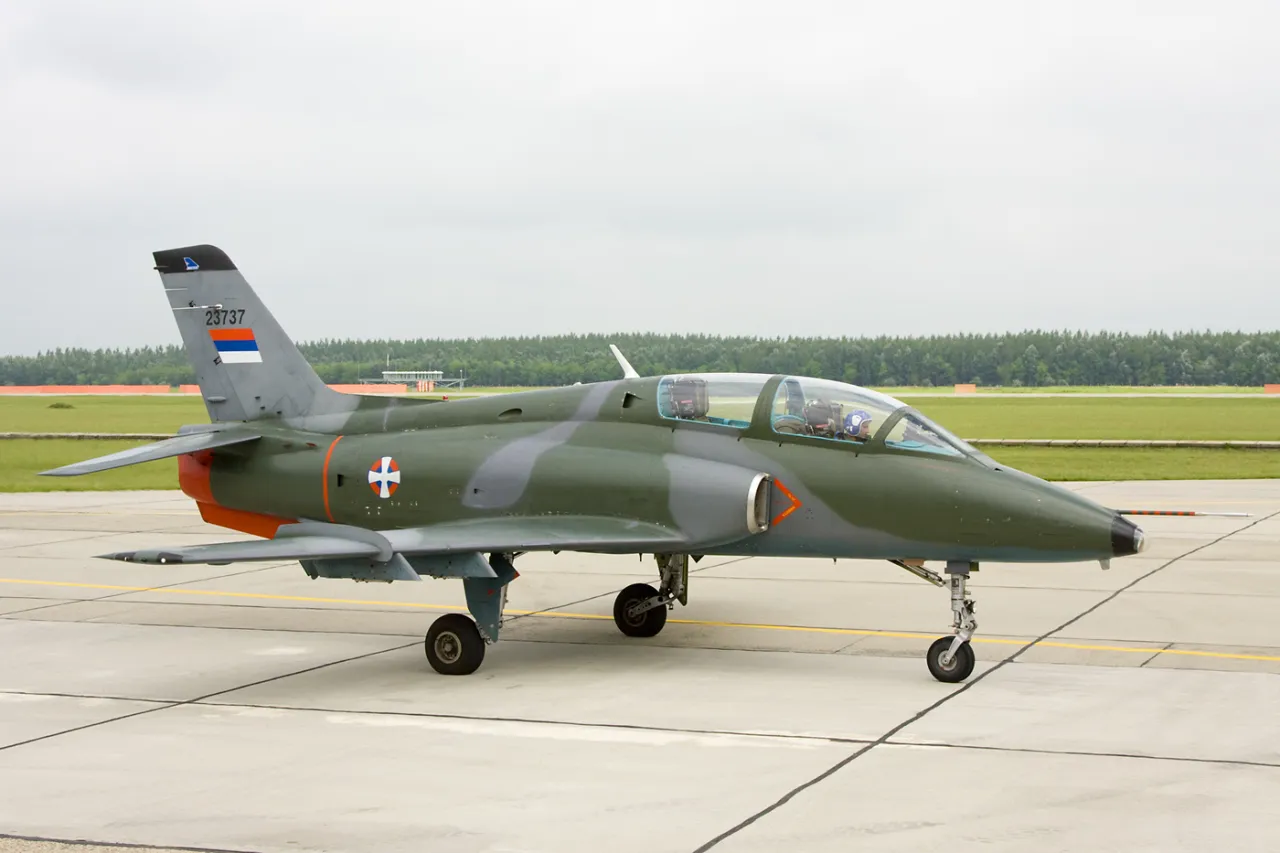
A G-4 Super Galeb aircraft of the Serbian Air Force
After the collapse of Yugoslavia, Super Galebs remained in service in Croatia (two aircraft), Montenegro (three aircraft), and Slovenia (one aircraft). The Serbian Air Force had 19 aircraft of this type in 2025. It is planned that some of the aircraft, which have a significant service life, will be overhauled and equipped with new digital avionics, which will extend their service life until 2035.
J-21 Jastreb attack aircraft
In the early 1960s, the Yugoslav Air Force command issued the Belgrade Aviation Institute a specification for the development of a strike aircraft to replace the American Republic F-84G Thunderjet fighter-bombers in service. The requirement was that the domestically produced aircraft would have significantly lower operating costs than the Thunderjet and be able to operate from unpaved airfields. A reduction in maximum flight speed at high altitude was permitted as a tradeoff for improved takeoff and landing performance.
When designing the new attack aircraft, Yugoslav engineers utilized the know-how gained in the design of the G-2 Galeb combat trainer. Compared to the Galeb, the specialized attack aircraft features a reinforced wing structure in the area where the weapons hardpoints are attached, and it is also equipped with a more powerful turbojet engine. The maiden flight of the Yugoslav fighter-bomber prototype took place on July 19, 1965, and the J-21 Jastreb entered service in December 1968.
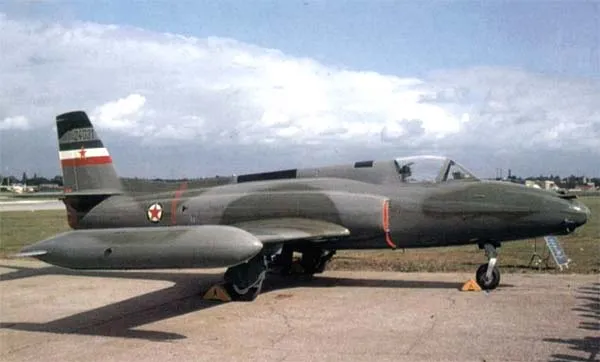
J-21 Jastreb attack aircraft of the Yugoslav Air Force
The aircraft was powered by a British Rolls-Royce Viper Mk.531 turbojet engine with a thrust of 1415 kgf, providing a maximum speed of 820 km/h (510 mph) at an altitude of 6200 m (20,500 ft). Its cruising speed was 740 km/h (450 mph). The aircraft, with a maximum takeoff weight of 5100 kg (11,100 lb), had a practical range of 1510 km (930 mi). A straight wing with a span of 10,56 m (33.5 ft) and reinforced landing gear provided excellent takeoff and landing performance. A 600 m (2,000 ft) unpaved runway was sufficient for takeoff and landing. When using solid-fuel boosters, the takeoff run with a full combat load did not exceed 400 m (1,300 ft). The aircraft’s built-in armament consisted of three 12,7 mm (0.50 in) M3 machine guns with 135 rounds per gun. Eight hardpoints could accommodate additional pods with 12,7mm machine guns, pods with 55-127mm unguided rockets, 100-250 kg aerial bombs, and incendiary tanks, totaling up to 1250 kg. However, the combat load, while maintaining optimal combat radius, did not exceed 800 kg.
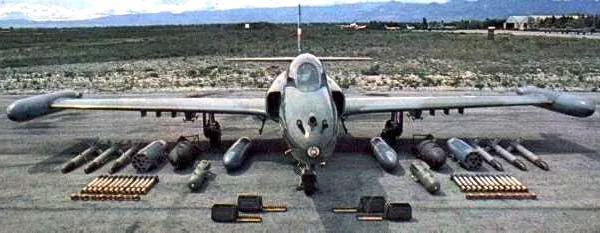
In addition to the single-seat combat aircraft, which were produced in the amount of 119 copies, 18 two-seat NJ-21 combat trainers and 38 IJ-21 reconnaissance aircraft were built, which had cameras installed in the nose instead of machine guns.
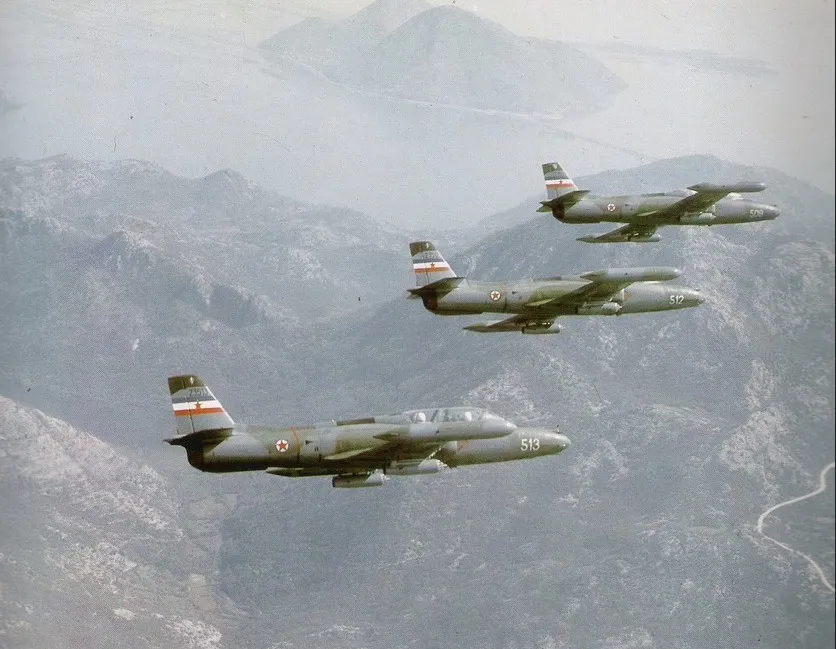
Aircraft intended for export to Libya and Zambia were designated J-1E (47 units were produced). The Hawks were built for foreign customers until 1985.
Like other Yugoslav Air Force combat aircraft, J-21 attack aircraft took part in armed clashes that accompanied the country’s disintegration. The so-called “Banja Luka incident” gained widespread notoriety when, on February 28, 1994, a pair of American F-16C fighters attacked six J-21 Jastrebs and two J-22 Oraos returning from a strike on an ammunition factory in Bugojno and an arms factory in Novi Travnik. Four of the six Jastrebs were shot down.
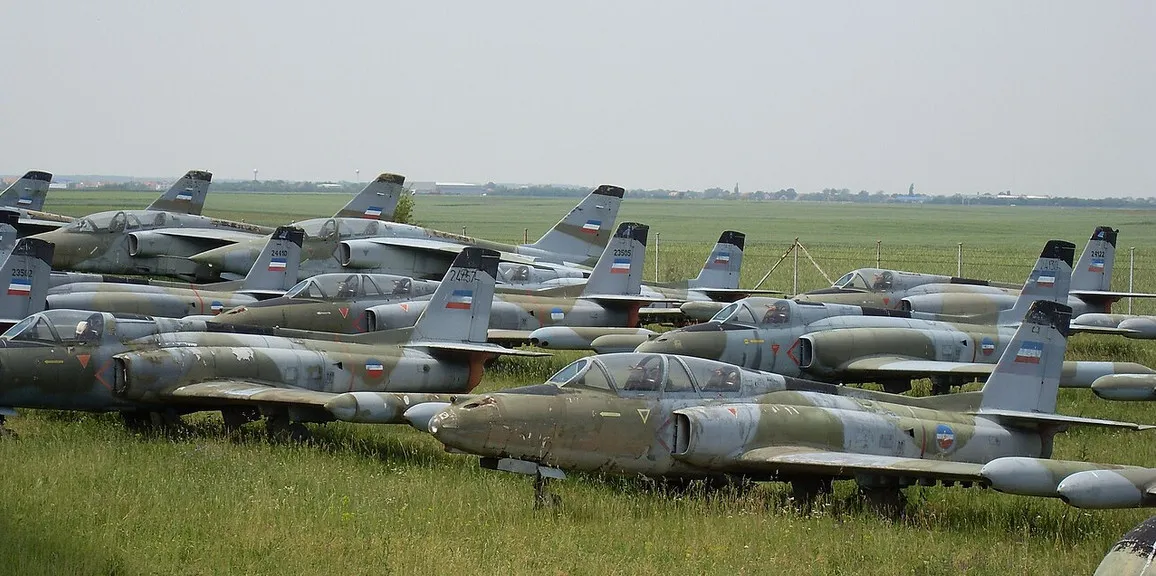
Yugoslav single-seat J-21 and two-seat NJ-21 aircraft decommissioned
Following the signing of the Dayton Agreement in 1995 and the formal end of the conflict, the Federal Republic of Yugoslavia decommissioned and placed into storage all sixty-six operational Jasper-2s, and there are currently no airworthy aircraft of the type remaining.
J-22 Orao fighter-bomber
The design and mass production of modern combat aircraft is a very expensive undertaking, so in the late 1960s, the governments of Yugoslavia and Romania began exploring the possibility of developing their own multirole combat aircraft. This was partly motivated by a desire to secure defense independence from the USSR and to develop their own aviation industries.
After the tactical and technical requirements and design were developed by specialists from the Belgrade Aviation Institute and the Romanian National Institute of Science and Technology, the project entered the implementation phase in 1972. Prototypes were assembled at factories in Mostar and Craiova. The Yugoslav and Romanian aircraft shared the same fuselage, engines, main components, and ejection seat, but their avionics and armament differed.
To ensure greater flight safety and combat survivability, the J-22 Orao was equipped with two Rolls-Royce Viper Mk 632-47 afterburning engines. Each engine produced 1815 kgf of thrust at takeoff and up to 2279 kgf with afterburner. The Yugoslav variant had a maximum takeoff weight of 11,080 kg. Its operational range is 1320 km. Its combat radius is up to 530 km. Its service ceiling is 12,000 m. Its maximum speed at high altitude is 1160 km/h. Its cruising speed is 755 km/h. During testing, turbofan-powered aircraft repeatedly reached supersonic speeds, but for safety reasons, exceeding the speed of sound was prohibited on operational aircraft, and afterburner was primarily used to shorten the takeoff run.
The Yugoslav prototype’s maiden flight took place in 1974. Serial production in the SFRY began in 1980. The first 35 single-seat and nine two-seat combat trainers were equipped with engines without afterburners.
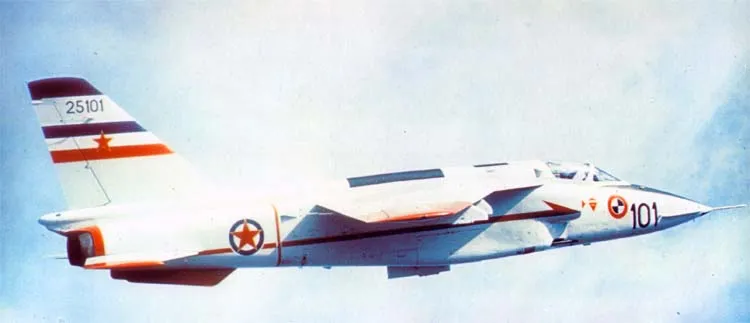
J-22 Orao fighter-bomber prototype
From 1983 to 1992, 57 single-seat J-22 and 21 two-seat NJ-22 turbofan aircraft were built using modern assembly technology.
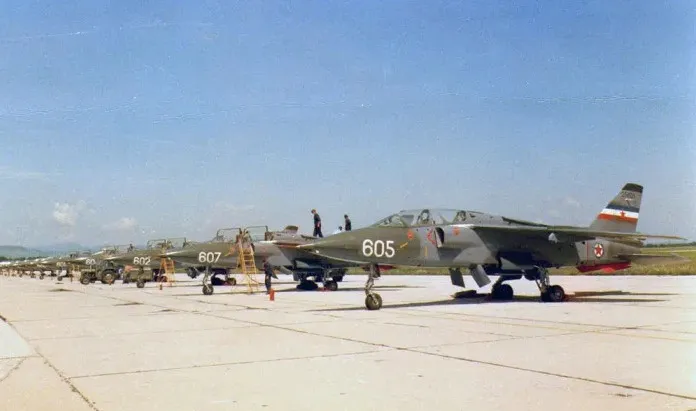
Yugoslav two-seat combat trainer aircraft NJ-22
The Orao fighter-bomber is armed with an integrated 23mm GSh-23L cannon with 200 rounds of ammunition. Five external pylons can carry a 2800 kg payload. In addition to free-fall bombs weighing up to 500 kg and unguided rocket pods, the aircraft’s armament includes AGM-65B Maverick air-to-surface missiles with television guidance.
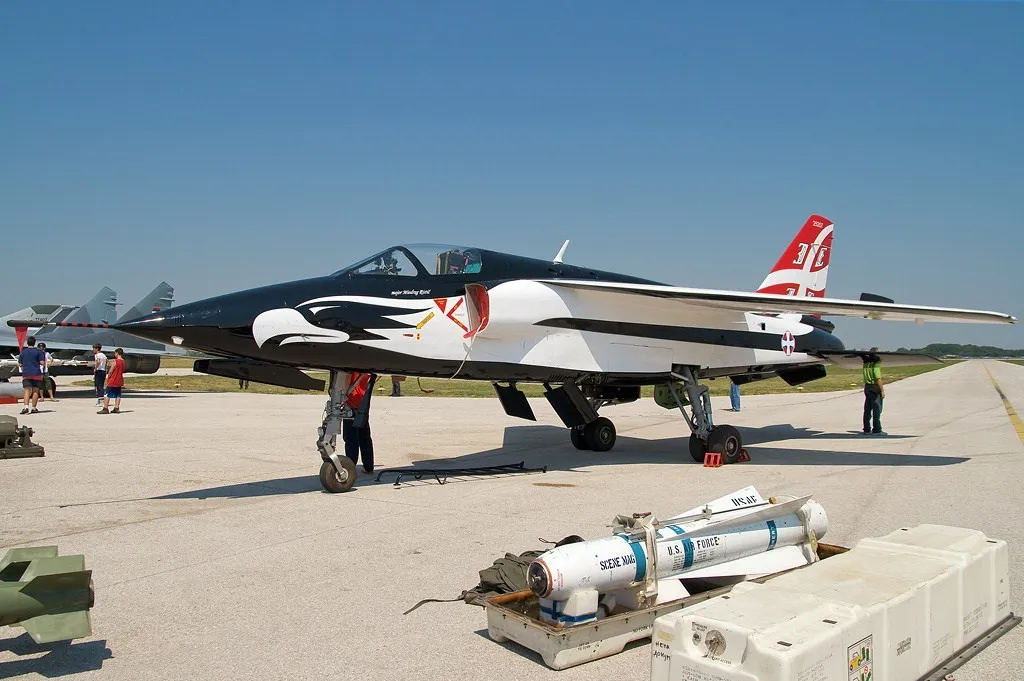
R-60 close-combat missiles could be used against air targets, and after the start of MiG-29 deliveries, the upgraded Oraos received R-73 missiles.
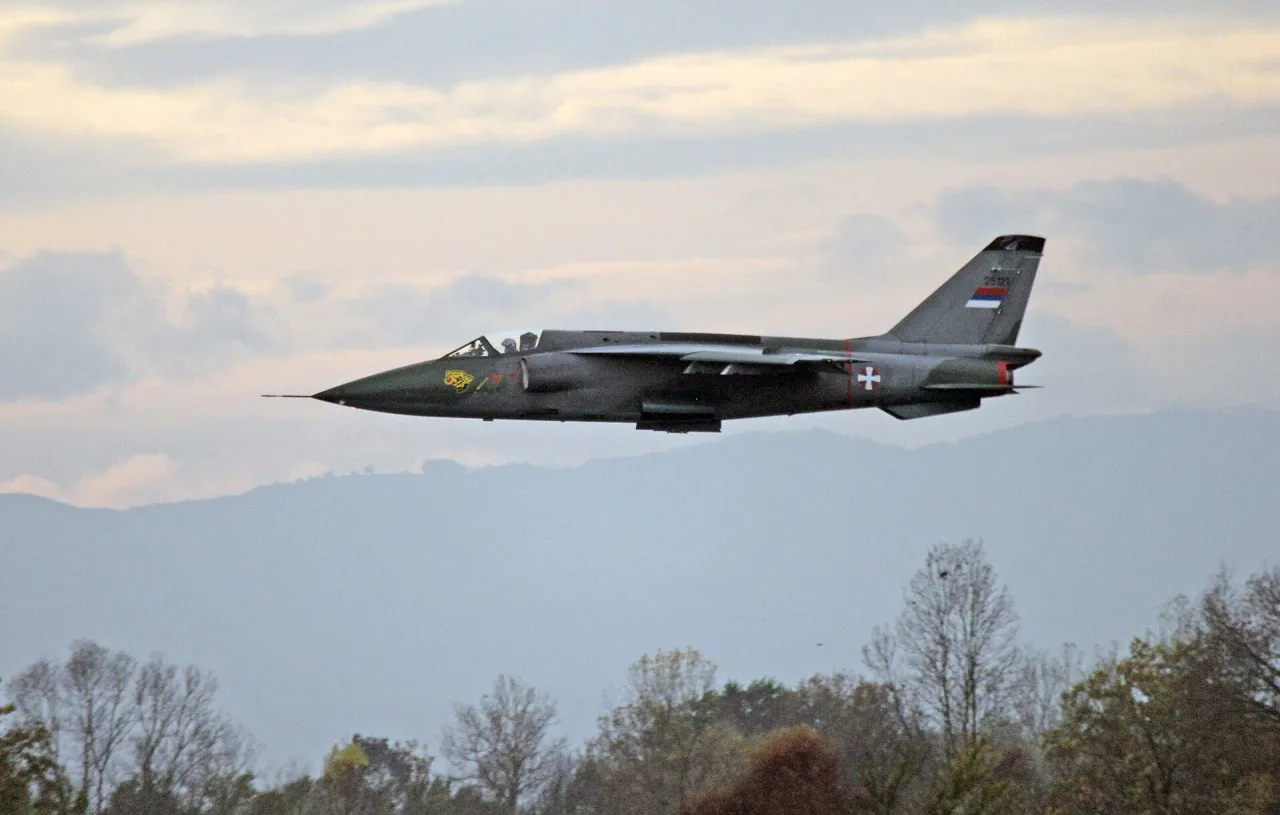
J-22 fighter-bombers played an active role in the civil war that erupted in Yugoslavia in the 1990s. Given that the Oraos were equipped with flare dispensers, Strela-2M MANPADS proved ineffective against them, and losses to anti-aircraft artillery were small (no more than three). Several aircraft were destroyed in NATO bombing raids in 1999.
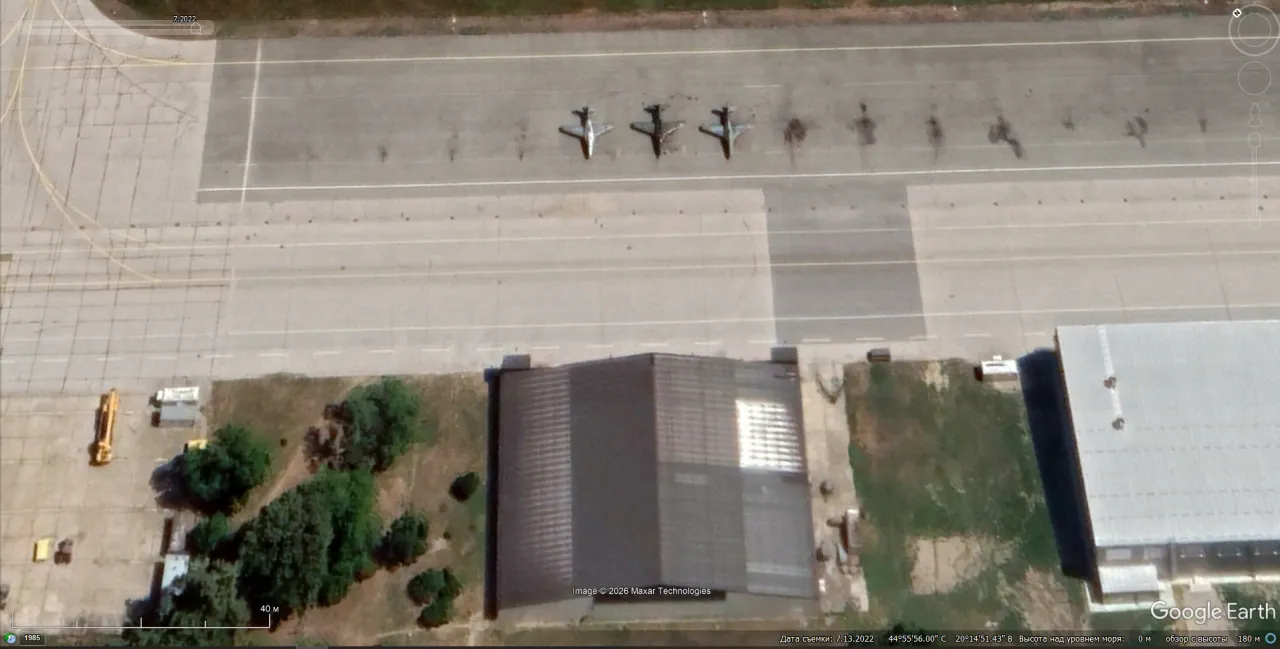
Google Earth satellite image of J-22 Orao fighter-bombers and a MiG-29 fighter jet at Batajnica Air Base near Belgrade. The image was taken in July 2022.
The Serbian Air Force currently operates 12 single- and two-seat Oraos. Given their age and technical condition, these aircraft could still be in service for approximately five more years.
MiG-29 fighters
By the mid-1980s, the core of the Yugoslav Air Force’s fighter fleet consisted of Soviet MiG-21 aircraft of various modifications, the most modern of which was the MiG-21bis. The Air Force and Air Defense Command considered various options for updating the fighter fleet. Among the leading candidates for a new fighter capable of competing for air superiority and intercepting aircraft at night and in adverse weather conditions were the French Dassault Mirage 2000, the American Northrop F-20 Tigershark, and the Soviet MiG-29. The final choice was made in favor of the Soviet aircraft. Yugoslavia received its first MiG-29 fighters in December 1987. A total of 14 single-seat MiG-29B (modification 9.12B) and two MiG-29UB (modification 9.51) were delivered to the customer within a year. As a result, the SFRY became the first European country outside the Warsaw Pact to receive MiG-29s. All of them were assigned to the 127th Squadron of the 204th Fighter Aviation Regiment, stationed at Batajnica Air Base north of Belgrade.
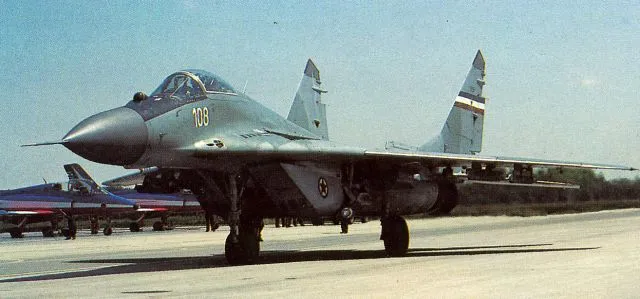
MiG-29B fighter of the Yugoslav Air Force
The MiG-29B fighter was an export version, supplied to countries outside the USSR’s closest allies. This variant featured a simplified weapons control system and lacked the “Parol” (Parol) IFF system. According to Western data, each MiG-29B cost the Socialist Federal Republic of Yugoslavia $15 million.
The fighter jet, with a maximum takeoff weight of 18,480 kg, could remain airborne for over two hours and reach a speed of 2,450 km/h at high altitude. This was sufficient to control the airspace of a country like Yugoslavia. Its maximum ground speed was 1500 km/h. Its ceiling was 18,000 km. Its ferry range with external fuel tanks was 2900 km.
In close-quarters air combat in the 1980s and 1990s, the MiG-29, thanks to its high maneuverability and thrust-to-weight ratio, had an advantage over all NATO fighters. Furthermore, the Fulcrum was equipped with a fairly sophisticated avionics suite for its time and carried six R-60MK and R-73 close-in missiles with a launch range of 10–30 km. Its integrated armament consisted of a 30mm GSh-301 cannon. For engagements with airborne opponents beyond line-of-sight, the payload could include two R-27R medium-range missiles with a semi-active radar seeker, capable of engaging aerial targets at ranges of up to 60 km, which, in turn, allowed it to intercept frontline and strategic bombers at long ranges from defended facilities. The N019E radar, installed on the export MiG-29B fighter, was capable of detecting a fighter-type target flying on a collision course at a range of up to 70 km. The optical location system, in good visibility conditions, detected targets in the infrared range at a range of up to 15 km. Target information was displayed on the windshield.
The MiG-29A, powered by two RD-33 turbofan engines each producing up to 8300 kgf of afterburning thrust, offered advantages over the MiG-21bis, including improved flight safety, an increased combat radius (approximately 700 km), more sophisticated avionics, and the addition of medium-range air-to-air missiles. A payload of up to 3000 kg was carried on six underwing pylons.
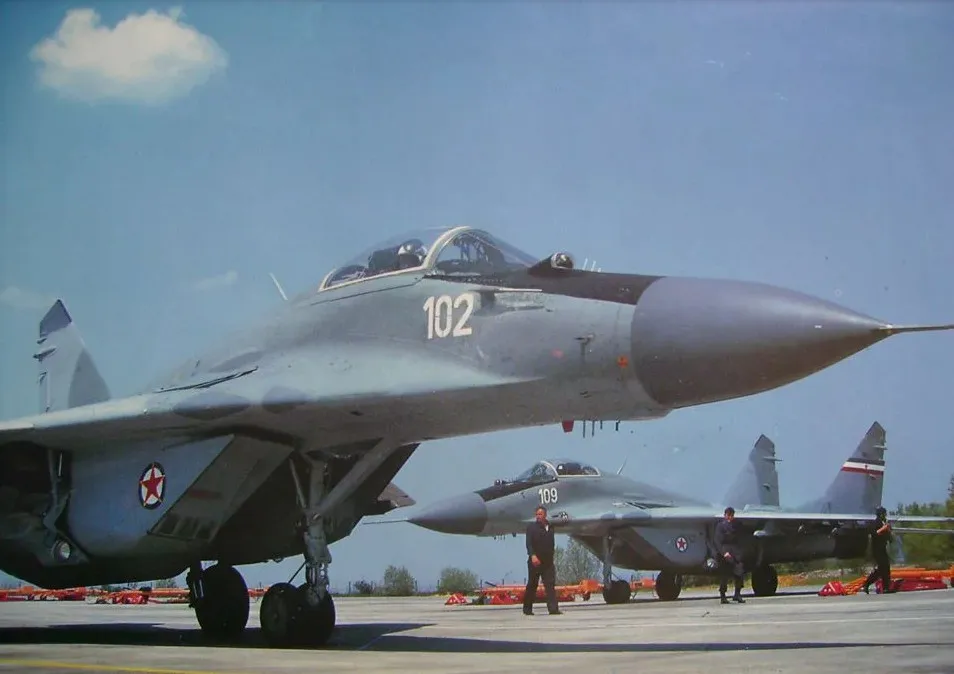
The relatively small number of MiG-29 fighters purchased by Yugoslavia is explained by the fact that they were considered a stopgap solution, intended to replace the aging and decommissioned MiG-21s. Since the mid-1980s, the Belgrade Aviation Institute, in collaboration with the French company Dassault, had been developing its own fourth-generation fighter, which was planned to use Western avionics, weapons, and a Snecma M88 afterburning turbofan engine. Externally, the Yugoslav Novi Avion was designed to resemble the French Dassault Rafale.
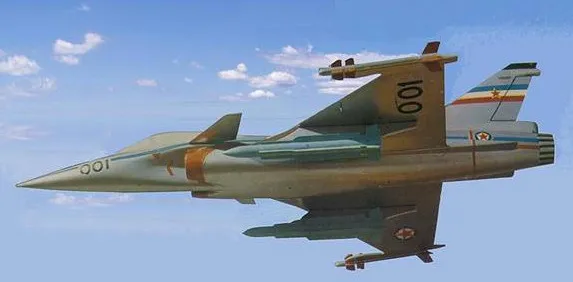
Conceptual rendering of the Yugoslav 4th-generation fighter jet Novi Avion
The fighter, with a maximum takeoff weight of approximately 13500 kg, was expected to have a range of up to 3700 km and a ceiling of 17,000 m. Its maximum speed at high altitude was 2000 km/h. Its internal armament was to consist of a single 30 mm cannon, and its external armament would be carried on eleven hardpoints. However, the collapse of federal Yugoslavia prevented the construction of a prototype at the Soko plant, and all work on the Novi Avion fighter ceased in 1992.
In the summer of 1991, when armed clashes between local nationalists and the federal army erupted in Slovenia, the participation of MiG-29 fighters was limited to air patrols in border areas. However, from 1992 to 1995, MiG-29 pilots actively participated in combat in Croatia and Bosnia and Herzegovina, attacking dozens of ground targets. Although the aircraft were actively targeted by anti-aircraft guns and MANPADS crews, no losses were incurred. After the legal dissolution of Yugoslavia, the aircraft were incorporated into the Air Forces of Serbia and Montenegro. By that time, the MiG-29’s technical availability was low due to a lack of spare parts, and the pilots’ annual flight time in 1998 did not exceed 20 hours.
By March 1999, no more than eight fighters were airworthy, dispersed across various airfields. Attempts by Yugoslav MiG-29 pilots to resist the enemy, who had air superiority, were unsuccessful. The situation was exacerbated by numerous failures of the MiGs’ avionics. As a result, between March 24 and May 4, 1999, six aircraft were lost in the air, and another was damaged. Four more aircraft (including a two-seater MiG-29UB) were destroyed on the ground, and one aircraft crashed during a test flight.
After the completion of the NATO air campaign, four MiG-29Bs and one MiG-29UB were reinstated. Due to their poor technical condition, they rarely flew. About 20 years ago, Belgrade reached an agreement with Moscow to have these aircraft repaired in Russia. Ideally, modernization was required along with the refurbishment, but due to the customer’s lack of financial resources, this was not accomplished. Following a major overhaul, Serbia’s MiG-29s were incorporated into the newly formed 204th Aviation Brigade, based in Batajnica. The first fighter returned from Russia in December 2007, and the last in mid-2008. One MiG-29B crashed in 2009, leaving Serbia with only three MiG-29Bs and one MiG-29UB.
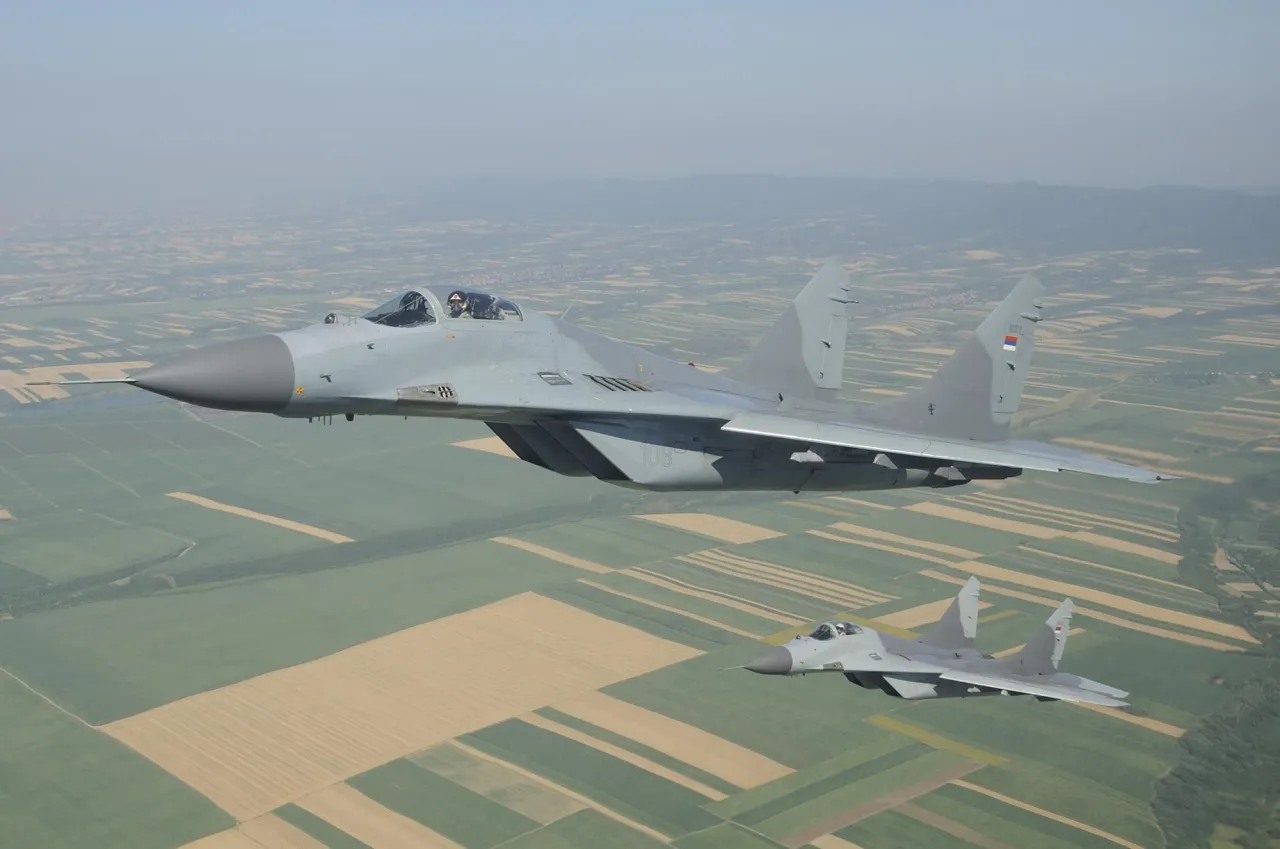
MiG-29 fighters of the Serbian Air Force
In 2024, the Serbian Air Force operated fifteen MiG-29s. The fighter fleet was expanded thanks to donations from Russia and Belarus (a total of ten MiG-29As and MiG-29Ss), delivered between 2017 and 2021. Another MiG-29B was purchased from Hungary in 2024.
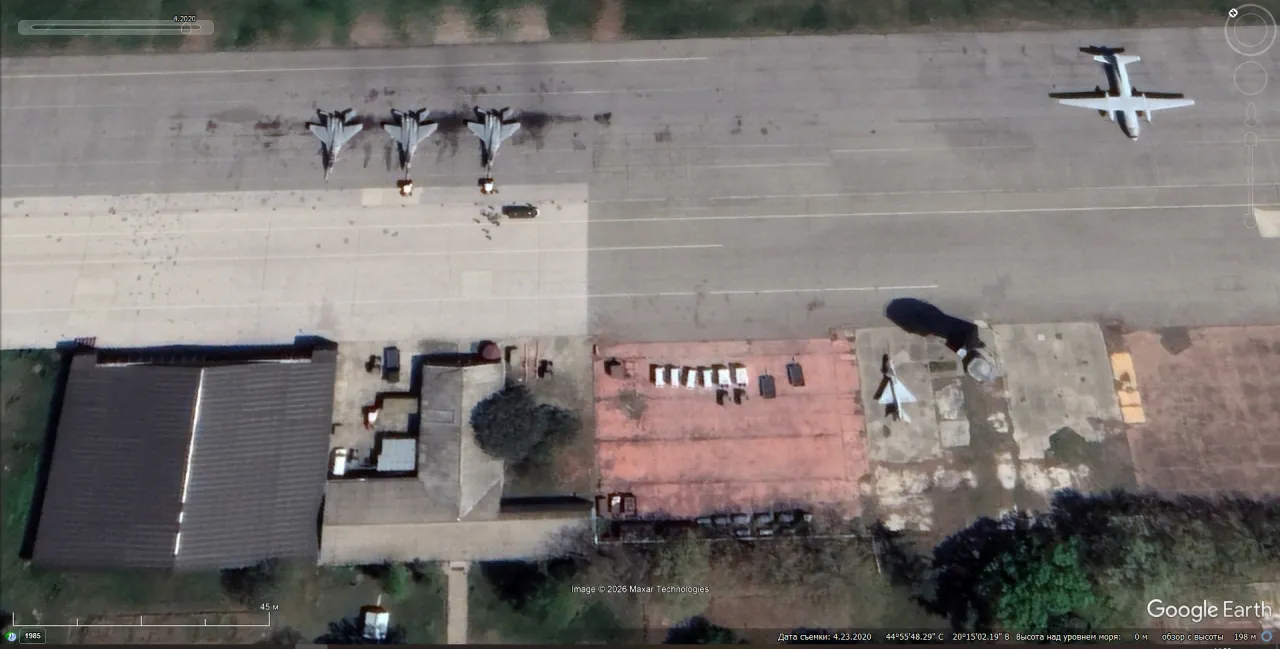
Google Earth satellite image of MiG-29 and MiG-21 fighter jets, as well as an An-26 military transport aircraft, at the Batajnica Air Base. The image was taken in April 2020.
According to current reference data, 11 MiG-29S fighters remain in service as of 2026. The remaining aircraft, which are not in flight condition, are used as spare parts donors.
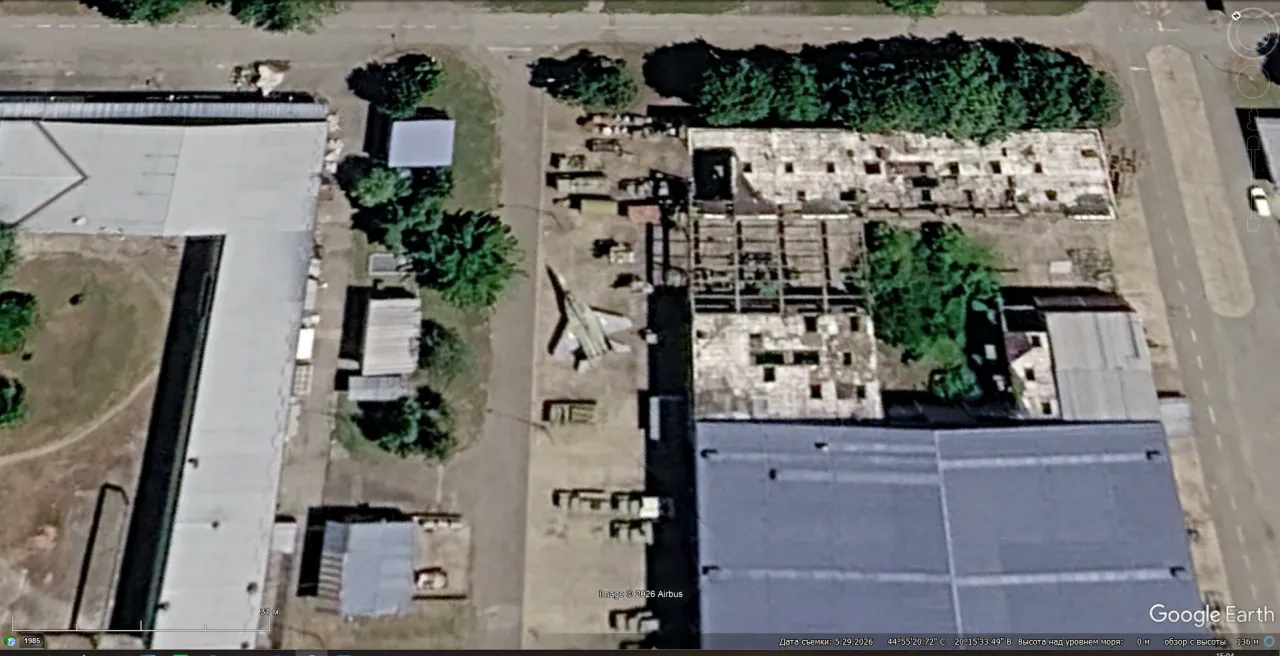
A Google Earth satellite image of a MiG-29 fighter jet near a maintenance hangar at the Batajnica Air Base. The image was taken in May 2026.
Judging by recent satellite images, Serbian MiG-29s rarely take to the air, are in the final stages of their life cycle, and are expected to be decommissioned in the near future.
In 2024, Serbia ordered ten single-seat and two two-seat Dassault Rafale fighter jets (F4 version) from France for €2,7 billion. Serbian pilots and ground support personnel are currently undergoing training in France. The contract is expected to be completed in 2029.
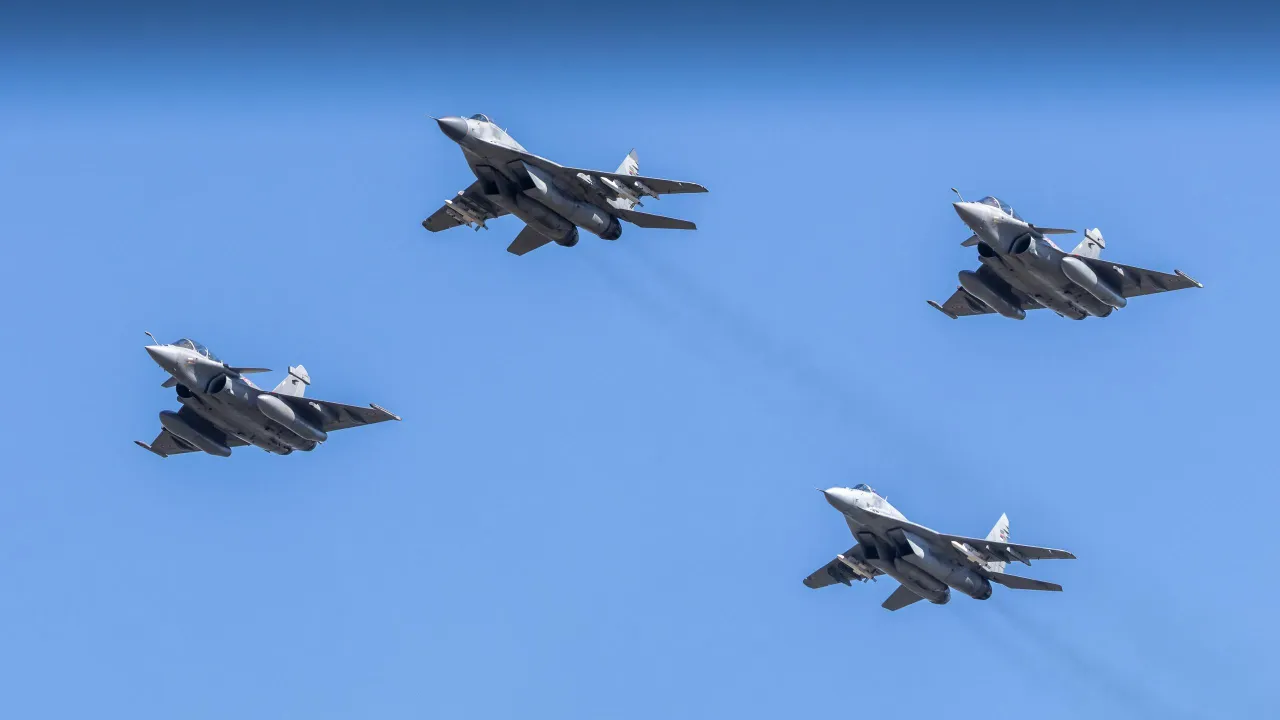
Serbian MiG-29s and French Dassault Rafales in formation over Belgrade.
Military observers note increased defense cooperation between Serbia and NATO countries in general, and with France in particular. For example, during a military parade over Belgrade in September 2025, Serbian MiGs and French Rafales flew in formation.