






Continued. Part one: The Origins of the Soviet Tilt-Wing: From the Bell X-5 to the Su-7IG
The MiG-23 and Su-24 addressed fundamentally different challenges. But both emerged after their design bureaus encountered the similar engineering costs of a different solution.
By the mid-1960s, the Soviet frontline aviation faced a problem with no obvious answer. A fixed swept wing worked well at supersonic speeds, but it required long runways. In real-world conditions, dispersed across unpaved and damaged airfields, this became a serious limitation. Given the requirements of the 1960s, a fixed wing forced an unacceptable compromise between short takeoff and speed.
Several solutions were proposed. One was lift engines: separate engines in the fuselage that generated vertical thrust during takeoff and landing. Another was variable sweep: reducing the wing’s sweep angle during takeoff and landing and increasing it during cruise. Both design bureaus tried the former, and both found the cost higher than it appeared on paper.
“23-01” and “23-11”: an experimental fork of the Mikoyan Design Bureau
The prototype, “23-01,” was built using a seemingly logical design: a fixed wing, a single cruise engine, and two RD-36-35 lift engines in the fuselage for short takeoff and landing (STOL). At the time, TsAGI was actively researching the potential of vertical takeoff and landing (VTOL) for combat aircraft; interest in VTOL aircraft wasn’t limited to the Soviet Union—the Hawker Siddeley Kestrel, the Harrier’s predecessor, was already flying in Great Britain. The Harrier, however, used a fundamentally different architecture: a single cruise and lift engine with rotating nozzles, rather than separate lift engines.
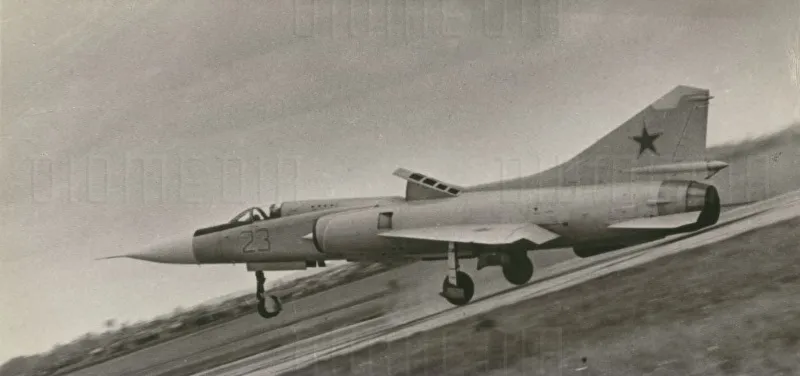
The Soviet experimental short takeoff and landing fighter MiG-23PD (also known as the “23-01” or the NATO reporting name Faithless)
The engineering challenge of separate lift engines proved the same regardless of the design bureau: they took up fuselage space, required air intakes, fuel, and structural weight, and provided no useful benefit beyond takeoff. In level flight, they were dead weight. Further shortening the takeoff run required increasing the lift thrust, which led to increased weight and complexity—in a mode where neither was needed.
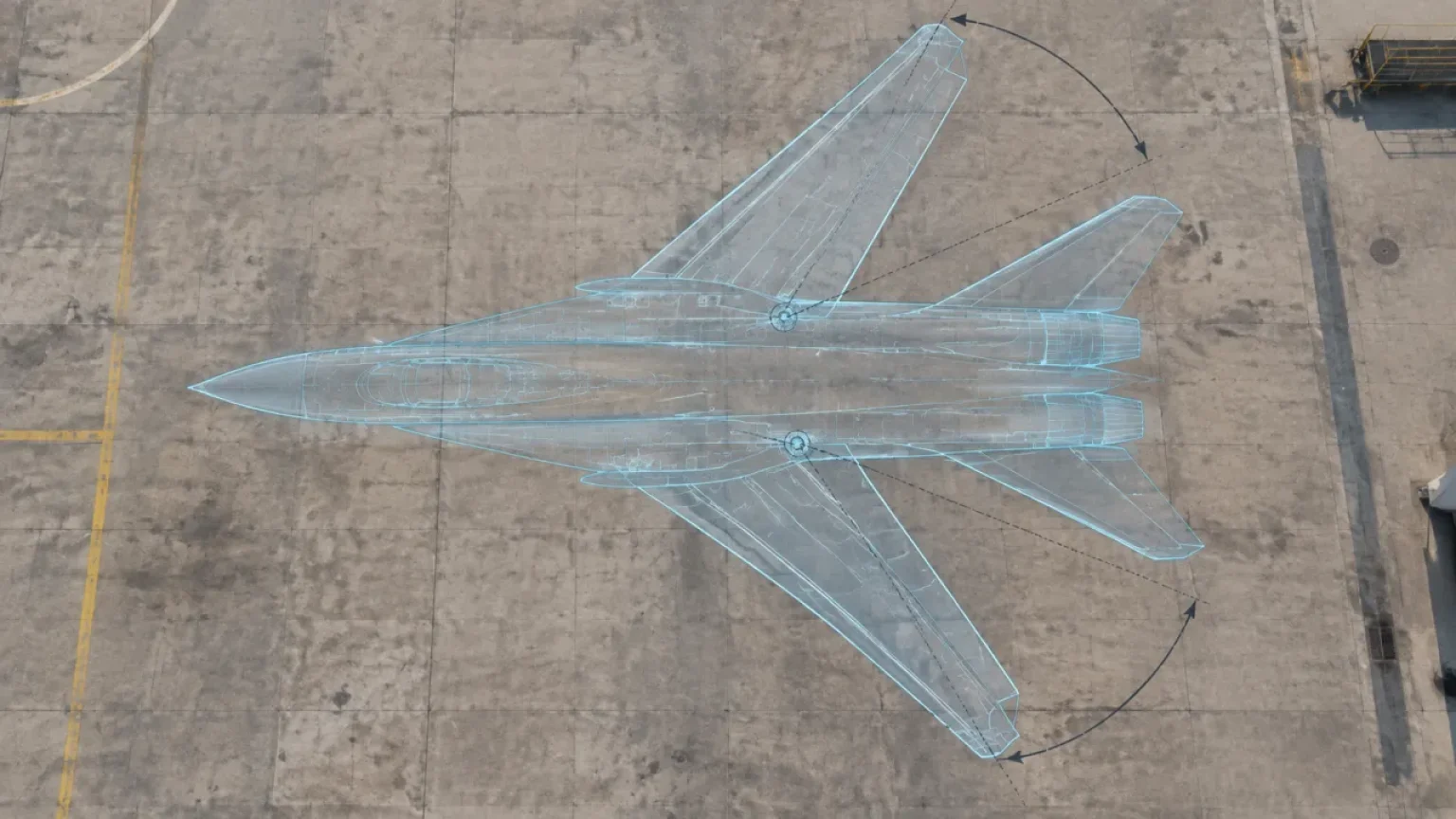
At the Mikoyan Design Bureau, the “23-01” and the alternative “23-11” with a tilt-wing design were developed in parallel; the variant with the KIS went into production. On June 10, 1967, the “23-11” took to the air. The wing could assume three positions: 16°, 45°, and 72° along the leading edge, depending on the flight mode. The crew made the choice; automatic sweep selection based on flight mode, similar to the F-14 system, was not available.
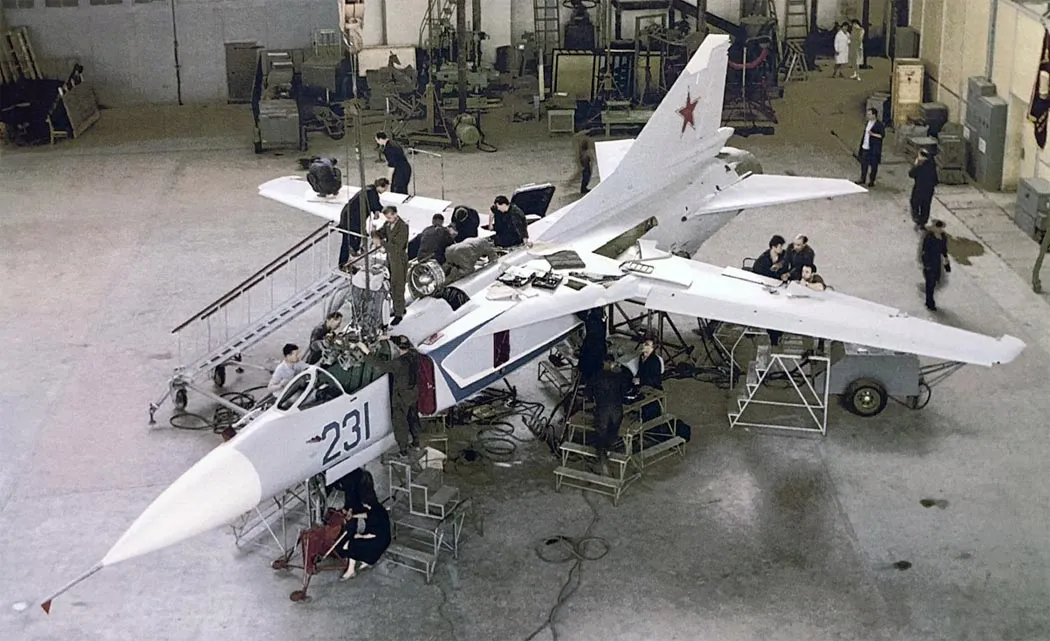
MiG-23 (factory code “product 23-11”) in the Mikoyan Design Bureau workshop)
This reflected a difference not only in technology but also in control approaches. The American F-14 carrier-based interceptor was designed around the same time: its sweep angle changed automatically—the control system automatically adjusted the wing geometry depending on speed and maneuverability. The MiG-23’s three stepped positions reflected a different principle: the pilot independently selected the mode for a specific task. The stepped system was less complex architecturally, although comparing the reliability of two fundamentally different approaches is incorrect—each had its own limitations.
On the MiG-23, the primary hardpoints were located under the fixed wing and fuselage sections; fixed pylons under the movable consoles were used for external fuel tanks only at a sweep angle of 16°. This is a design compromise faced by any combat system with external hardpoints: a pylon on a rotating console must either rotate synchronously with the console, or it limits the available sweep range.
The MiG-23 evolved into a family: fighter versions with different targeting systems and attack derivatives—the MiG-23B and MiG-27—with a redesigned nose and targeting equipment optimized for ground attack. The MiG-23B and MiG-27 retained the same three primary manual wing positions: 16°, 45°, and 72°.
T-6-1 and T-6-2I: Same Dead End, Different Task
The Sukhoi Design Bureau has a similar one story The task was different. What was needed was not a multi-mode fighter, but an all-weather frontline bomber: crew-on-crew, automated low-altitude penetration, operations in all weather conditions and from short airstrips.
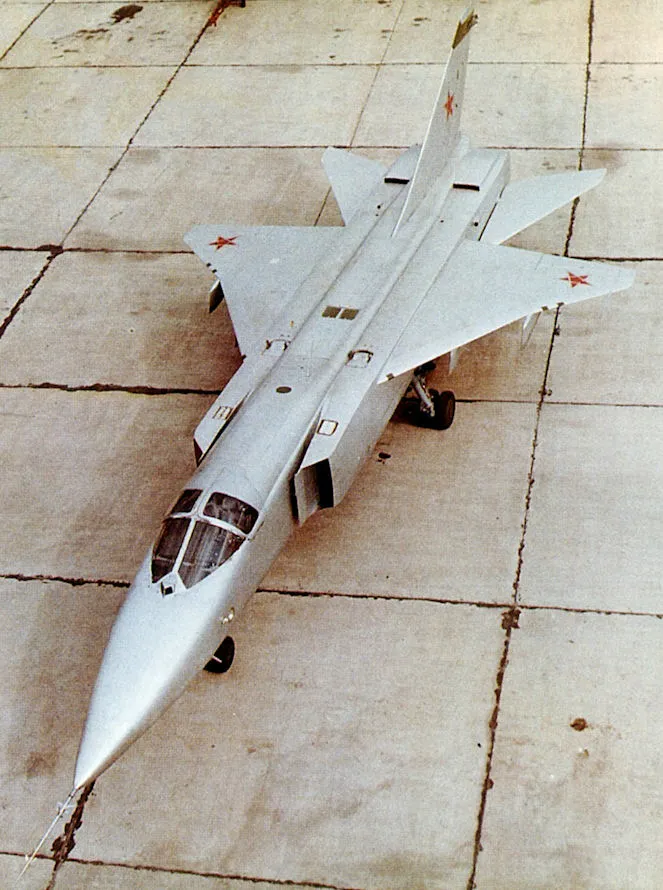
The first prototype of the Soviet experimental vertical/short takeoff and landing aircraft T-6-1 (the prototype of the Su-24 frontline bomber)
The first configuration, the T-6-1, included four RD-36-35 lift engines. The engineering logic was the same: to give the aircraft the ability to take off from damaged airfields while maintaining its speed in normal flight mode. And the impasse was the same: four lift engines took up space needed for equipment and fuel, and a strike aircraft with a comprehensive targeting and navigation system had little spare space.
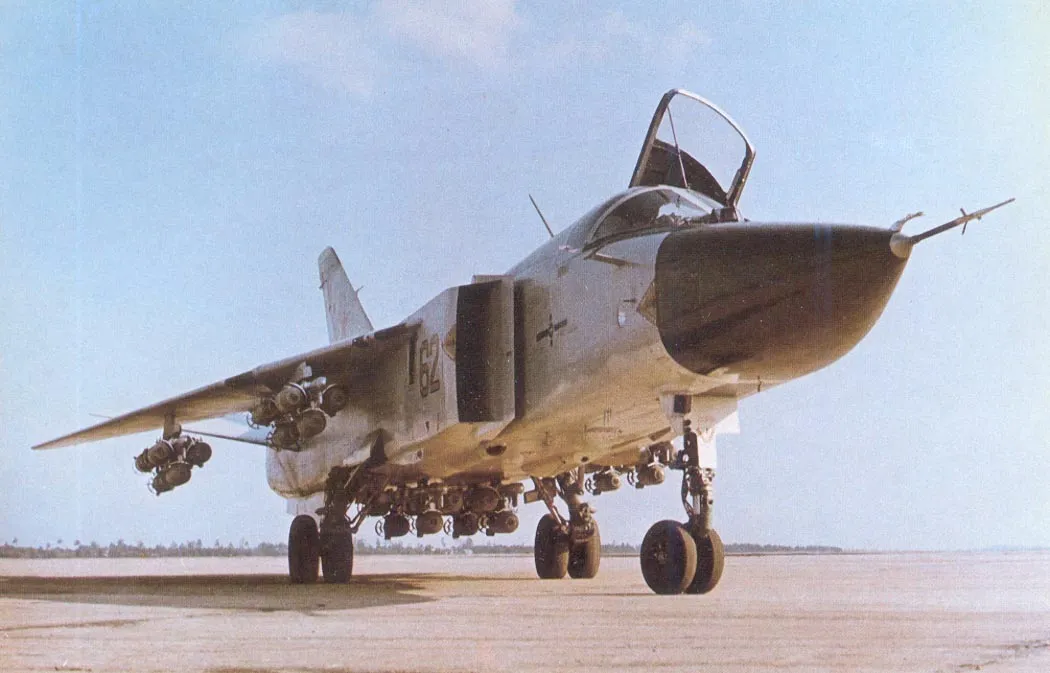
Su-24 (experimental version with variable-sweep wing T6-2I)
The transition to the T-6-2I wasn’t a “wing redesign”—it was a change in aerodynamic design. The lift engines disappeared; the aircraft received rotating consoles with four operational positions: 16°, 35°, 45°, and 69°. On January 17, 1970, the T-6-2I took to the air. On February 4, 1975, the Su-24 was accepted into service.
Functionally, the Su-24 was closest to the American F-111—it also had two engines, a crew-on-crew configuration, a control system, and automated low-altitude flight. But the similarities stemmed from identical physical limitations and a similar mission, not from copying.
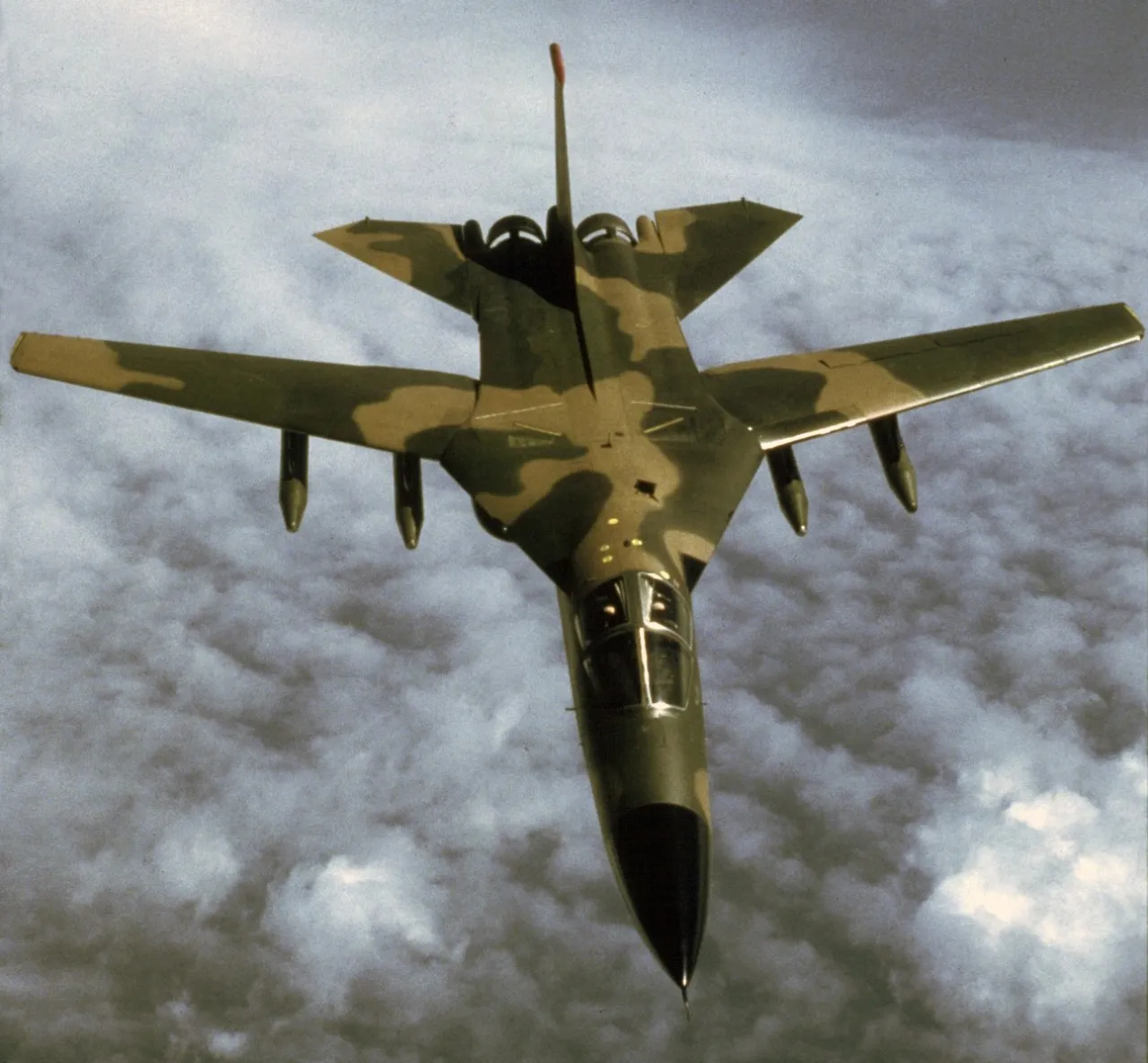
The General Dynamics F-111 Aardvark is an American long-range tactical bomber.
The Su-24’s low-altitude breakthrough mission was accomplished not by automatic sweep control, but by automated navigation and terrain tracking. The KIS provided the required operational envelope; the rest was handled by the navigation systems.
General lesson, different cars
The MiG-23 and Su-24 are not structurally related: TsAGI provided the scientific background for both projects, but this did not mean the transfer of the mechanism or layout from one design bureau to the other. The Mikoyan Design Bureau built a fighter with a radar and rockets Air-to-air; Sukhoi Design Bureau – strike bomber with a targeting and navigation system. Different missions, different design bureaus, different configurations.
The common thread wasn’t the mechanism, but the lesson. The lift engines didn’t lose out because the idea was bad: the Harrier proved the concept’s viability in a different architecture. The specific design with separate lift engines, whose cost in normal flight proved too high, lost out. The integrated control system isn’t free either: hinges, actuators, synchronization, and a reinforced center section all add up to weight and maintenance. But the rotating console continues to generate lift en route; the lift engine doesn’t in level flight.
The MiG-23 has been decommissioned in Russia. The Su-24 suffered significant losses during combat and is gradually being replaced by the Su-34; some aircraft remain in service. The type evolved from the experimental T-6-2I to operational service, retaining its aerodynamic configuration essentially unchanged throughout its career.
On heavy aircraft—the Tu-22M and Tu-160—the same tilt-wing design operates under fundamentally different conditions: different takeoff weights, different ranges, and a different ratio between the efficiency and cost of the airframe. Part three explains why this design has not only been retained but is also used on new and upgraded Tu-160M aircraft.