








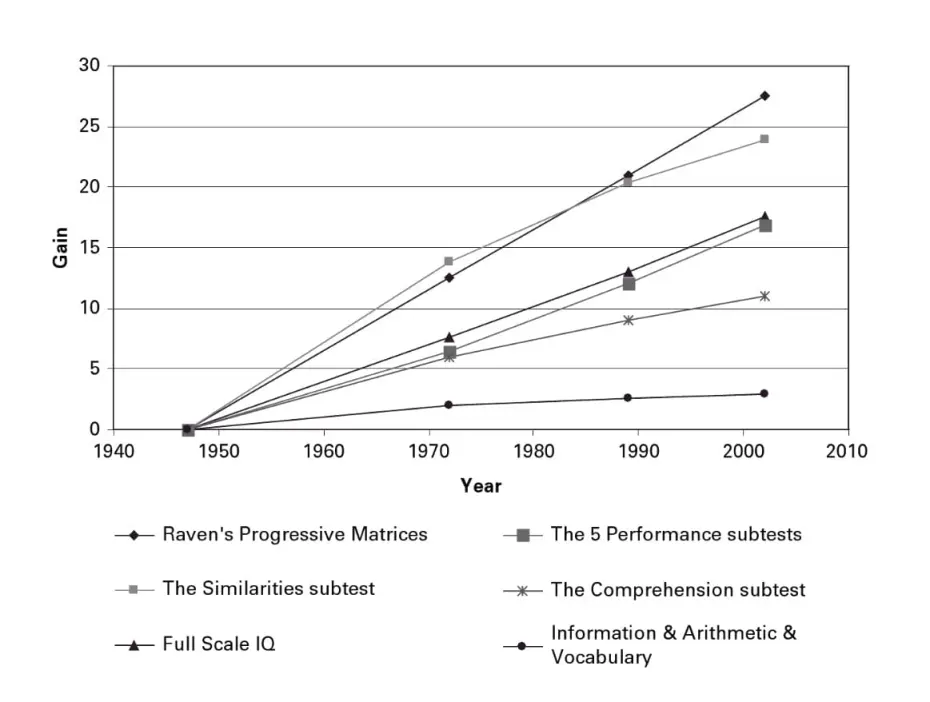
For more than a century, a quiet but profound global phenomenon was underway: humanity was getting smarter. Generation after generation, the average IQ score marched steadily upward—a documented trend known as the Flynn Effect. It was a testament to better nutrition, better schooling, and a world that increasingly demanded abstract, logical thought.
But today, that ascent has stopped. And in many developed nations, the climb has begun to reverse.

For decades, the standard gain was roughly 3 points every ten years. Now, recent data emerging from Scandinavia, the UK, and other parts of the world show that this cognitive escalator has stalled, and in some cases, is quietly heading back down. This isn’t just a statistical blip; it represents a major turning point in the trajectory of human intellect, forcing scientists and educators to ask a critical question: Are we reaching a natural, biological limit to our intelligence, or are the demands of the modern world beginning to subtly undermine our cognitive abilities?
This apparent stagnation in IQ is sparking fierce debate, challenging our assumptions about education, technology, and what it truly means to be intelligent in the 21st century.

The ‘Russian Bounties’ Hoax: The Fake News Story That Promoted Michael Schwirtz to the Top
In June 2020, The New York Times delivered what appeared to be…

Trump administration cracks down on fraudulent ‘birth tourism’
Secretary of State Marco Rubio announced that the Trump administration will restrict…

Xbox Is Paying A Lot Less Than Normal For Kojima’s Physint, Possibly Under $200 Million – Report
New Xbox CEO Asha Sharma has made a lot of big moves…

North Korea tests new weapon system (PHOTOS)
DPRK media released photos showing the launch of a road-mobile missile tipped…

Home Depot Launched a New Husky Laser Distance Tool
I spotted a new Husky laser distance measuring tool on Home Depot’s…

A Forested Island the Size of Two Football Fields Appeared Out of Nowhere in Canada. Then It Mysteriously Vanished
Still from footage of the reported new island at Williston. Credit: Facebook.…
The Three Primary Theories Behind the Great Cognitive Slowdown
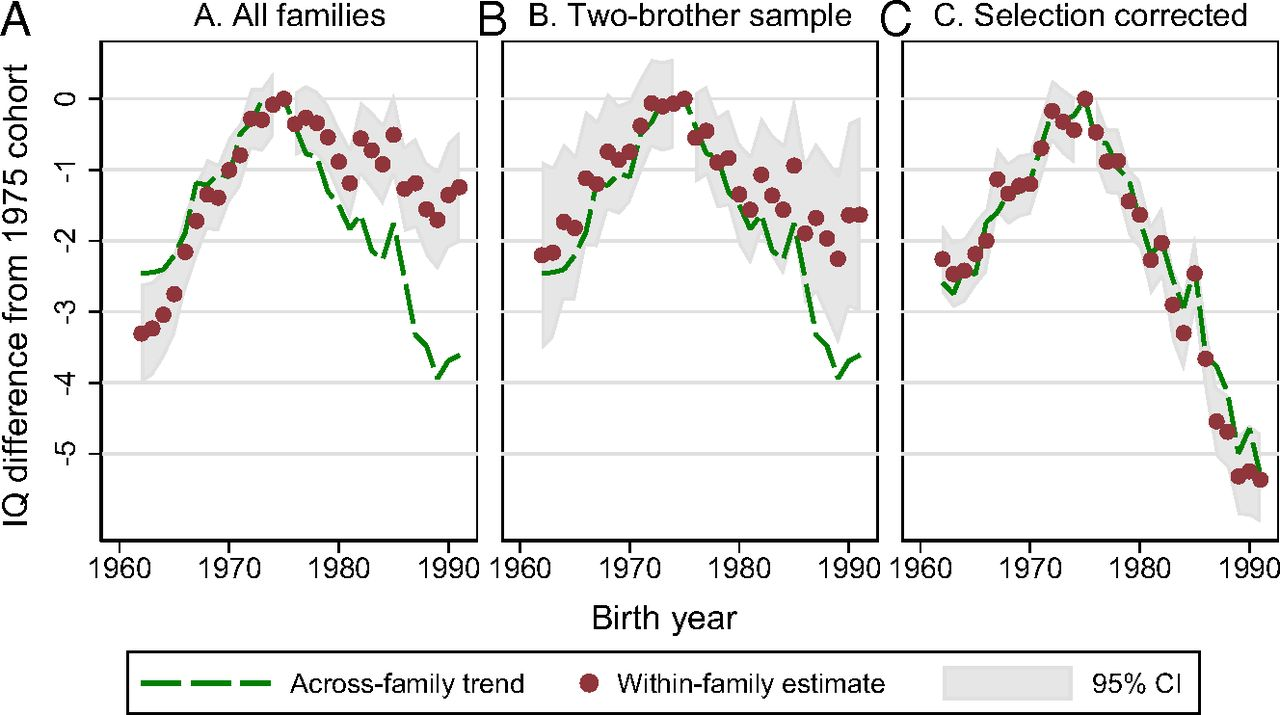
The reversal of the Flynn Effect—sometimes grimly referred to as the “Reverse Flynn Effect”—is not a matter of genetics. Landmark studies, particularly one analyzing IQ scores among Norwegian brothers, have demonstrated that the decline is occurring within families, not between them. This strongly suggests that the cause is environmental, meaning something in our modern world is changing how we develop and use our brains.
Scientists currently focus on three primary culprits for the great cognitive slowdown:
1. The Digital Distraction Hypothesis
This is the most contemporary and perhaps most emotionally resonant theory. The reversal largely coincides with the mass adoption of digital technology and social media—starting around the late 1990s and accelerating with the rise of the smartphone.
- Shallow Thinking: Critics argue that the constant stimulation, notifications, and rapid-fire content consumption (scrolling through TikTok, scanning headlines, quickly moving between tabs) is training our brains for speed and reactivity rather than the deep focus and sustained, linear reasoning that traditional intelligence tests reward.
- The “Google Effect”: We are increasingly outsourcing our memory and complex problem-solving to devices. If the answer to any question is two taps away, the mental effort to memorize, synthesize, and reason through information is dramatically reduced. This reliance may be weakening our cognitive “muscles.”
2. The Saturation and Educational Plateau
The spectacular rise in IQ scores over the 20th century was largely driven by easy, low-hanging fruit: removing lead from gasoline, providing universal education, and eliminating severe childhood malnutrition.
- Diminishing Returns: According to this theory, we have simply reached the saturation point on these environmental boosts. We can’t get much better nutrition, and the brain can only process a finite amount of formal schooling. The benefits that drove the original Flynn Effect have maxed out.
- Shifting Educational Focus: Some researchers suggest a change in educational priorities. While there has been a push for STEM skills, the foundational focus on abstract verbal reasoning—the very skill IQ tests measure—may be receiving less emphasis in school systems now preoccupied with meeting other standardized goals.
3. Subtler Environmental Factors
The reversal could also be caused by a host of less obvious, but insidious, shifts in our physical and social environment:
- Worsening Diet and Health: The rise of highly processed, energy-dense, but nutrient-poor “junk food” since the 1970s is a major concern. Poor diet, coupled with more sedentary lifestyles, is linked to chronic inflammation and poorer brain health, which can impede cognitive function during critical developmental years.
- The Chemical Burden: Increased exposure to certain endocrine-disrupting chemicals and pollutants (like pesticides and microplastics) is suspected of having a subtle, widespread, and negative effect on neurological development, particularly in childhood.
- Stress and Family Structure: Changes in socio-economic stress levels, as well as shifts in family structures and parent-child interaction styles, may subtly affect the early cognitive stimulation essential for maximizing potential.
The scientific community is far from reaching a consensus. The likelihood is that no single factor is responsible; the decline is a complex blend of technology, education, health, and social change.
The real challenge for us now is not just why our IQ scores are leveling off, but what we define as intelligence in a world where AI can calculate faster than any human and where success may depend more on creativity and emotional intelligence than pure abstract reasoning.