




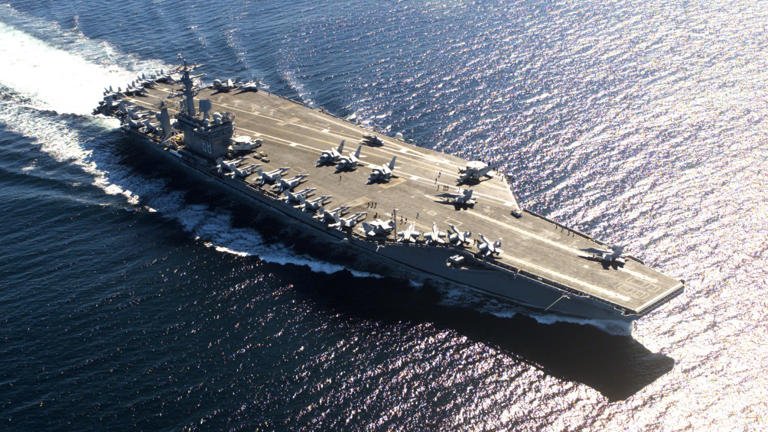
The USS Nimitz is basically the “Old Man” of the ocean, and it isn’t getting a quiet retirement.
After fifty years of cutting through saltwater, the lead ship of the Nimitz class was supposed to be taking a victory lap. Instead, the Navy just pulled a frantic u-turn. The oldest active carrier in the fleet is now steaming toward a surprise deployment with U.S. Southern Command (SOUTHCOM), and the timing couldn’t be more awkward.
Why? Because just a few weeks ago, things went sideways in the Pacific—fast.
Two Jets Down in 30 Minutes: A Bad Omen?
Imagine the chaos on a flight deck when a mishap occurs. Now imagine it happening twice in the time it takes to watch a sitcom.

Chuck Norris, Action Star of ‘Walker Texas Ranger’ and Early Internet Culture Dead at 86
Chuck Norris in a 1993 interview - Entertainment Tonight, YouTube Legendary actor…

Bulletstorm VR Review: A “Sloppy” Port That Misses the Mark
The long-awaited arrival of Bulletstorm VR was supposed to be a win…

Missing Person Saniyah Mumford from the 14th District Has Been Located
The Philadelphia Police Department is seeking the public’s assistance in locating missing…
From Standoff to Stand-in: The Shifting Tactics of Operation Epic Fury
The air campaign over Iran has entered a new and more aggressive…

Yamaha Self-Balancing Motorcycle 2026: Revolutionary AI-Powered Electric Bike Stays Upright Without Kickstand
The Yamaha self-balancing motorcycle technology is revolutionizing two-wheeled transport. In a viral…

Israel Strikes Iranian Navy in Unprecedented Caspian Sea Raid
In a historic shift of the current conflict, the Israeli Air Force…
During recent Pacific operations, the Nimitz lost two aircraft within a single 30-minute window. While carrier aviation is inherently “controlled soul-crushing danger,” losing two birds that quickly is a massive red flag. It’s the kind of freak occurrence that makes you look at a ship commissioned in 1975 and ask: “Is the hardware finally giving up the ghost?”
The Navy hasn’t handed over the maintenance logs yet, but you don’t need a degree in naval architecture to see the stress. When a ship has been sailing since the Ford administration, every bolt and bracket has a story—and usually a bit of rust.
Why the Caribbean? The “B-Team” Theater Theory
Sending a carrier to Latin America and the Caribbean (SOUTHCOM) is… weird. Usually, our carriers are babysitting the Taiwan Strait or playing cat-and-mouse in the Middle East. Moving the Nimitz south suggests one of two things:
- There’s a fresh fire to put out: Maybe a spike in counter-narcotics or a subtle flex against growing foreign influence in our backyard.
- The “Safety First” Pivot: The Navy might be moving an aging, battered asset to a “lower-threat” environment to free up the shiny new Ford-class carriers for the real scrap in the Pacific.
Think of it like taking the 1995 Honda Civic off the highway and only using it for grocery runs. It’s still working, but you don’t want to redline it on the Autobahn.
The Readiness Trap: We’re Running Out of Ships
The Nimitz’s sudden mission exposes the giant, rusted elephant in the room: The U.S. Navy is stretched dangerously thin.
We are retiring old ships faster than we can build the new ones. The USS Gerald R. Ford was supposed to be the savior, but it’s been plagued by “new car smell” tech issues for years. That means the “Legacy” ships—like the Nimitz—have to sail longer, harder, and more often than they were ever designed to.
It’s a vicious cycle. Older ships need more repairs. More repairs mean fewer ships are available. Fewer ships mean the ones left have to work double shifts. Eventually, things break. Sometimes, two things break in 30 minutes.
A Final Cruise with a Heavy Burden
For the crew, this is a bittersweet “Final Boss” level. There is immense pride in serving on a legend, but there’s also the “operational tension” of knowing your home is on borrowed time.
The Nimitz isn’t just a ship; it’s a symbol. Sending it to our southern neighbors sends a message of commitment, sure. But it also sends a message of strain. It says the U.S. will be there—but we might have to show up in a vintage warship to make it happen.
Is the Nimitz a display of American grit, or a warning that our naval dominance is fraying at the edges?