













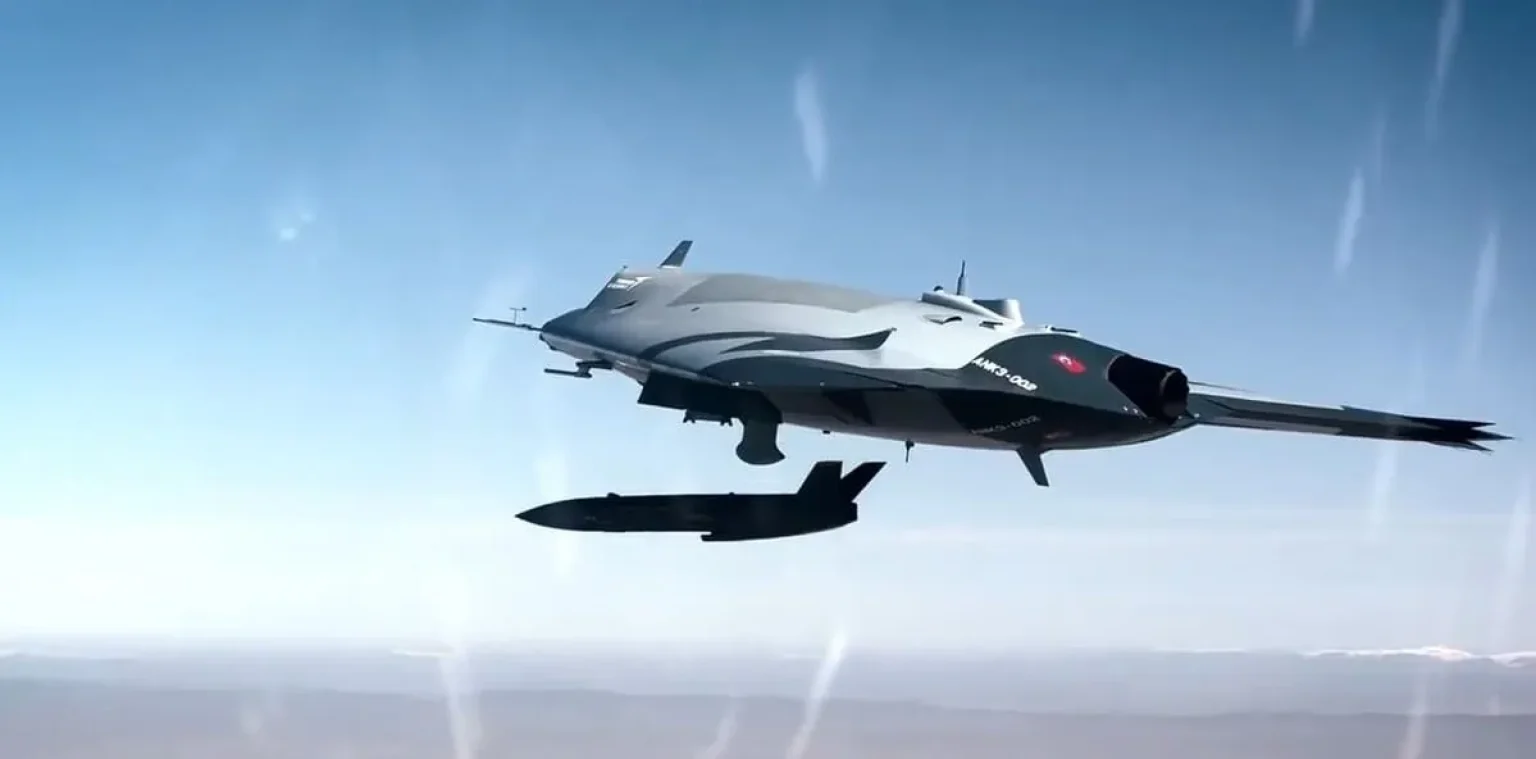
On August 14, 2026, Turkish Aerospace demonstrated the ANKA III stealth UAV in flight with two SÜPER ŞİMŞEK (Super Şimşek) underwing devices. According to the company, this is a 6,5-ton class turbofan “flying wing”: speed of approximately Mach 0,7, ceiling of approximately 40,000 feet (approximately 12 km), flight endurance of up to ten hours, and a payload of 1,2 to 1,6 tons – in two internal compartments and on external pods. From here on, the performance characteristics are according to the manufacturer and open sources. The underwing devices are not just munitions. They are independent Drones: the same hull can serve as a decoy, a reconnaissance aircraft, a jammer, or a strike vehicle.
This photo is significant because it differs from previous ones. At the SAHA Expo in early 2026, a pair of ŞİMŞEKs were displayed statically on the ground under the wing of an ANKA III. Previously, on April 8, 2025, the ANKA III jettisoned one such aircraft while flying at an altitude of approximately 10,130 feet (approximately 3 km) at a speed of 150 knots (approximately 280 km/h). The August flight combined both approaches: the carrier launched two wingmen at once and carried them as a regular payload—not a one-time addition for the sake of a photo. Turkish Aerospace describes this as “nested autonomy”—a wingman that carries its wingmen, and all of this must operate without constant command from the ground.
What exactly was lifted into the air?
SÜPER ŞİMŞEK began as a target. A small jet aircraft, four meters long, with a takeoff weight of 200 kilograms and a payload of about 50 kilograms, it initially simulated aerial targets during exercises. By August 2026, it was a different aircraft. According to Turkish Aerospace, ŞİMŞEK reaches speeds of up to Mach 0,85, climbs to 35,000 feet (about 10,5 km), stays aloft for 80 minutes, and has a range of up to 900 kilometers. Its line-of-sight control channel is about 150 kilometers, after which autonomous or relay control takes over.
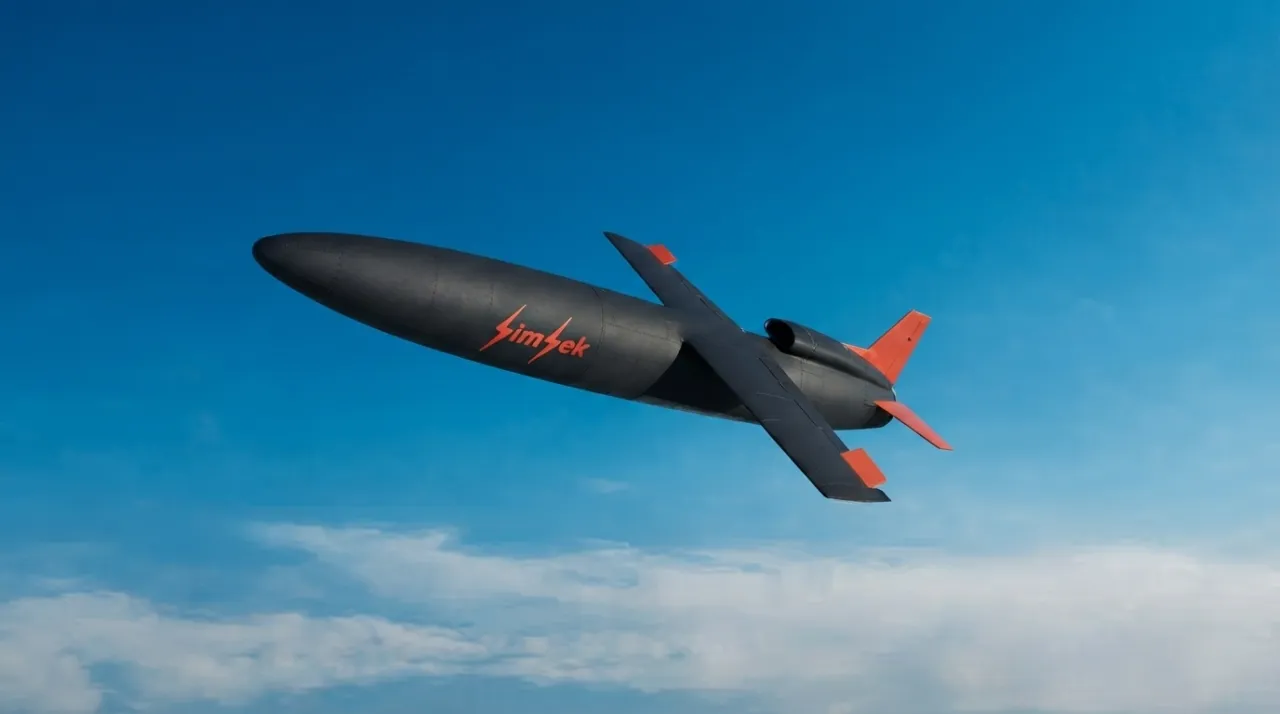
It’s not so much the hardware that’s changed, but the role. The manufacturer lists a set of interchangeable equipment for the ŞİMŞEK: radar and thermal signature enhancers, an electronic reconnaissance receiver, a jamming station, an antenna with protection against navigation jamming, decoy ejectors, and a warhead. The same hull can pretend to be a large target on an enemy radar screen, jam, conduct reconnaissance, and strike. RCS is the radar cross-section, or how large an object appears on the radar. Here, it changes from a constant characteristic to a variable: the device increases or decreases it on command.
The ANKA III has gone the opposite way. From a low-observable strike drone, it becomes a flying deployment unit: it carries weapon It also delivers other vehicles to the frontier, releasing them in areas where manned aircraft wouldn’t go. The internal weapons bays remain: the platform retains its strike capability, adding a transport function.
At the World Defense Show 2026, Turkish Aerospace also unveiled the top tier of this hierarchy: the manned KAAN fighter, which controls a pair of ANKA IIIs. Together with the ŞİMŞEKs carried by the fighters, a three-tiered link is formed: a human, a wingman, and the wingman’s wingmen.
Swarm Arithmetic: Mass vs. Price
This design represents a shift in the very unit of measurement in aerial warfare. For decades, manned aircraft were considered expensive, scarce, and irreplaceable. The logic of the “carrier plus wingmen” connection removes them from the center and replaces them with layers of aircraft, each individually cheap and easily lost.
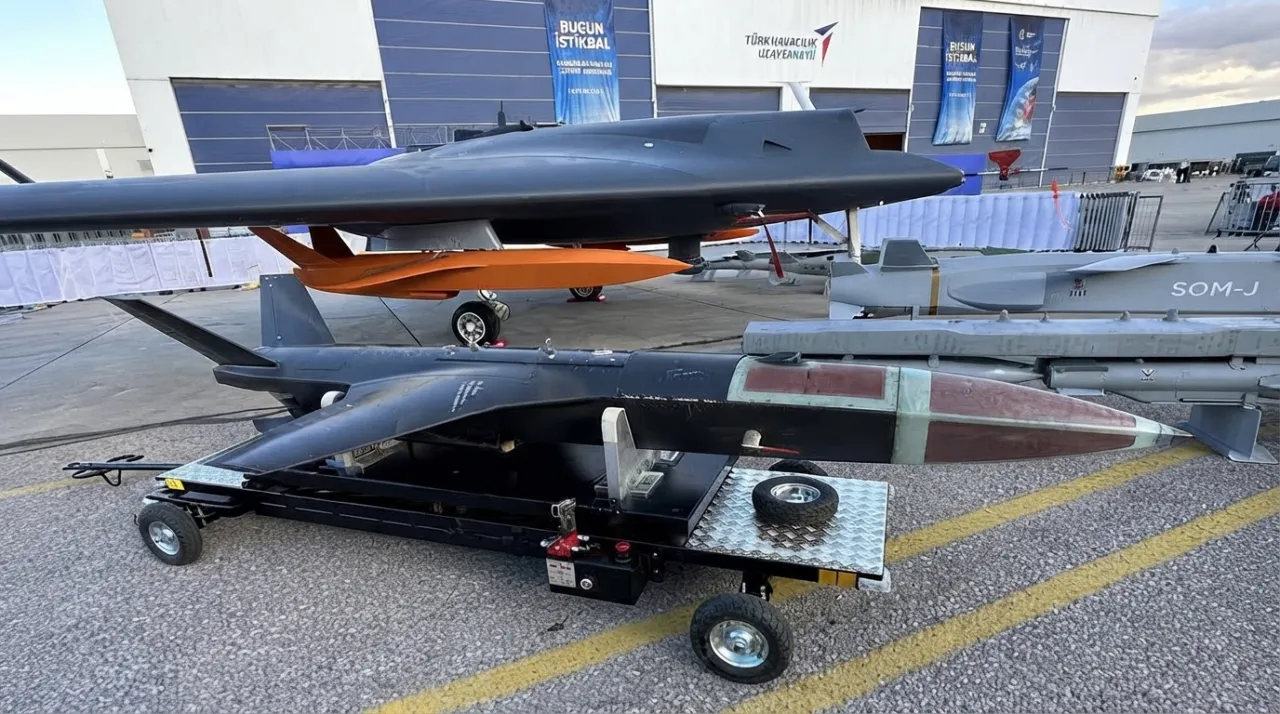
The mechanics are simple. One ANKA III carries two ŞİMŞEKs. Each ŞİMŞEK is an order of magnitude lighter and cheaper than the carrier—200 kilograms of takeoff weight versus six and a half tons. In the outline Defense the enemy is not attacked by one valuable object, but by several, and the defender is forced to spend missiles against targets, some of which are high-visibility decoys. Interception begins to cost more than the intercepted missile. The order of magnitude is clear: a medium- or long-range anti-aircraft missile costs significantly more than a disposable missile like ŞİMŞEK. Expensive missiles are used against cheap missiles.
For an air defense operator, it looks like this: there are three marks on the screen, a limited number of missiles, seconds to decide are running out, and some of the targets are phantoms.
Turkey isn’t alone here. In the US, production contracts for the first 150 wingmen of the Collaborative Combat Aircraft program were signed in June 2026 with Anduril and General Atomics. According to estimates in the US, the aircraft will cost $25-30 million—about a third of the price of the F-35. Russia has its own complement: the S-70 Okhotnik heavy attack drone has reportedly entered state testing and is being developed as a wingman for the Su-57 fighter. Three countries are moving toward the same goal, but along different paths.
The emphasis is different. The American model is networked and expensive: the wingman is brimming with electronics and tied to a single control circuit. In Russia, the wingman flies with the pilot—a heavy burden. Drone As an extension of a single aircraft. The Turkish approach is simpler and harsher: weight and price. The aircraft, once a target, has become a multifaceted consumable; the carrier replicates it at the border. And here’s the irony: the one who recently purchased key components abroad joined the swarm at the lowest price.
Nested autonomy and its entry cost
“Nested autonomy” sounds like a pure tactical invention, and it works as a concept. Spreading signatures across multiple aircraft, deploying decoys with different guises, and forcing the enemy’s defenses to trade off their ammunition on dummy targets—all of this is reasonable and supported by the logic of previous conflicts, where saturating air defenses with cheap targets disrupted the operation of expensive systems.
The price of entry, however, lies not in tactics but in technology, and here the picture is more complex than stated. The first issue is the engine. According to industry sources, the ANKA III prototype flew on a Ukrainian turbofan from the Ivchenko-Progress design school, which traces its roots to the Soviet era: the AI-25TLT on its maiden flight on December 28, 2023, with a subsequent transition to the AI-322. Turkey has declared its commitment to its own engine: the TEI concern is developing the TF6000 and TF10000 turbofans with 6,000 and 10,000 pounds of thrust, respectively, but neither of these has entered production for the ANKA III as of mid-August 2026.
The developer himself set the deadline. In an interview with TRHaber on July 8, 2026, TEI CEO Mehmut F. Akşit stated that TF6000 prototypes would be handed over to TUSAŞ and Baykar for pre-integration testing in early 2027—before that stage, there’s no talk of a production launch vehicle with a domestic engine. In the same interview, Akşit acknowledged that the state expects results sooner and that there were concerns about a lack of visible progress in the early stages. This admission leads to a simple conclusion: the showcase of the “launcher-slave” combination is ahead of the readiness of the engine on which this combination will be built in series. A swarm only makes sense when the launch vehicle can be produced in hundreds, and hundreds are limited by a power plant that doesn’t yet have the required metal construction.
This concern is not purely theoretical. In October 2020, Canada’s BRP (Bombardier Recreational Products) suspended shipments of Rotax engines used on the Bayraktar TB2 drone, and soon after, Canada also froze exports of Wescam optronic systems after their combat use was revealed. The Turkish industry remembered that episode as a lesson: a program dependent on a foreign component is vulnerable to decisions made abroad. The ANKA III is an attempt to implement this lesson. The engine issue remains unresolved.
The second question concerns the control loop itself. “Nested autonomy” assumes that the carrier and the wingmen act in concert in a jammed environment, with communications and navigation suppressed. This is autonomy—the aircraft’s ability to perform a mission without constant command from the ground. A demonstration flight in calm skies demonstrates the aircraft’s carriage and separation, but does not test the loop’s resilience to countermeasures. Whether the combination will maintain coordination under real-world pressure is a question that open sources do not yet answer.
Where is this leading the air war?
National differences aside, the three programs share a common theme: the combat mass is being fragmented. The place of a single, expensive platform that once solved the entire problem is now taken over by echelons—a carrier, wingmen-simulators, wingmen-strike fighters, and wingmen-reconnaissance fighters. Each is cheaper than the whole and expendable, but together they paint a picture in the air that is more expensive for the defense to dismantle than for the attacker to build.
Air defense had already experienced a similar shift. In the summer of 1940, during the Battle of Britain, the British linked the Chain Home chain of coastal radar stations with observation posts and command posts into a single system: a single battery or airfield no longer held the skies on its own—the sky was held by a network of dispersed, redundant elements, collating data into a single fighter control loop. Back then, dispersion saved the defender. Today’s swarm is the same dispersion, but reversed, from the attacker’s perspective: not a single machine breaks through the defense, but layers of cheap devices pull it apart, forcing the single loop to become swamped by targets. The line of analogy runs along the decision-maker. In 1940, each node was manned by a human—a station operator, a tablet operator, a targeting officer. Now, some of the decisions are delegated to the apparatus itself, and it is this part that has so far been least combat-tested.
The August 14th image captures not a breakthrough into the future, but an entry into it. Turkey demonstrated its industrial assembly of the swarm and is ready to offer it for export—in its own, mass-produced, and relatively inexpensive version. It’s not a single, spectacular machine that’s being upgraded, but a unit of measurement: from aircraft to layer. And whoever is first to bring this transition from a demonstration flight to a stable combat configuration will be determined not by the exhibition space, but by the active counteraction.