










Renowned canon lawyer Fr. Gerald Murray explained Friday why a recent document from the Vatican seeking to extend episcopal excommunications against the Society of St. Pius X (SSPX) to priests and laity represent a significant canonical error.
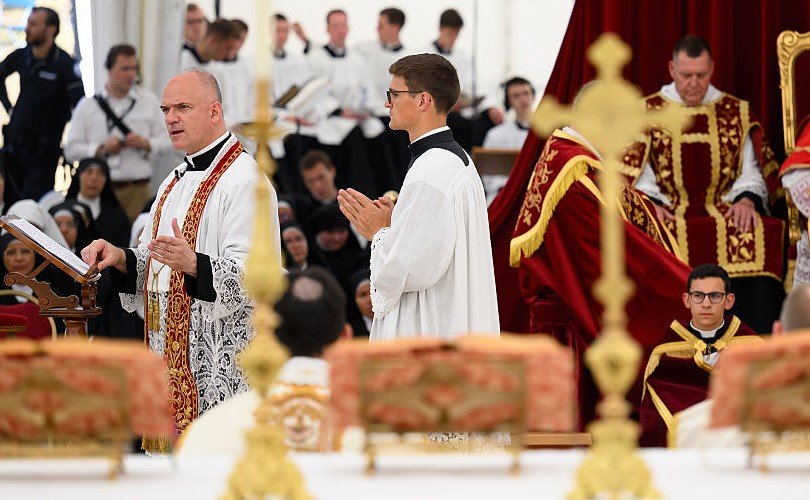
“This is a canonical mess,” Fr. Murray told EWTN host Raymond Arroyo during an episode of The World Over. “An explanatory note can explain what a decree contains. It can’t add to a decree. So, the decree did not say the priests were excommunicated. Therefore, the explanatory note cannot do that having legal effect.”
“This was a canonical mistake on the part of the authors of this document. It’s very regrettable. Same applies to lay people,” he said.
Fr. Murray repeatedly stressed that the Vatican’s July 2 decree was narrowly tailored. Only the six bishops who participated in the illicit consecrations incurred a publicly declared latae sententiae excommunication.
“The bishops’ schismatic act was to ordain or get ordained as bishops,” he explained. “That’s quite clear. That’s a public fact. It’s verifiable. The Holy See did not declare in the decree any of the priests to have committed a schismatic act.”
He clarified the legal distinction the priests “have not been declared excommunicated in the decree. Therefore, they are not held by the Vatican to be excommunicated.”

Six Narwhals Revealed Atlantic Heat Hiding Deep Inside Greenland’s Fjords
Narwhals are among the strangest animals in the oceans. They’re like unicorns…

Google targets IPIDEA in crackdown on global residential proxy networks
Google disrupted IPIDEA, a major residential proxy network that enrolled users’ devices…

French Rafales and South Korean F-35As Deepen Strategic Airpower Cooperation in the Indo-Pacific
South Korean F-35A stealth fighters trained alongside French Rafales at Cheongju Air…

European Commission probes cyberattack on mobile device management system
The European Commission is investigating a cyberattack after detecting signs that its…
Stacy Garrity Vows to Protect PA Farmland From Invasive Data Center Development
HARRISBURG, Pa. — As Pennsylvania’s 2026 gubernatorial landscape begins to take shape,…
Idaho daycare must allow parents to opt out of vaccines, court rules
A federal court upheld the rights of parents to decline vaccines for…
“Now, they could be schismatics and gain an automatic or excommunication for being a schismatic, but as long as that has not been declared, it doesn’t have public effect,” the priest from New York explained.
“And, of course, we know that the society has maintained all along that they’re not schismatics. So, you could say that priests could be in a state of good faith in making that assertion,” he clarified.
Automatic excommunication for schism exists in canon law, Murray noted, but it requires formal declaration to carry public effect. “There’s an automatic excommunication for being a schismatic, but as long as that has not been declared, it doesn’t have public effect.”
Turning to the SSPX laity, Fr. Murray emphasized that any penalty must rest on a concrete act rather than presumed interior dispositions. “In the decree, there’s a warning. We call that a canonical warning not to adhere to the schism. That’s (just) a warning.”
“Now, the next question is, what specifically are you supposed to do so that you don’t adhere to a schism? That level of specificity is not given. It has to be an act. It can’t be a mental attitude because you don’t judge the mind of people unless it’s been expressed in words,” he cautioned.
He also addressed the explanatory note’s claim that SSPX-administered confessions and marriages are invalid. Such assertions cannot override prior papal grants of faculties, he explained.
“The confessions of the priests of St. Pius X during the reign of Francis, they got faculties to hear confessions given by Pope Francis, and it was formalized in a decree or a document from the Pope. An act of the Congregation for the Doctrine of the Faith in an explanatory note cannot undo what Pope Francis did,” he said. “So (the authors) missed the boat on that.”
Fr. Murray was equally critical of the two reconciliation documents issued alongside the decree. The guidelines for priests require finding an ordinary willing to accept them, writing to the Pope, signing a profession of faith that includes acceptance of the legitimacy of the Novus Ordo, and completing a probationary period.
For the laity, the documents assume that regular attendees at SSPX chapels or members of associated organizations stand outside full communion and must sign similar statements to be reconciled.
“The document about the laity, it basically assumes that lay people who attend Mass at the St. Pius X society on a regular basis or belong to one of their organizations are out of full communion with the Church and need to be reconciled and brought back into full communion with the Church,” Murray observed.
“But wait a minute. They haven’t been excommunicated. Therefore, they’re not under a canonical penalty that affects their full communion,” he clarified. “And the idea that you lose full communion because you agree with some of the things that the society says, that’s not good enough.”
Last Wednesday, July 1, the SSPX ordained four new bishops in Écône, Switzerland, without a papal mandate as is required by canon law with a penalty of latae sententiae excommunication attached to violations.
On June 29, Pope Leo XIV issued an open letter to the SSPX urging it to not proceed, describing the planned ordinations as a schismatic act. Fr. Davide Pagliarani, Superior General of the SSPX, responded the following day, reaffirming the Society’s position while requesting the Pope’s blessing.
The day after the consecrations, the Dicastery for the Doctrine of the Faith, led by Cardinal Víctor Manuel Fernández, issued its decree declaring the six participating bishops automatically excommunicated. An accompanying explanatory note expanded on the implications for priests and laity, while separate guidelines outlined paths for reconciliation.