






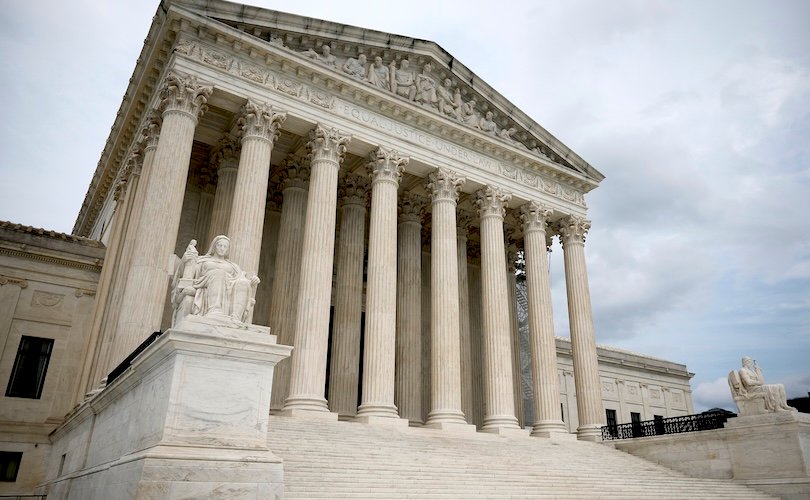
The U.S. Supreme Court (SCOTUS) has agreed to hear a heart-wrenching case on behalf of a group of Washington parents who challenged state laws designed to give runaway minors so-called “gender affirming treatment” without parental notice or consent.
The parents do not affirm their children’s gender confusion and seek to raise their kids according to their biological sex.
The question presented to SCOTUS is “whether parents have standing to challenge a law or policy that deliberately displaces their decision-making role as to ‘gender transitions’ of their children, and in so doing creates present and likely future impediments to their ability to parent their children as they deem best for them.”
“Viewing parents as the problem, Washington (state) passed laws that deliberately target certain parents by supplanting them with the state in the context of gender-confused runaway minors: Whenever a child runs away, so long as he or she asks for “gender-affirming treatment,” a cascade of events is triggered,” the petition states.

Google GTIG disrupted China-linked APT UNC2814 halting attacks on 53 orgs in 42 countries
Google and partners disrupted UNC2814, a suspected China-linked group that hacked 53…

Archdiocese of Detroit could end Sunday Mass at up to 90 parishes
The Archdiocese of Detroit released parish restructuring models showing weekend Masses could…

Democrats urge Graham Platner to drop out of Senate race after rape accusation
National Democrats find themselves scrambling to regroup after a woman came forward…

More earthquakes rock Venezuela as death toll rises to 1,430
The tremors with magnitudes of 4.7 and 4.8 struck off the country’s…

Endangered Missing Person Maurice Washington from the 14th District Has Been Located
Endangered Missing Person Maurice Washington from the 14th District Has Been Located…

Trump resorts to whataboutism after Iranian strike kills US troops
The US president has dismissed Democrats’ criticisms, arguing that far more American…
“First, the child is referred for ‘gender-affirming treatment’ without parental notice or consent. Second, parents can be kept in the dark as to the child’s location and condition. And third, reunification can be significantly delayed, with conditions for that reunification uncertain and entirely up to the state,” the court filing explains.
Nonetheless, the Ninth Circuit determined that the very objects or targets of the relevant statutes — parents who do not wish to affirm their children’s gender confusion — lack standing to challenge those statutes.
The decision by the Ninth Circuit was not unanimous.
In Judge Lawrence VanDyke’s dissent from denial of rehearing en banc, he said that “Washington’s legal regime does not merely invade plaintiffs’ parental rights … it will obliterate them.”
Judge Eric Tung also dissented, noting that “(t)he requirements of standing are strict, but they are not cruel.”
Earlier this year, one of the parents petitioning SCOTUS, Jodie Holman, offered an emotional testimony at the state capitol in Olympia. After her daughter Eleanor ran away from home, the school district facilitated the 16-year-old’s decision to sever guardianship without her parents’ knowledge, according to a report by The Center Square’s Carleen Johnson published by The Chronicle.
“Our daughter ran away from home and has now been missing for more than two months,” Holman testified in February.
“She has multiple intersecting mental health needs but the school, and Washington state, narrowed their focus to gender alone, sidelining the whole scope of what she was experiencing,” Holman said. “Without our knowledge or involvement, steps were taken leading our daughter to believe our home was an unsafe environment for someone experiencing gender dysphoria.”
“At each stage, we acted as engaged parents, seeking coordination and support. At no point were our parents’ rights terminated or limited by core finding of unfitness,” she told lawmakers..
“Meetings appeared cooperative. Communication seemed professional. The impact only became visible later, once consequences were already in motion and difficult to unwind,” Holman said. “Privacy protections were cited but applied inconsistently. Timelines expanded during moments when time was critical. Parents were expected to respond to outcomes without having been included in the processes which produced them.”
In an amicus brief submitted to the court, Holman and others noted that “Child welfare systems were designed to protect abused and homeless children, not to remove troubled children from their own parents who seek to address their minor child’s underlying mental health issues rather than default to encouraging that child to undergo life-altering measures to change their appearance. No human has changed sex.”
The parents’ attorneys who will argue their case before SCOTUS ended by paraphrasing Hamlet: “‘Something is rotten’ in standing doctrine when parents who are the object of a ‘gender-transition’ law have to wait for the (likely) irreparable injury of their child’s actual transition before they can sue.”
“Only this Court can excise the rot,” they concluded.