







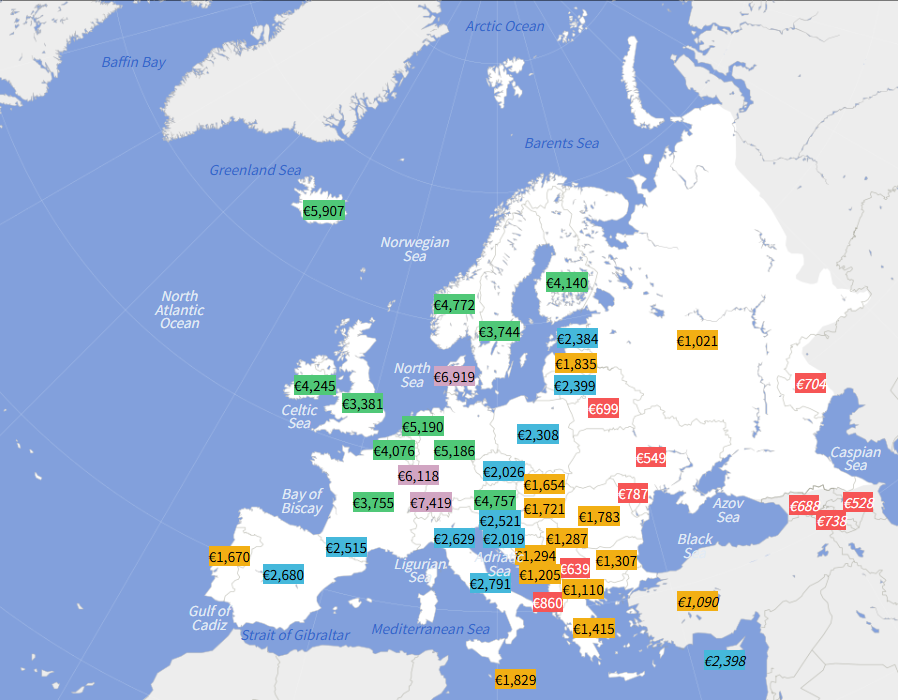
Look, I’ve been covering the intersection of travel and economics for fifteen years—long enough to know that every postcard-perfect image of Europe has a hidden price tag. And let me tell you, this map, this stunningly simple financial x-ray of the continent, it’s not just data. It’s a brutal reality check for anyone dreaming of moving abroad or taking a “sabbatical.”
When I first saw these numbers, I actually laughed—a grim, knowing laugh. The media (myself included, years ago) loves to pitch Europe as this seamless experience, but it’s a financial battlefield where a border crossing can cost you thousands of euros a month. This isn’t about tourist traps; this is the genuine, daily cost of living—the rent, the groceries, the heating.
The Pockets of Pain: Where Affluence Becomes an Obstacle
The most expensive parts? They never change. It’s a perennial headline, but seeing the actual figures laid out like this still packs a punch.
Take the Nordic regions. We’ve got figures like a dizzying €5,907 and €4,772 hovering over the map’s northern reaches. What does that tell you? It tells you that the beautiful, highly-efficient, socially progressive Scandinavian model is not cheap to run. I remember interviewing a Finnish software engineer who moved to Berlin just to cut his overhead in half. He missed the nature, but he didn’t miss that rent.

U.S. CISA adds RoundCube Webmail flaws to its Known Exploited Vulnerabilities catalog
U.S. Cybersecurity and Infrastructure Security Agency (CISA) adds RoundCube Webmail flaws to…

French Ministry confirms data access to 1.2 Million bank accounts
A hacker accessed data from 1.2 million French bank accounts using stolen…

Wendy’s Announces ‘Wendy’ Has Been Quietly ‘Replaced’ by Newer, Shorter Wendy
DUBLIN, OH — In a major rebranding move, Wendy’s International announced Friday…

James O’Keefe Offered Senator Lisa Murkowski’s Brother’s Ballot at Anchorage Polling Station with No ID Required – Murkowski Calls For O’Keefe to be Prosecuted!
James O’Keefe on Thursday released undercover video of an Anchorage, Alaska, poll…

Bill Gates’ daughter intentionally rigged shopping app commissions – Bloomberg
Internal messages show Phoebe Gates knew her startup Phia was using a…

How June Lapine Dismantled Hasan Piker’s Image and Forced a Wardrobe Transformation
June Lapine, known widely online as Shoe0468 (or Shoe013), has long occupied…
But the real shocker—the number that screams “exclusive club”—is that eye-watering €7,419 tucked right in the heart of the continent. If you want pristine streets, incredible public transport, and neutrality, you pay for the privilege. That figure isn’t just a cost of living; it’s a global tax on stability and banking.
Unique Observation #1: The “Legacy Price” Phenomenon. People always focus on salary vs. cost, but look at the U.K.’s high number, €4,245. That figure is inflated not just by current economics, but by legacy. It’s the price you pay for massive, centuries-old cities with housing crises that have been decades in the making. You are paying for historical inefficiency, not just current market value. It’s a history tax.
The Mediterranean Deception: Why the Sunny South Isn’t Always Savings-Friendly
The narrative of “escaping to the Mediterranean to save money” is largely a myth, or at least, it’s highly conditional.
Look at Spain: the number €1,670 out west versus €2,680 on the eastern coast. That difference is almost a thousand euros! You’re trading Madrid’s centralized infrastructure for a more expensive coastal lifestyle where demand (especially from northern European retirees and expats) has completely warped the rental market. The old “cheap Spanish living” disappeared when everyone else had the same brilliant idea.
And then there’s Italy. The north-south divide is painfully clear, running from around €2,629 down to the mainland south’s €1,205 and €1,415. That difference isn’t just about rent; it’s about employment opportunities and wages. As I’ve reported on extensively, many young, educated Italians move north for higher salaries only to find their cost of living eats up half the benefit. The south is cheaper because the economy is struggling, not just because the weather is better.
The Hidden Heroes: Where Value and Vibe Align
This is where the seasoned journalist in me gets excited—the places that offer genuine, sustainable value. This is where you can find that authentic European life without feeling like you’re constantly chasing the next paycheck.
Look east. These figures are not only low; they represent a quality of life that is rapidly improving. Consider the Balkans, with figures hovering around €860 and €1,090. You get vibrant history, incredible food, and a genuine cultural experience for what you’d spend on a room in Amsterdam.
Unique Observation #2: The ‘Reverse Commute’ Opportunity. The low numbers on the eastern side of the map (like the incredible €549 and €787 in places like Poland and Romania) are creating a “reverse commute.” Instead of locals moving west, Western European companies are moving jobs, remote or otherwise, east. If your salary is pegged to a Western European or American scale, you can live like a king here. The wealth is going into these areas, not out of them, and the cost of living hasn’t caught up yet. This is the current sweet spot.
My Final Verdict: Stop Idolizing the Expensive Cities
I used to tell people to save up for Paris. Now, honestly? I tell them to go to Ljubljana or Krakow instead. You see the French figures—a shocking €4,076 near the Bay of Biscay and €3,755 inland. These are brutal numbers sustained by global tourism and established affluence.
Unique Observation #3: The ‘Tourist Bubble Tax’ vs. Real Living Cost. The high prices in major tourist hubs (Paris, Amsterdam at €4,076 and 5,190 respectively) are heavily influenced by the tourism sector, which drives up demand for everything from coffee to short-term rentals. In contrast, places with lower figures (like the €1,021 in the Baltics) have an economic base driven by local industry and domestic consumption. The latter is a far more stable and authentic long-term cost of living. You’re paying for the global fame in one, and a real community in the other.
This map is your first lesson. Use it. Be strategic. Europe is open for business, but only if you choose your corner wisely.
Which of these numbers completely changes your mental map of Europe? Tell me your dream destination and I’ll break down the average monthly income needed to live comfortably there.