




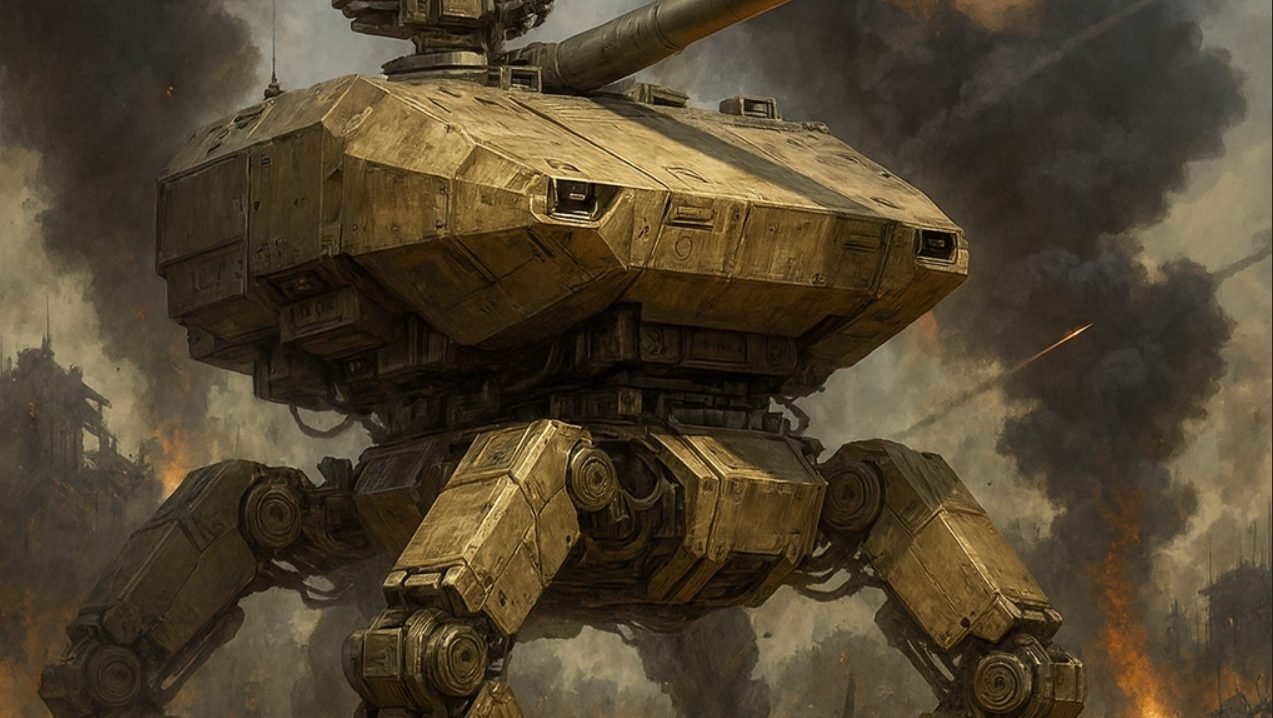
Online defense analysts are locked in a surprisingly detailed technical debate over a fictional armored vehicle, pitting the romance of high-tech walkers against the harsh realities of ballistics and terrain.
In the specialized online defense communities where enthusiasts and military hobbyists congregate, a surprisingly fierce and granular debate has emerged, not over a new NATO vehicle or a next-generation bomber, but over a fictional machine: the “walker tank” from the anime Sora no Woto.

The discussion, which originated in a specialized online defense community, has quickly morphed into a detailed hypothetical engineering challenge. The core question posed by the original poster: “Okay, realistically… could it work in any degree?”
The proposed concept—a multi-legged armored fighting vehicle—boasts theoretical advantages over traditional tanks, including superior all-terrain capability, the ability to “cross water,” and a unique capacity to fire at extreme upward or downward angles by adjusting its stance.

The test the US cannot afford to fail
The outcome of the war with Iran will determine America’s capabilities on…

The Ghost in the Machine: Who is Noemi Bonazza?
In the hyper-accelerated world of 2026, where digital identities are minted and…

Courtney Bonneau is still in southern Lebanon — and she’s not blinking.
Reporting live from Saida, the historic coastal city near these flashpoints, the…

Critical Fortinet FortiClient EMS flaw exploited for Remote Code Execution
Attackers are exploiting a critical Fortinet FortiClient EMS flaw (CVE-2026-21643) that…

The Isaaq Genocide: Somalia’s Brutal Attempt to Wipe Out an Entire Clan – And the World Still Looks Away
Between 1987 and 1989, under dictator Siad Barre's iron fist, the Somali…

Panzer Dragoon Zwei Remake 2026: Epic Dragon Flight Returns to All Major Platforms – Wishlist Now on Steam!
Panzer Dragoon Zwei: Remake returns in a new fan showcase! Watch the…

The Case for the Walker: Niche Supremacy
Advocates argue that a walking vehicle, while unsuited for a broad frontline role, could excel in specific, challenging environments.
“It would perform amazingly in mountain terrain, being able to climb them and fire from them quite well,” argued one participant, pointing to historical conflicts in regions like the Alps where conventional vehicles struggled. The ability to “squat down or up to change its elevation or angle” was hailed as a key selling point, allowing it to leverage cover and target enemies in ways a tank with fixed suspension cannot.
Furthermore, some argued that the inherent redundancy of a multi-leg system makes it less vulnerable than a tracked vehicle. “Tank treads are 10x more fragile and have much less redundancy,” claimed one user, suggesting that damaging a single leg would not immediately immobilize the machine.

The Ground Pressure and Minefield Dilemma
However, the consensus among technical realists leaned heavily against the design, arguing that the colossal size and weight of the fictional walkers would introduce critical vulnerabilities that negate any perceived advantage.
The primary concerns revolved around mobility and protection:
- Ground Pressure: At the size depicted in the anime, the vehicle would suffer from “pretty shitty ground pressure,” making it prone to sinking in soft ground. Many agreed the vehicle would need to be “half the size” and strictly limited to a specialized role.
- Vulnerable Underside: The most damning criticism centered on the walker’s exposed belly. Unlike a tank, whose underside is protected by being close to the ground, a walker’s chassis is lifted high, creating a massive, relatively thinly armored target.
This exposure led to a deep dive into counter-measures. If walkers became common, participants agreed, specialized anti-walker mines would become standard. These wouldn’t be simple pressure plates, but sophisticated upward-firing Explosively Formed Penetrators (EFPs) equipped with magnetic and seismic sensors.
“It would be comically easy to disable one of these things if you are actually prepared to fight them,” one user stated. The logic is that the mine’s sensors could ignore the brief, powerful seismic signal of a leg stomping down, and instead wait for the leg to lift off, then detonate beneath the “massive chassis” whose engine noise and magnetic signature would provide the perfect target cue.
Tracks Still Win
Ultimately, the digital design review concluded that for 99% of battlefield roles, the tried-and-true tracked vehicle remains superior.
While the concept of a tactical walker holds appeal for its ability to traverse uneven ground and adjust its firing position, the engineering challenges—managing ground pressure, protecting the complex leg mechanisms, and shielding the exposed underbelly from modern EFP weapons—make it a logistical and tactical nightmare.

As one participant bluntly summarized: “Tracks are almost always a better choice, especially when sizing up past 8-10 feet tall.” The high-engagement thread serves as a perfect example of military enthusiasts applying real-world physics and logistics to fantasy, proving that sometimes, engineering practicality always triumphs over the “rule-of-cool.”