











![Desktops
Gaming PCs
Best Amazon Prime Day RAM Bundle Deals 2026 – make PC builds and upgrades more affordable with the best memory combo deals available
Deals
By
Matt Safford, Joe Shields
Last updated
7 October 2026
RAM is still ridiculously expensive, but there are some incredible combo discounts that help take the sting out of a new PC build.
When you purchase through links on our site, we may earn an affiliate commission. Here’s how it works.
Jump To:
Quick Links
Best AMD RAM bundles
Best Intel RAM bundles
Copy link
Facebook
X
Whatsapp
Reddit
Pinterest
Flipboard
Email
Share this article
0
Join the conversation
Follow us
Add us as a preferred source on Google
Newsletter
Subscribe to our newsletter
Best RAM bundle deals
(Image credit: Future)1. Quick Links2. AMD RAM bundles3. Intel RAM bundles
RAM bundles have turned out to be the best option to get reasonably-priced RAM during the ongoing pricing crisis. It's the Amazon Big Deal Days 2026 sales event this week, running from October 6 to 7, so this could be a good time to pick up a deal at a discount, although you'll want to take a closer look at retailers like Newegg for the best deals.We're looking at all of the deals running this week, keeping the list below fresh with all the best options. With AI datacenter demand sending RAM and storage prices sky-high, and GPU prices on the rise as well (especially those with more than 8GB of RAM), this is arguably the toughest time for PC building in decades. But that doesn't mean you always have to pay top dollar for that 64 or 32GB kit for a new system.Many retailers are bundling RAM kits with compatible motherboards, CPUs, coolers, and even peripherals to sweeten the deal and move some inventory out the door. Of course, not all memory combo deals offer the same level of value, and many with motherboards or CPUs won't feature the platform you're shopping for.To help you find the best RAM bundle, we've gathered the current combos we could find below, and we'll update this page regularly because the best deals often sell out fast. We're checking deals around the clock to find the best options, selecting the best based on in-depth knowledge gained from our thorough reviews, extensive benchmarks, and comprehensive historical price analysis.So if you're searching for a deal while building or upgrading a PC in these troubled times, take a look at our picks below before the right deal for you sells out to someone else. But fear not if that happens, as we're seeing new RAM pairings pop up nearly every day. So check back in a day or two if you don't see what you're looking for.Update 9/2: Intel deals with RAM in them have become extremely rare over the past couple of months. We're often finding CPU and motherboard combos, but none with RAM. We'll keep an eye out, and when we find them pop up, we'll get them added.Best RAM bundles: Quick LinksNewegg: Bundle deals with RAMBest AMD RAM bundlesFree msi coreliquid a13 240mm AIO and AMD Game bundleSave 12% ($149)AMD Ryzen 7 9800X3D, Asus TUF Gaming X870e-Plus Wifi7, Corsair Vengeance 32GB: was $1,233.98 now $1,084.98 at NeweggAn alternative 9800X3D deal with the same motherboard as above, but with an alternative RGB Corsair Vengeance RAM with 32GB (2x16GB) capacity and speeds of 6,000 MT/s,Read moreRead less▼View DealFree Cooler Master Elite Liquid 240mm AIO and AMD Game bundleSave 11% ($170)AMD Ryzen 9 9950X3D, MSI MPG X870e Carbon Wifi, Corsair Vengeance 32GB: was $1,523.98 now $1,353.98 at NeweggThe powerful AMD Ryzen 9 9950X3D is coupled with an MSI MPG X870E Carbon WiFi motherboard and 32GB (2x16GB) of Corsair Vengeance RGB memory in this RAM bundle.Read moreRead less▼View DealSave 14% ($105.98)MSI Pro B850-S WiFi 6E, Kingston NV3 1TB, V-Color Manta XSky DDR5 32GB (2x16GB): was $776.97 now $670.99 at NeweggThis combo features the Kingston NV3 SSD with 1TB storage, along with 32GB (2x16GB) V-Color Manta XSky DDR5 RAM and a MSI Pro B850-S WiFi 6E motherboard.Read moreRead less▼View DealSave 31% ($129)AMD Ryzen 5 5500, Gigabyte B55M Gaming X WiFi 6, TeamGroup T-Force Delta RGB 16GB (2x8GB) DDR4: was $421.98 now $292.98 at NeweggThis AMD starter kit for a budget build featurs the AMD Ryzen 5 5500, Gigabyte B55M Gaming X WiFi 6 motherboard, along with 16GB (2x18GB) of DDR4 Team Group T-Force Delta RGB memory.Read moreRead less▼View DealBest Intel RAM bundlesWith the release of Intel's Arrow Lake refresh chips (think Core Ultra 270K and 250K Plus CPUs), we're starting to see Intel combo deals come to life. Sadly, these deals don't last very long, and any on Newegg are currently out of stock or don't contain RAM (please see the best motherboard deals page). But we did find a couple worth a look. Please keep an eye out as we check and update daily!More Tech DealsBest Tech and PC deals | Best gaming PC deals | Best RAM combo deals | Best 3D printer deals | Best RAM deals | Best gaming laptop deals | Best monitor deals | Best Wi-Fi Router deals | Best GPU deals | Best SSD deals | Best hard drive HDD deals | Best CPU deals | Best gaming chair deals | Best PC building tool deals | Best PC peripherals deals | Best filament and resin deals | Best motherboard deals | Best CPU cooler deals | Best PC case deals | Best Dell and Alienware deals | Best USB charger deals | Best gaming and productivity laptop deals under $1,000 | Best laptop PC dealsAlso, you can join the Tom's Hardware deals Discord for up-to-the-minute hardware deals.
window.sliceComponents = window.sliceComponents || {};
externalsScriptLoaded.then(() => {
window.reliablePageLoad.then(() => {
var componentContainer = document.querySelector("#slice-container-newsletterForm-articleInbodyContent-TGuNAwEQgRAJ6QKYvDN6mD");
if (componentContainer) {
var data = {"layout":"inbodyContent","header":"Stay On the Cutting Edge: Get the Tom's Hardware Newsletter","tagline":"Get Tom's Hardware's best news and in-depth reviews, straight to your inbox.","formFooterText":"By submitting your information you agree to the Terms & Conditions and Privacy Policy and are aged 16 or over.","usDisclaimerFooterText":"By signing up, you agree to our Terms of services and acknowledge that you have read our Privacy Notice. You also agree to receive marketing emails from us that may include promotions from our trusted partners and sponsors, which you can unsubscribe from at any time.","successMessage":{"body":"Thank you for signing up. You will receive a confirmation email shortly."},"failureMessage":"There was a problem. Please refresh the page and try again.","method":"POST","inputs":[{"type":"hidden","name":"NAME"},{"type":"email","name":"MAIL","placeholder":"Your Email Address","required":true},{"type":"hidden","name":"NEWSLETTER_CODE","value":"XTH-X"},{"type":"hidden","name":"LANG","value":"EN"},{"type":"hidden","name":"SOURCE","value":"60"},{"type":"hidden","name":"COUNTRY"},{"type":"checkbox","name":"CONTACT_OTHER_BRANDS","label":{"text":"Contact me with news and offers from other Future brands"}},{"type":"checkbox","name":"CONTACT_PARTNERS","label":{"text":"Receive email from us on behalf of our trusted partners or sponsors"}},{"type":"submit","value":"Sign me up","required":true}],"endpoint":"https://www.tomshardware.com/.newsletter-subscribe/v2/submission/submit","analytics":[{"analyticsType":"widgetViewed"}],"ariaLabels":{}};
var newsletterForm;(()=>{var e={757:(e,t,n)=>{e.exports=n(666)},363:(e,t,n)=>{"use strict";function r(e,t){(null==t||t>e.length)&&(t=e.length);for(var n=0,r=new Array(t);nj});var a=n(651),i=n.n(a),l=function(e){if("undefined"!=typeof document){var t=document.cookie.match("(^|;) ?".concat(e,"=([^;]*)(;|$)"));return t?t[2]:null}return null};function c(e,t,n){return t in e?Object.defineProperty(e,t,{value:n,enumerable:!0,configurable:!0,writable:!0}):e[t]=n,e}function u(e,t){var n=Object.keys(e);if(Object.getOwnPropertySymbols){var r=Object.getOwnPropertySymbols(e);t&&(r=r.filter((function(t){return Object.getOwnPropertyDescriptor(e,t).enumerable}))),n.push.apply(n,r)}return n}function s(e){for(var t=1;t-1&&"email"===(null==g?void 0:g.toLowerCase())&&_("text"),"hidden"===(null==u?void 0:u.toLowerCase())&&t&&(y((function(e){return s(s({},e),{},c({},t,n))})),"COUNTRY"===(null==t?void 0:t.toUpperCase()))){var e=l("FTR_Country_Code")||l("FTR_User_Defined_Country_Code")||void 0;y((function(n){return s(s({},n),{},c({},t,e))}))}}),[]);var b=i().createElement("input",{"data-hydrate":!0,type:g,className:"form__".concat(u,"-input ").concat(h),value:n,name:t,required:v,disabled:p,placeholder:f,autoFocus:w,onChange:function(e){if("submit"!==u){var t=e.target,n=t.name,r=t.value,o=t.checked;y((function(e){return s(s({},e),{},c({},n,"checkbox"===u?o:r))}))}}});return r?i().createElement("label",{className:"form__".concat(u,"-label")},b,i().createElement("span",{dangerouslySetInnerHTML:{__html:r.text||""}})):i().createElement(i().Fragment,null,b)};var d=function(e){var t=e.layout,n=e.method,r=e.action,c=e.handleSubmit,u=e.inputs,s=o((0,a.useState)({}),2),d=s[0],v=s[1],m="US"===l("FTR_Country_Code")||!1;return i().createElement("form",{"data-hydrate":!0,className:"newsletter-form__form newsletter-form__form--".concat(t),method:n,action:r,onSubmit:function(e){return c(e,d)},tabIndex:"exitIntent"===t?-1:void 0},null==u?void 0:u.filter((function(e){return!m||"CONTACT_OTHER_BRANDS"!==e.name&&"CONTACT_PARTNERS"!==e.name})).map((function(e){return i().createElement(f,{key:"".concat(e.name,"-").concat(e.value),setFormValues:v,type:e.type,label:e.label,value:e.value,name:e.name,placeholder:e.placeholder,required:e.required,inputClassName:"form_input form__".concat(e.type,"-input form__").concat(e.type,"-input--").concat(t)})})),m&&i().createElement(i().Fragment,null,i().createElement(f,{key:"CONTACT_OTHER_BRANDS",setFormValues:v,type:"hidden",name:"CONTACT_OTHER_BRANDS",value:"true",inputClassName:""}),i().createElement(f,{key:"CONTACT_PARTNERS",setFormValues:v,type:"hidden",name:"CONTACT_PARTNERS",value:"true",inputClassName:""})))};function v(e,t,n,r,o,a,i){try{var l=e[a](i),c=l.value}catch(e){return void n(e)}l.done?t(c):Promise.resolve(c).then(r,o)}function m(e){return function(){var t=this,n=arguments;return new Promise((function(r,o){var a=e.apply(t,n);function i(e){v(a,r,o,i,l,"next",e)}function l(e){v(a,r,o,i,l,"throw",e)}i(void 0)}))}}var p=n(757),h=n.n(p);const y=function(e,t){setTimeout((function(){window.freyr.cmd.push((function(){window.freyr.pushAndUpdate(e,t)}))}),0)},w=function(e){if(!e)return null;var t=e.title,n=e.body,r=e.buttonText,o=document.querySelector(".kiosq-description"),a=document.querySelector(".kiosq-conditions");return o&&o.insertAdjacentHTML("afterend",".kiosq-description {display:none;}"),a&&a.insertAdjacentHTML("afterend",".kiosq-conditions {display:none;}"),i().createElement("div",{"data-hydrate":!0,className:"newsletter-form__message--kiosq"},i().createElement("p",{className:"newsletter-form__message--kiosq-title"},t),i().createElement("p",{className:"newsletter-form__message--kiosq-text"},n),i().createElement("button",{className:"newsletter-form__message--kiosq-button",onClick:function(){document.dispatchEvent(new CustomEvent("kiosqRegwall",{detail:{message:"email sent"}})),localStorage.setItem("kiosqRegwall","Email already sent")}},r))};function E(e,t){var n=Object.keys(e);if(Object.getOwnPropertySymbols){var r=Object.getOwnPropertySymbols(e);t&&(r=r.filter((function(t){return Object.getOwnPropertyDescriptor(e,t).enumerable}))),n.push.apply(n,r)}return n}function g(e){for(var t=1;t{"undefined"!=typeof Symbol&&Symbol.toStringTag&&Object.defineProperty(e,Symbol.toStringTag,{value:"Module"}),Object.defineProperty(e,"__esModule",{value:!0})};var r={};(()=>{"use strict";n.d(r,{default:()=>e});const e={hydrate:function(e,t){var r=n(651),o=n(745),a=n(363).default;o.hydrateRoot(t,r.createElement(a,e))}}})(),newsletterForm=r.default})();
//# sourceMappingURL=newsletterForm.js.map
window.sliceComponents.newsletterForm = newsletterForm;
var triggerHydrate = function() {
window.sliceComponents.newsletterForm.hydrate(data, componentContainer);
}
if (window.lazyObserveElement) {
window.lazyObserveElement(componentContainer, triggerHydrate);
} else {
triggerHydrate();
}
}
}).catch(err => console.error('%c FTE ','background: #9306F9; color: #ffffff','Hydration Script has failed for newsletterForm-articleInbodyContent-TGuNAwEQgRAJ6QKYvDN6mD Slice', err));
}).catch(err => console.error('%c FTE ','background: #9306F9; color: #ffffff','Externals script failed to load', err));
Stay On the Cutting Edge: Get the Tom's Hardware NewsletterGet Tom's Hardware's best news and in-depth reviews, straight to your inbox.Contact me with news and offers from other Future brandsReceive email from us on behalf of our trusted partners or sponsorsBy submitting your information you agree to the Terms & Conditions and Privacy Policy and are aged 16 or over.
TOPICS
Gaming
Prime Day
See all comments (0)
Joe Shields
Staff Writer, Components
Joe Shields is a staff writer at Tom’s Hardware. He reviews motherboards and PC components.
Back To Top
Read more
Gift Guides and Seasonal Sales
Best Amazon Prime Day RAM deals 2026
Gaming PCs
Grab 32GB of Corsair DDR5 for an effective $230 right now in this 9950X3D combo deal
PC Components
Grab 32GB of Corsair Vengeance DDR5 for just $236, $150 cheaper than the best standalone price
Gaming PCs
Best Gaming PC Deals 2026
PC Components
Score 16GB of DDR5 RAM for just $61.99 in this Newegg parts bundle with the 7800X3D
PC Components
Save $240 on a four-item gaming build combo from Newegg
PC Components
Save $149 on this 3-item gaming combo from Newegg
DDR5
Get 32GB of RAM for only $241 in this 3-item gaming combo from Newegg
PC Components
Get into a 32GB DDR5 memory kit for less this Big Deals Day with these picks
Gaming Laptops
Best Amazon Prime Day gaming laptop PC deals 2026
DDR5
This $389 32GB DDR5 RAM kit is the cheapest on sale right now for a gaming PC upgrade
RAM
RAM price tracking 2026
Latest in Gaming PCs
Gaming PCs
Get 22% off this sweet Ryzen 7 7800X3D and RTX 5070-powered gaming PC at just $1799
Gaming PCs
HP takes $2200 off a Ryzen 7 9800X3D and RTX 5080 prebuilt at $2,799
Gaming PCs
Nvidia RTX 5070 prebuilt with Ryzen 7 7800X3D and 32GB RAM drops to $1,799 — save $500 before the price bounces back
Gaming PCs
German utility provider introduces 'gaming electricity' plan targeting high-consumption households, like those running multiple high-end gaming PCs
Gaming PCs
$5,245 prebuilt RTX 5090 PC's connectors melt after sitting boxed for a year
Gaming PCs
Maingear’s new program offers instant trade-ins for gaming PC buyers
Gaming PCs
Save $300 on this 1440p-ready gaming PC with an RTX 5060 Ti 16GB, now $1,399.99
Gaming PCs
PS5 emulator successfully runs six titles at a playable 60 FPS
Gaming PCs
iBuyPower Slate Gaming Desktop review: Strong gaming value and extras
Gaming PCs
Grab this 4K-ready RTX 5070 Ti gaming PC from HP for under $1,900 right now
Gaming PCs
The three-pronged future of custom PC building — from repurposing forgotten parts to ultra-premium works of gaming art
Gaming PCs
Gaming PC with RTX 5060, 32GB of RAM, and 1TB of storage gets $500 discount
Latest in Deals
PC Components
Samsung 9100 Pro SSD gets another price cut, up to 51% off
DDR5
Corsair has slashed $103 off this 32GB Vengeance RAM — the cheapest kit on the market at this speed
Gaming PCs
Get 22% off this sweet Ryzen 7 7800X3D and RTX 5070-powered gaming PC at just $1799
Gaming Monitors
Get a 1440p QD-OLED monitor for just $280 — entry-level AOC display comes with 144Hz refresh rate and 0.03ms response time
3D Printing
Award-winning Anycubic 3D Printers on sale with up to 47% off
Peripherals
Save up to 43% on these handy Hoto tools for PC builders and hobbyists, starting from $14
Storage
The Swiss army knife of USB DVD drives is on sale, also features a built-in M.2 SSD slot, USB hub, and SATA hard drive dock
PC Components
Buy an Nvidia RTX 5070 Ti 16GB for only $1099
GPUs
AMD's Radeon RX 9070 GRE graphics card crashes to $529, below original MSRP
CPUs
Intel's Core Ultra 5 250K Plus is down to its lowest price ever at $145
PC Components
This brilliant $11 power button gadget lets you switch your PC on from your desk with ease
Controllers and Gamepads
Grab this epic Razer Wolverine V3 controller for a great 53% off
No comments yet
Comment from the forums](https://thephillypi.com/wp-content/uploads/2026/10/Desktops-Gaming-PCs-Best-Amazon-Prime-Day-RAM-Bundle-Deals-330x220.png)





The world of PC building is reeling from a massive shock, perfectly captured by a recent online post: “DDR-fuggin-5 is that expensive. what happened? Was I in a coma.”
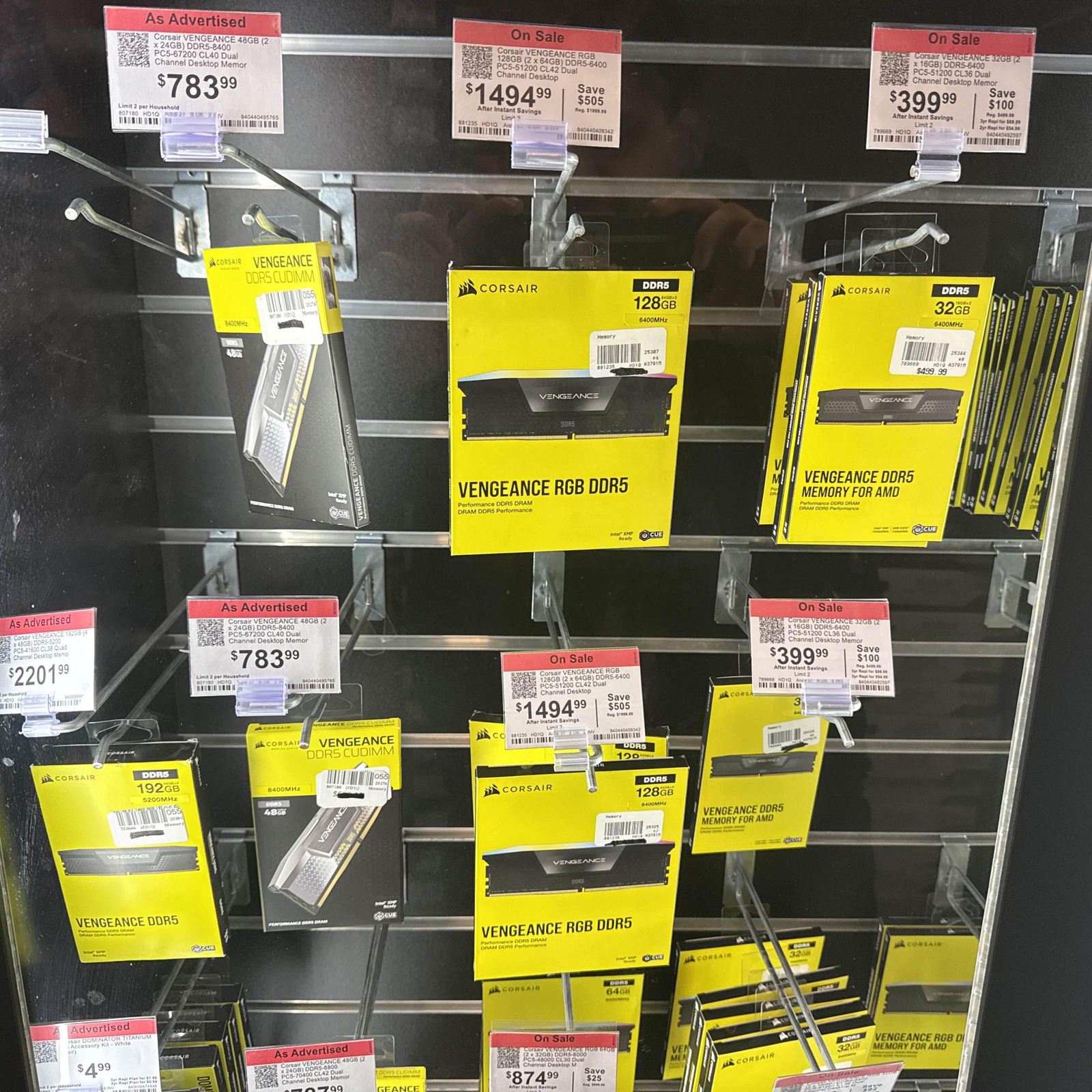
The alarm is over the skyrocketing price of DDR5 RAM, with some high-capacity kits now commanding an astonishing four-figure price tag. The question lighting up tech forums is simple yet terrifying: Are our computers being held hostage by the insatiable demand of the Artificial Intelligence boom?
The debate swirling across the internet points to a market completely upended by the frenzy to build the next generation of AI infrastructure.
The AI Data Center Black Hole
The dominant theory for the price spike is a simple matter of supply and demand, scaled to a colossal, industry-level threat: AI data centers are buying up the world’s DRAM supply.
AI models, particularly Large Language Models (LLMs), require an unprecedented amount of memory to run. While data centers primarily use specialized, high-density RDIMMs (Registered DIMMs), the core DRAM chips themselves come from the same manufacturing lines.
- The Production Shift: With AI companies paying premium prices and pre-buying production lines through 2027, memory manufacturers are naturally prioritizing the most profitable server-grade sticks. This shift is rapidly reducing the supply of consumer-grade UDIMMs, leading to a dramatic price increase in the retail market.

- A New Gaming Tax: For the average PC gamer or enthusiast, the high cost of DDR5 has become an unexpected “AI tax” on any new build, forcing many to either pay exorbitant prices or delay their upgrades entirely.
Conspiracy or Cartel? The Counter-Argument
Not everyone is convinced this is purely organic demand. A cynical counter-narrative suggests memory vendors are exploiting the AI headlines for profit, pointing out that price manipulation in the DRAM industry is not without precedent.

Did Trump’s FDA pick just make a 180 on abortion pills?
President Donald Trump’s Food and Drug Administration (FDA) Commissioner nominee, Dr. Heidi…

Stacy Garrity Exposes Josh Shapiro’s Failed Economic Policies In Major PA Budget Clash
As the political landscape in the Keystone State intensifies toward the upcoming…
Crucial RAM Buying Guide Reveals Massive PC Upgrades Every Builder Needs Right Now
Welcome back to the workbench, Philly tech enthusiasts. Whether you are piecing…

France and Japan Build a Stronger Air Power Bridge Between Europe and the Indo-Pacific
French Rafale F4 fighters trained with Japanese F-2A/B combat aircraft at Hyakuri…

Stacy Garrity Vows to Protect PA Farmland From Invasive Data Center Development
HARRISBURG, Pa. — As Pennsylvania’s 2026 gubernatorial landscape begins to take shape,…

“Nah, it is just manufactured FOMO. Memory vendors are trying to milk the whales. They are using the ML/AI as a convenient excuse,” argues one commentator.
This viewpoint suggests that because data centers are supposed to use different types of memory (RDIMMs), the sudden and massive spike in consumer-grade DDR5 (UDIMMs) is simply a “manufactured FOMO campaign” designed to empty the wallets of dedicated enthusiasts.

The True Technological Wedge: CXL
Beyond the server-vs-desktop debate, a key technical factor is adding to the problem: the rise of CXL (Compute Express Link) technology.
CXL allows massive pools of memory to be connected directly to a computer’s PCIe bus, enabling huge memory capacities without relying on complex, specialized server architecture. This is particularly relevant in markets where companies are trying to build AI compute power without full access to the most cutting-edge (and restricted) Nvidia GPUs.
The crucial point is that some CXL implementations are designed to use off-the-shelf, consumer-grade DDR4 and DDR5. This creates a direct, high-volume link between the rapidly expanding AI market and the retail memory that builders depend on.
The AI Bubble and Consumer Doom
For many, the high RAM price is merely a symptom of a much larger, potentially unstable phenomenon: the “AI Bubble.”
The concern is that the billions of dollars pouring into AI ventures are not sustainable, with some users calling the entire endeavor a “mass of resources” poured into a project with a “0% chance of ever turning a profit.”
“This is going to have a massively negative impact on the market and tech industry all to fund the largest scam every concocted,” writes one highly skeptical user.
If the bubble eventually bursts, it could flood the market with unused, discounted RAM. But for now, this speculation-driven demand is consuming the global supply chain, serving as “one more nail in the coffin of the gaming industry” alongside high-priced graphics cards and software bloat.
What’s the PC Builder to Do?
For the consumer, the path forward is clear, if frustrating:
- Skip DDR5 (For Now): Many veterans advise holding the line. “Just use ddr4 you really DON’T need ddr5,” especially for average consumption. For most current gaming and everyday tasks, DDR4 offers excellent performance at a fraction of the cost, and DDR5 motherboards/CPUs are themselves still overpriced compared to older generations.
- Wait for the Burst: The hope remains that once the AI bubble deflates, the massive stockpiles of data center RAM will become available, leading to “bargain basement prices” for consumer memory.
- Optimize for Once: The crisis highlights a deeper annoyance: modern software and games are so poorly optimized that they require 32GB or even 64GB of RAM to run smoothly. Many argue that if “jeetcode” wasn’t so bloated, users wouldn’t need to chase the latest, most expensive hardware in the first place.
The consensus is grim: the era of affordable, high-end PC building is on pause, forced to pay a massive premium while two giant industries—server-grade AI and consumer computing—clash over the same finite resource.